
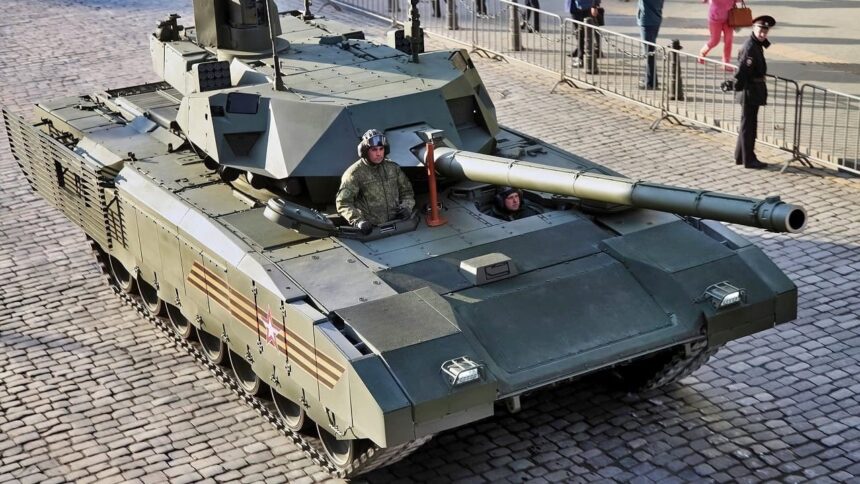
Summary and Key Points: Russia revealed the T-14 Armata in 2015 with a 125mm 2A82-1M smoothbore, an unmanned turret, and an armored crew capsule, then kept it out of the war in Ukraine for fear of losing it to cheap drone swarms, as with the Su-57. UNITED24 reports a proposed modernization: a chrome-lined 152mm smoothbore with guided rounds, 40 rounds and a 24-round autoloader, a tethered Pterodactyl UAV, and short-range anti-drone defenses like the Arena-M a T-72B3A used in July.
The T-14 Armata Is Back?
Russia first publicly revealed the T-14 Armata in 2015.
T-14 Armata Tank from Russia. Image Credit: Creative Commons.
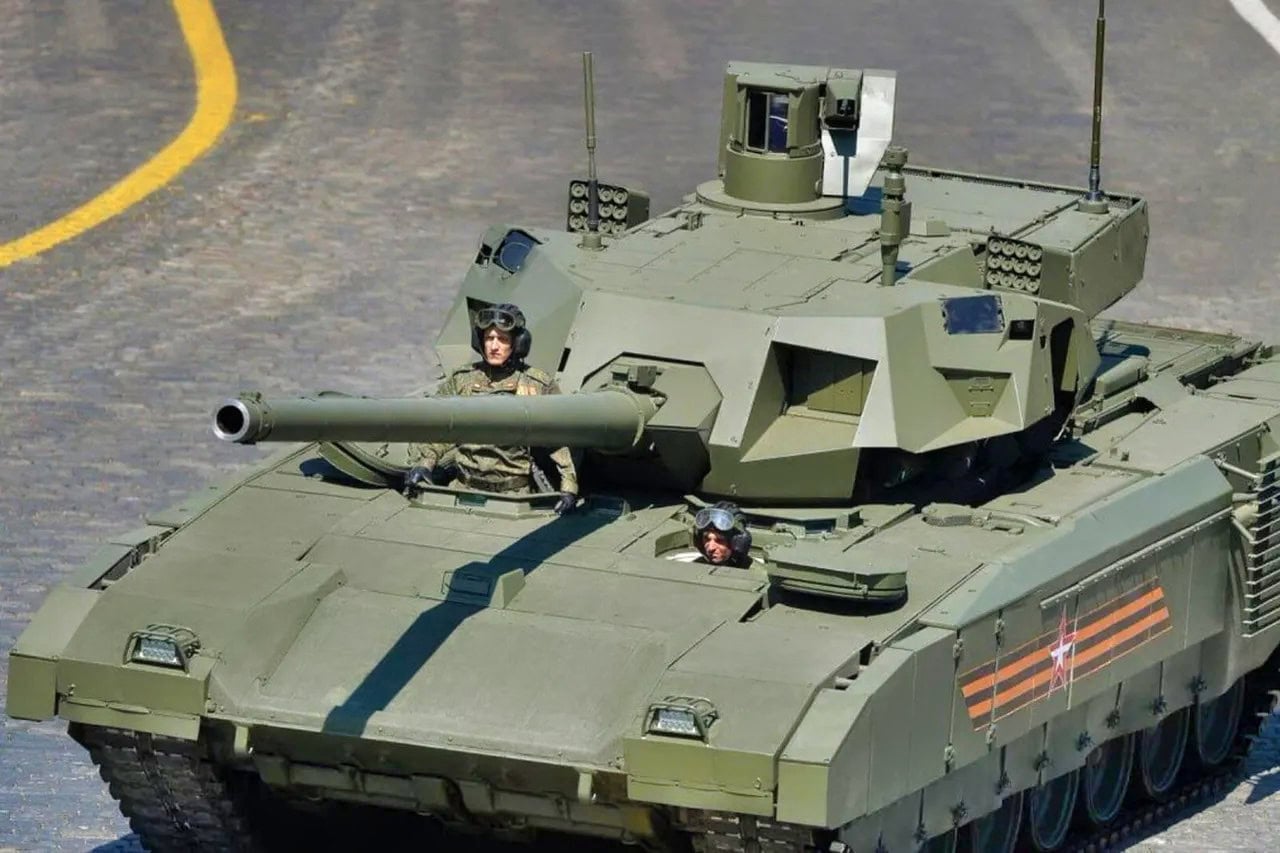
Russian T-14 Armata Tank. Image Credit: Social Media Screenshot.
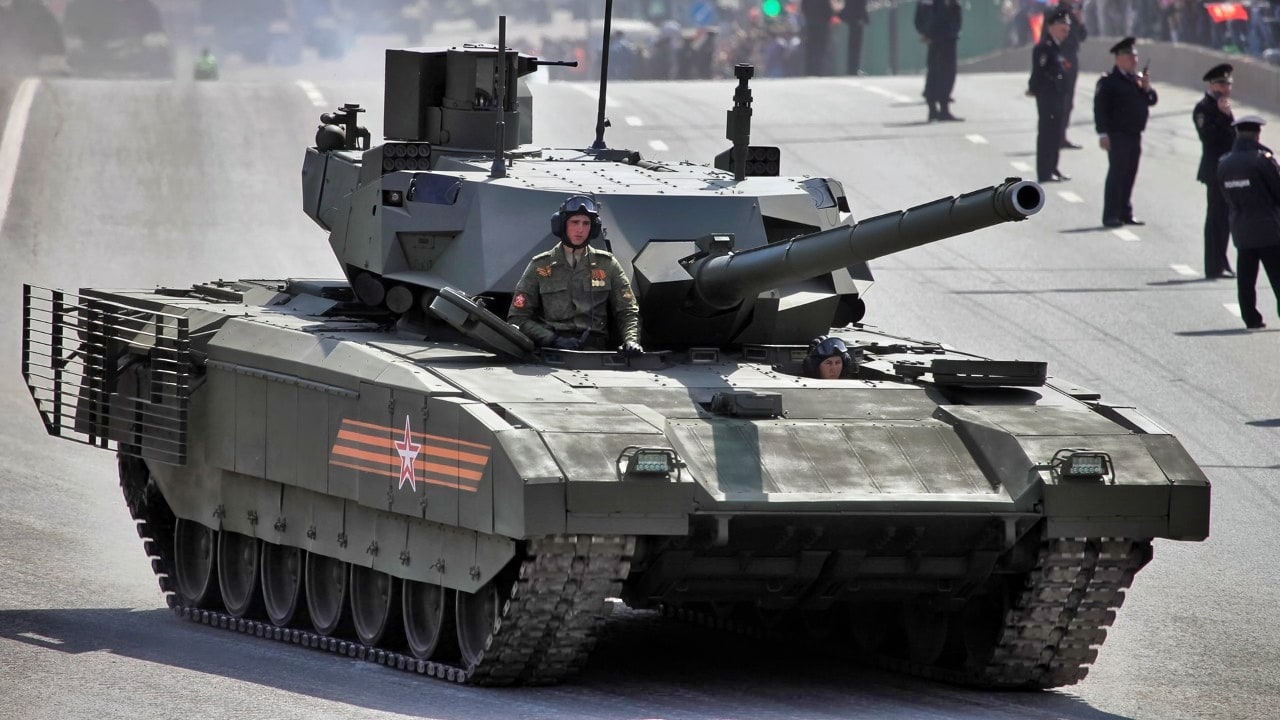
T-14 Armata Tank from Russia
At the time, the world was in awe of the technology Russia displayed. The impressive tank was built around the 125mm 2A82-1M smoothbore cannon.
Despite the revolutionary design and Russia’s significant investment in the technology underpinning the T-14, the tank hasn’t really been deployed in battle.
This reluctance to deploy the T-14 is especially odd, given that Russia finds itself in the throes of a major — indeed, possibly existential — war with neighboring Ukraine (an obvious proxy of NATO).
Despite the need for as many weapons and platforms as possible, Russia has not fully deployed its small cluster of T-14 Armatas.
That decision has received much consternation from Western critics of Russia. Some speculate that perhaps Russia’s T-14 is overhyped.
Real Limitations
Others point to the obvious limitations of the T-14’s production line, as the entire Russian defense industrial base is deeply committed to the war effort— and a nation’s defense industrial base can only prioritize so much.
An alternative explanation, though, is that the older Soviet-era Main Battle Tanks (MBTs), which are cheaper and easier to mass-produce, are more useful against Ukraine.
The War in Ukraine is fundamentally different from previous wars.
One of the reasons for this has been the widespread use of drone swarms and anti-tank missile systems.
Given the expense of the T-14 Armata, and how much time and effort it takes to build one of these tanks, Moscow figures it’s not worth risking this costly platform being lost to cheap Ukrainian drone swarms.
Regardless of the reasons, the effect is that Russia isn’t using this technically advanced platform when it needs every platform it can get.
Now, there’s news that the Russians intend to
Now, the Russians are talking about redesigning the platform itself.
A Unique Redesign Effort Underway?
UNITED24 reports that Moscow is considering a modernization package for the T-14 that would significantly upgrade its already powerful main gun.
Moscow reportedly wants to add a 152mm smoothbore cannon armed with new guided ammunition and an integrated reconnaissance drone system (with an enhanced fire-control system) to give this impressive, expensive platform short-range air defense capabilities.
The proposed 152mm weapon reportedly has a chrome-lined barrel and would be paired with an autoloader (a feature commonly found on Russian tanks, even from the Soviet era).
The new Armata would supposedly carry 40 rounds for the main gun, with 24 inside the autoloader.
This isn’t a new concept.
In the heady days of the Cold War, the Soviet Union experimented with a 152mm cannon for its T-95 MBT, known as “Object 195.”
The T-95 never entered production.
By mounting the 152mm smoothbore cannon on the Armata, Russian engineers would give this already sophisticated tank greater firepower.
But other tank designs did not adopt the 152 mm smoothbore cannon because of the significant trade-offs it brings. More internal volume is needed to accommodate the larger ammunition.
The heavier weapon also likely requires a turret redesign, plus changes to ammunition storage and the autoloader itself, which must now accommodate the larger, heavier 152mm smoothbore ammunition.
As noted above, Russian designers allegedly plan to pair the larger 152mm smoothbore cannon with some form of limited, short-range air-defense capability to specifically counter drone threats (which are only growing more advanced with each passing battle in the war in Ukraine).
Yet it remains largely theoretical.
The capability has precedent in the war.
In July, a Russian T-72B3A employed the Arena-M Active Protection System (APS) against incoming Ukrainian first-person-view (FPV) drones.
The tank resisted the initial attack.
However, one report from Janes Defense Weekly suggests that the tank was eventually destroyed (getting us back to the persistent problem drones present for defenders.
All they need is one more than what the air defense system can handle, and the platform being attacked is defeated by the cheaper, expendable FPVs.
Still, the Russians are clearly experimenting on their older T-72s and T-90s. Now, Russian designers might want to scale that defensive capability–however limited–up for the more valuable T-14 Armata.
Tank-Launched UAVs?
Russian designers are also reportedly exploring another unique capability.
That is installing a Pterodactyl reconnaissance UAV on the upgraded T-14.
The Armata could theoretically launch a tethered UAV that would give the advancing T-14 crew unprecedented situational awareness without exposing the tank itself to the enemy.
Combined with the improved smoothbore cannon’s guided munition, the Armata could theoretically detect and engage targets far beyond visual range (BVR), a key capability all combatants in today’s wars seek.
Moscow spent more than a decade developing this advanced tank–with an unmanned turret, no less–an armored crew capsule, and the most advanced sensors and active protection of its day.
Yet, the Russians barely deployed any of these systems into combat against the Ukrainians.
In fact, the Russians actively kept the Armatas out of the fight, fearing that these expensive platforms would be destroyed by cheaper drones, adding embarrassment to the Russian war effort.
Replacing these systems would also be difficult.
It’s the same reasoning behind why the Russians haven’t really deployed their Su-57 Felon warplane to fight in Ukraine.
A Wake-Up Call
If Russia loses those older Soviet-era systems, it costs them, but not nearly as much as losing the T-14 in combat.
Now, without ever having really fought in modern combat, the T-14s are potentially being significantly upgraded. The proposed changes are not merely cosmetic.
They’ll require significant redesigns.
Whatever happens with the T-14s, the War in Ukraine has so fundamentally changed the requirements of modern warfare that not even the next-generation MBT that the world feared when it was unveiled in 2015 is apparently good enough to fight in its current configuration.
That should be a necessary wake-up call for the Americans, who have not fought a truly modern war in the twenty-first century (and judging by the performance in the Iran War, the US military needs a lot of work).
The Russians, whatever people may say, are clearly behind the curve, thinking that not even their newest, most advanced MBT is safe from drastic redesigns.
About the author: Brandon J. Weichert
Brandon J. Weichert is the Senior National Security Editor at 19FortyFive.com. He also manages The Weichert Brief on Substack. Weichert also hosts “National Security Talk” on Rumble. He is the author of four bestselling national security books, most recently A Disaster of Our Own Making: How the West Lost Ukraine (Encounter Books). Follow him via Twitter/X @WeTheBrandon.