

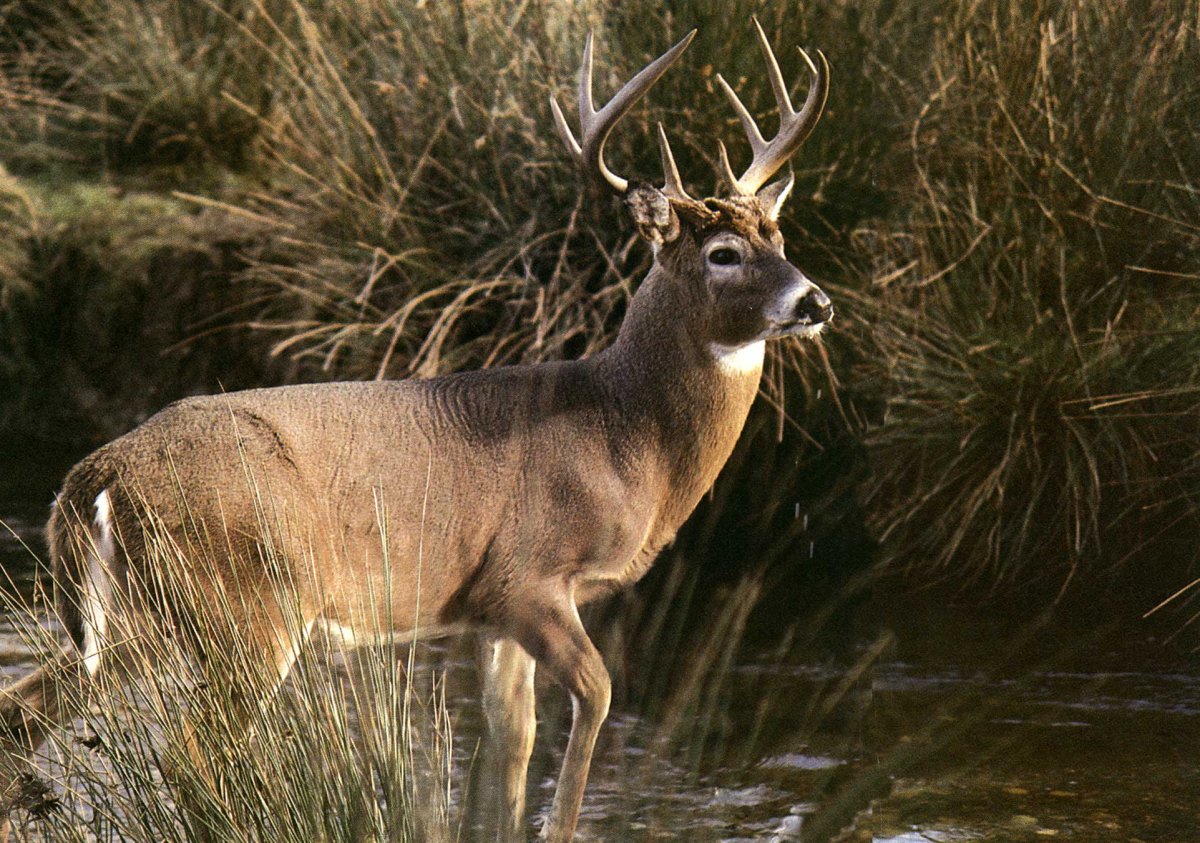
The first whitetail buck that I ever shot was more the result of luck than skill. I was on my first deer hunt with a New Jersey hunting club in the Mount Misery area of Lebanon State Forest. After three days of fruitless driving and standing, I was finally out on my own for an afternoon of stillhunting. Most of the older hunters had jobs and, after hunting the first two days of the season, they left us kids to mind the camp until they returned Friday night to hunt the last day.
After wandering for two hours, taking compass readings at every turn, I knew that if I cut through a small cedar swamp, camp would be no more than a half-mile away.
I entered the cedars and began jumping from one dry hummock to the next. Stopping for a moment, I decided to try picking my way through the wall of trees on several dry spots that I noticed up ahead. I leaned against a tree, with my single-barrel 12 gauge under my arm, and took a compass reading. I was searching up ahead for my fourth or fifth dry spot to alight on, when the chosen dry spot slipped away into the darkness.
As I stood staring in disbelief, another dry spot slid into view, replacing the first one-only this one was different. It had black eyes, a black button on the end of its nose, and two very widely set ears, pointing my way.
It was as if someone had dumped ice cubes down my back. I knew what I was looking at, but wasn’t sure whether it was real or not. Then a parade of deer began moving through the water as easily as ducks in a pond.
With aching eyes, I examined each head as it appeared among the trees, searching for any sign of antlers. Often it was impossible to tell whether I was looking at the head or tail-end of a deer; there were so many in that small stretch of swamp with me, and they kept changing positions. Finally, I eased the shotgun to my shoulder and searched diligently for antlers.
Suddenly, I saw a head with antlers on it. They were only spikes, but big enough to be legal, and I was afraid if I took too long to make my shot that they, too, would disappear. With all the precision I could muster, I sighted down the barrel and squeezed off the single load of 00 buck shot. Tree bark filled the air, and the sound of snapping twigs and many feet splashing in the ankle-deep water surrounded me.
My right cheek ached from having been pressed down too tightly on the gun stock during recoil. My feet were getting soaked as I raced to where the deer had been standing when I shot.
There was nothing there. My deer was gone. I looked around, wild-eyed, and then saw a tan heap, just five yards away in the tea-colored cedar water. I had my first buck. The drag out of the swamp was uneventful, except for the sound of crinkling skim ice and the splashing of water, as deer moved around me within the swamp every time I paused for a rest. Back at camp, everyone congratulated me. When I told them we could all get our bucks in that swamp, they sniffed a little deeper of the swampy aroma emanating from my drying socks and pants near the wood stove, and said they knew of dryer areas where deer were. My buck was the only deer taken in camp that year.
The part that water plays in a whitetail’s life is debatable. Observers of deer behavior, and many biologists, say that deer sometimes drink water after eating, but insist that the need for water is not the driving, dependable force that their need for food is. These same people also claim that deer get the bulk of the liquids their bodies need from the succulent foods they eat.
Maybe so, but I have never found whitetails far from water. Perhaps they don’t need to consume the water directly, as many insist, but the plants containing an excess of liquid, which they eat, do need an abundant water supply. That may explain why whitetails are always found near water.
A friend of mine, Fred Buckley from Huntley, Montana, sends an annual Christmas card inviting me to come to his in-laws’ ranch to hunt. We originally became acquainted while hunting whitetails in Wyoming.
“The whitetails on the ranch are concentrated down in the river bottoms,” Fred wrote one year, “like they were in the Devil’s Tower area of Wyoming.”
Fred, Reggie Lingle, Paul Bruun, and I had been deer hunting the Black Hills, located on the Wyoming-South Dakota border. Although we hunted the Bear Lodge area, often we drove to Devil’s Tower to observe the whitetails. It was not unusual to see as many as 100 in a herd, drifting up from the brush-lined banks of the Belle Fourche River and feeding in the open ranch land every evening.
Our camp was situated within 100 yards of a small creek that emptied into the Belle Fourche. One morning, while sitting on a stump overlooking the creek, I saw three deer crossing it. The range was about 70 yards. At the sound of my shot, two deer ran off, and the third thrashed a few seconds in the autumn leaves before laying still.
Paul was standing over my deer when I got to it. He had been seated on the other side of the creek and was waiting for the deer to move a few yards so he could get a shot. Paul got his deer the next day, 200 yards farther down the creek.
The deer in this area are typical of Western whitetails they’re never more than a few hundred yards from an abundant water supply. Again, this may not be because of any need to drink heartily two or three times a day, but rather because creek and river bottoms are the only places they can find suitable cover for concealment, and the lush, moisture-laden foods they need.
On the other hand, I know of very few Eastern, Southern, or Midwestern swamps of more than a few acres in size that don’t have whitetails in or near them. Also, I have never found a high mountain with whitetails living on it that does not have a flow of water somewhere near its crest.
It needn’t be a big stream; any flowing water will do. I learned this while turkey hunting one spring near my home in Vermont. Close by is a high ridge that looks like good game country, but doesn’t have an obvious swamp or stream on it. I rarely hunted this mountain, except to occasionally prowl the lower slopes when squirrels were gorging on acorns.
At dusk one May evening, I was driving on a road near the ridge. I’d stop once in a while and squawk on a raspy crow call, hoping to get a gobbler from the valley to respond. At one stop, from far up on the mountain, I heard a gobbler answer me. Assuming it was an older bird that was dethroned and chased from his original territory, I planned to return to the mountain early the next morning and try to capitalize on his misfortune.
The gobbler was responsive to my calling at dawn. I was elated when he stepped into a woodland trail 90 yards away and looked in my direction. But then he turned directly away from me and walked off. He ignored my most seductive calls. As I sat staring after the now-departed gobbler, a deer stepped out into the same trail and walked up the mountain, following the turkey.
Shortly after the deer disappeared, and while I was debating about walking up that trail to see what was so popular up there, I was startled to see the gobbler walking back down the trail toward me. He had remembered exactly where my calls were coming from and walked to within 20 yards of me, pausing to strut every few steps.
I left my gobbler hanging in a tree and walked up the trail to see what was so interesting. What I found was a spring seep.
Water percolated up out of the ground and seeped downhill for perhaps 50 yards before being completely swallowed up by the dry mountainside again. This 50-yard swath had low, lush brush growing along it, the edges of which were showing the first green grasses of the year.
When I later mentioned the spring seep to a game biologist, he said that many states were looking for a way to effectively manage and encourage growth around such watering places. It seems that these seeps remain open and have lush growth surrounding them, even in the bitterest of winter weather. Often, in a dry autumn, they may be the only reliable water supply that game has for a mile in any direction. Now, when the wild apple crop is not abundant – which usually occurs during a dry year – I use a tree stand overlooking a spring seep high up on a ridge among the beechnuts and oaks during deer season.
My observations of spring seeps from tree stands have revealed some interesting hunter habits. Every hunter I saw moved only a short distance up or down the seep, until he found an easy place to cross. Even hunters in thigh-high rubber boots avoided getting their soles wet. They all crossed at a 90° angle.
Yet, the area within five to 10 yards on each side of a seep is where many whitetails exist. Any stalker’s odds are greatly increased if he hunts up and down spring seeps, rather than across them.
Available water not only provides the moisture and food that deer need throughout the year, it also provides protection from predators and hunters. The deer in that New Jersey cedar swamp were not there for the food-the closest edible leaf was 30 feet off the ground. They were hiding from hunters, and I just happened to stumble onto them.
I stumbled onto a similar situation when hunting the farm country of northern New Jersey.
I had been bowhunting from a tree stand where a well-used deer trail exited a cornfield and entered a patch of woods. Seventy yards into the woods, a 20-foot wide, ankle-deep creek flowed. For more miles than I cared to walk, the creek banks were lined with big oaks, beechnuts, and maples from 20 feet to 100 yards out from the water. The occasional patch of evergreens or honeysuckle was interspersed along the field edges, between the various cropfields and the woodland strip.
While basking in the early-morning sun and observing the cornfield, I heard splashing water behind me. I looked back and saw two bucks, an eight-pointer and a six-pointer, exiting the creek. They moved about 20 yards from the creek bank into the brush and, after staring at their backtrail, bedded down. Ten minutes later, a bowhunter walked down to the water. He stared at the tracks entering the stream. He was evidently trailing the two bucks.
The hunter looked upstream, then downstream. Not seeing any stepping stones to facilitate a dry crossing, he walked off. All that separated him from two beautiful bucks was a pair of wet feet.
I tried stalking the two bucks, but they recrossed the stream and eluded me, even though I did get my feet wet. That afternoon, I moved my tree stand. The next time they tried this evasive maneuver, I was ready. Unfortunately, my marksmanship was not.
But I learned that even if whitetails don’t need a drink every day, they are never far from water. And, they are masters at using water to their advantage.
In New York’s Catskill Mountains, a strip of lush greenery separated a highway from the shores of a man-made lake. My hunting partners and I knew deer were there. After several failures, because of insufficient manpower to drive them into a waiting hunter, we decided to try a “squeezing” operation.
The three-eighths-mile forested strip was about 200 yards wide at one end, tapering down to only 30 yards at the other end. With the wind in our faces, my brother and I began moving slowly and silently through the ever-narrowing strip-he up top by the highway, me on the lake side.
The plan was simple. The deer would be squeezed down into the narrow neck and, rather than break out across the highway, they would turn and try to come back through the other, now closely-spaced, hunters. It seemed almost foolproof.
“Did they cross the highway?” I asked my brother.
“No,” he answered, looking down on us from the roadway 50 feet above. “But what’s that out there?”
Read Next: How to Hunt Swamp Bucks
I looked where he pointed and saw seven deer, one with a rack of antlers visible above the water from 250 yards away, swimming to the far shore. Two days later, we pushed through the same area, and the buck was dropped on the shore as the deer tried their water escape trick again.
The secret to scoring on these deer is a willingness to get your feet wet. Just wearing waterproof shoes or boots is not enough -you must be able to wade swampy areas and follow the marshy course of spring seeps and small streams.
And if a biologist tells me that he has discovered whitetails that have developed webs between their split hooves to take better advantage of their watery environment, I’ll believe it.
Read the full article here