

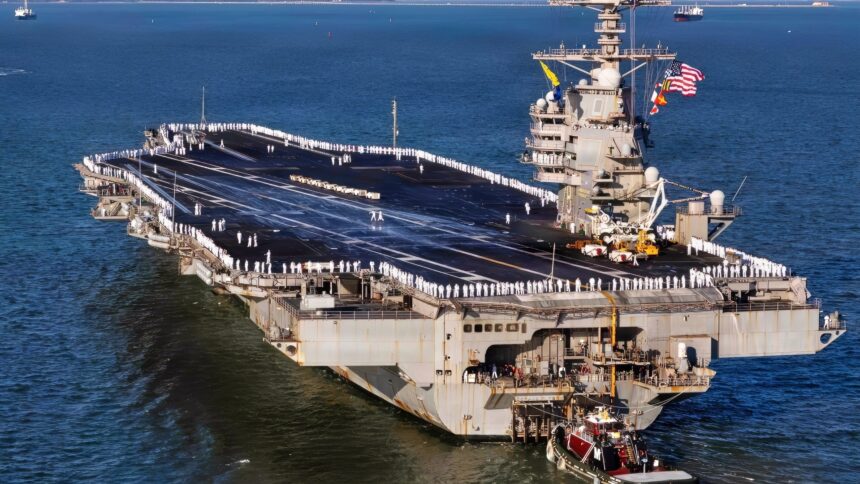
USS Gerald R. Ford is the Navy’s newest aircraft carrier, with electromagnetic catapults to launch jets and new arresting gear to stop them on landing. Yet its deployed air wings have not included the Navy’s F-35C stealth fighter. In June 2019, Navy spokesman Capt. Daniel Hernandez told USNI News that Ford-class carriers were designed to launch and recover the F-35C fighter jet, but he also said they still needed modifications to support it through a full deployment.
USS Gerald R. Ford: New Class of Aircraft Carrier and No F-35C
Among the necessary changes were stronger jet blast deflectors — the panels that shield the deck from hot exhaust during launches — and classified spaces for aircraft operations.
In July 2026, as Ford prepared to enter Norfolk Naval Shipyard in Virginia for maintenance after its 326-day deployment, the Navy said it had already carried out a jet blast deflector overhaul while the carrier was at Naval Station Norfolk.
The Navy did not say whether that work included the modifications needed for an F-35C deployment, however.
“This continuum has already supported the shipyard team to accomplish advance work on the carrier while at Naval Station Norfolk— including early testing, preparations for temporary service installation, and jet blast deflector overhaul.
The continuum also provides an opportunity to resolve any additional work following completion of the availability,” a press statement revealed.
A Lockheed Martin Corp’s F-35C Joint Strike Fighter is shown on the deck of the USS Nimitz aircraft carrier after making the plane’s first ever carrier landing using its tailhook system, off the coast of California, November 3, 2014. REUTERS/Mike Blake (UNITED STATES – Tags: TRANSPORT MILITARY)/File Photo
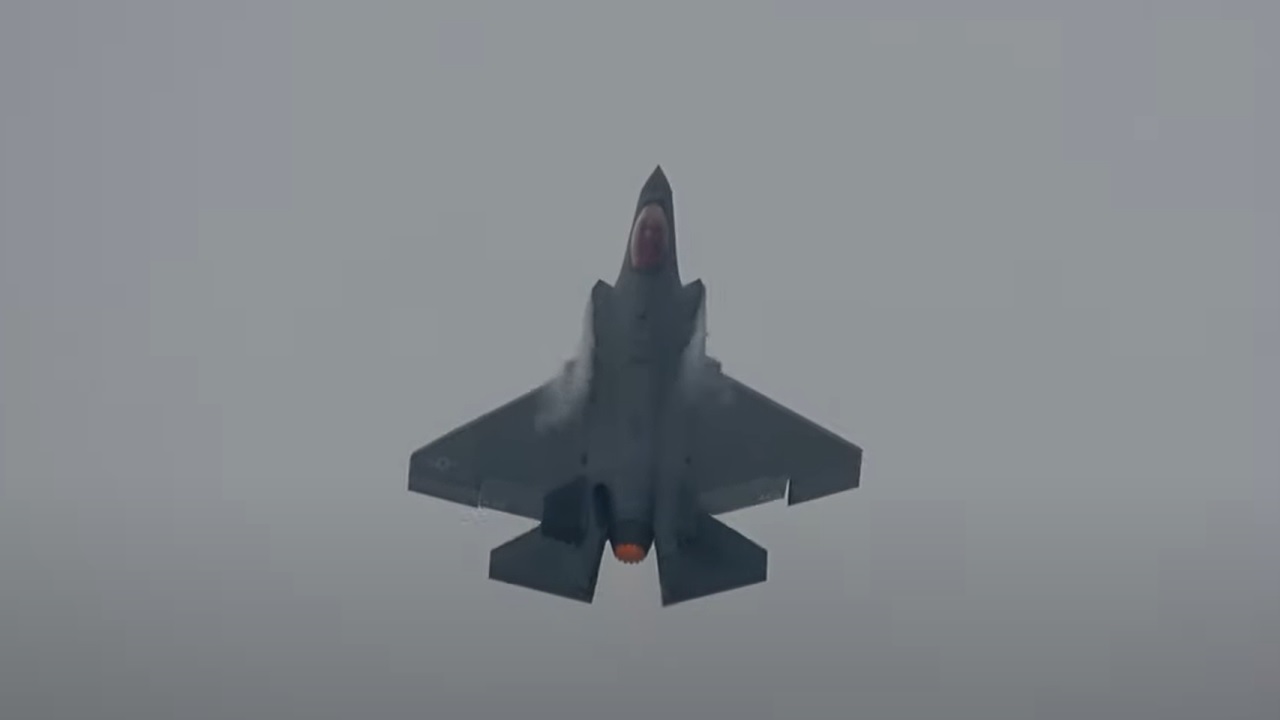
F-35C. Image Credit: YouTube Screenshot.
What the F-35C Is, and What It Was Built To Do
The F-35C is the carrier version of the F-35 stealth fighter, and therefore the obvious choice for America’s newest aircraft carriers.
It has larger wings than the Air Force’s F-35A, plus reinforced landing gear to handle the forces of catapult launches and arrested landings.
Its wings fold so crews can move and store the aircraft aboard a crowded carrier.
It differs from the F-35B, which can land vertically on amphibious ships. An F-35C uses a catapult to take off from short runways, and it catches a wire on landing to slow down quickly.
F-35Cs have already been deployed aboard modified Nimitz-class carriers, meaning they are actively in service at sea.
But the question is when the Ford-class, in its entirety, will be ready to deploy F-35C squadrons.
The Scale of the Problem
The problem lies in the large amount of heat and energy generated when an F-35C prepares for takeoff.
An aircraft needs jet blast deflectors, which rise behind an aircraft as it prepares to launch.
The deflectors push the exhaust upward, away from sailors and other aircraft waiting nearby.
The Navy has recognized that the existing deflectors are insufficient and that a more robust version is needed to support repeated F-35C launches.
The Navy launched an F-35C with a land-based test version of the ship’s electromagnetic launch system as far back as 2011.
When the Problem Was Identified
The problem was first noted while the F-35C was still being built, with a 2010 Department of Defense test report warning that the F-35C’s exhaust might require the carrier’s jet blast deflectors and active cooling just ahead of it on the flight deck. Those temps can hit 3600 Degrees Farenheight.
Then, in 2011, the Navy started testing the fighter’s exhaust against a deflector on land.
Navy testimony to Congress from the time said that any changes missing from Ford’s design would be installed before the ship ever deployed with F-35Cs.
The F-35C was always part of the plan for the Ford class, but the Navy did not complete all the changes needed to operate it reliably before the lead ship was delivered in 2017.
In 2019, Hernandez said the remaining modifications were scheduled for a later maintenance period.
The Next Ford-Class Carrier
Knowing the problem existed, the Navy changed course for the second Ford-class carrier.
In November 2020, a contract change to add F-35C modifications to the future USS John F. Kennedy during construction was announced, ensuring that the next Ford-class carrier would be equipped with these modifications ahead of its planned entry into service.
Congress required that the ship be capable of deploying with the aircraft before completing a later maintenance period.
Kennedy then completed its first builders’ sea trials in February 2026, but it has not yet joined the fleet or deployed with F-35Cs. America’s next Ford-class ship is scheduled for official delivery in March 2027.
And A Return to Steam Catapults?
Ford-class carriers are also in the news because major changes may be coming to their catapult systems.
On August 13, 2026, President Donald Trump directed defense officials to submit, within 60 days, a plan to replace the electromagnetic catapults and weapons elevators planned for the fourth carrier, the future USS Doris Miller, with steam and hydraulic systems.
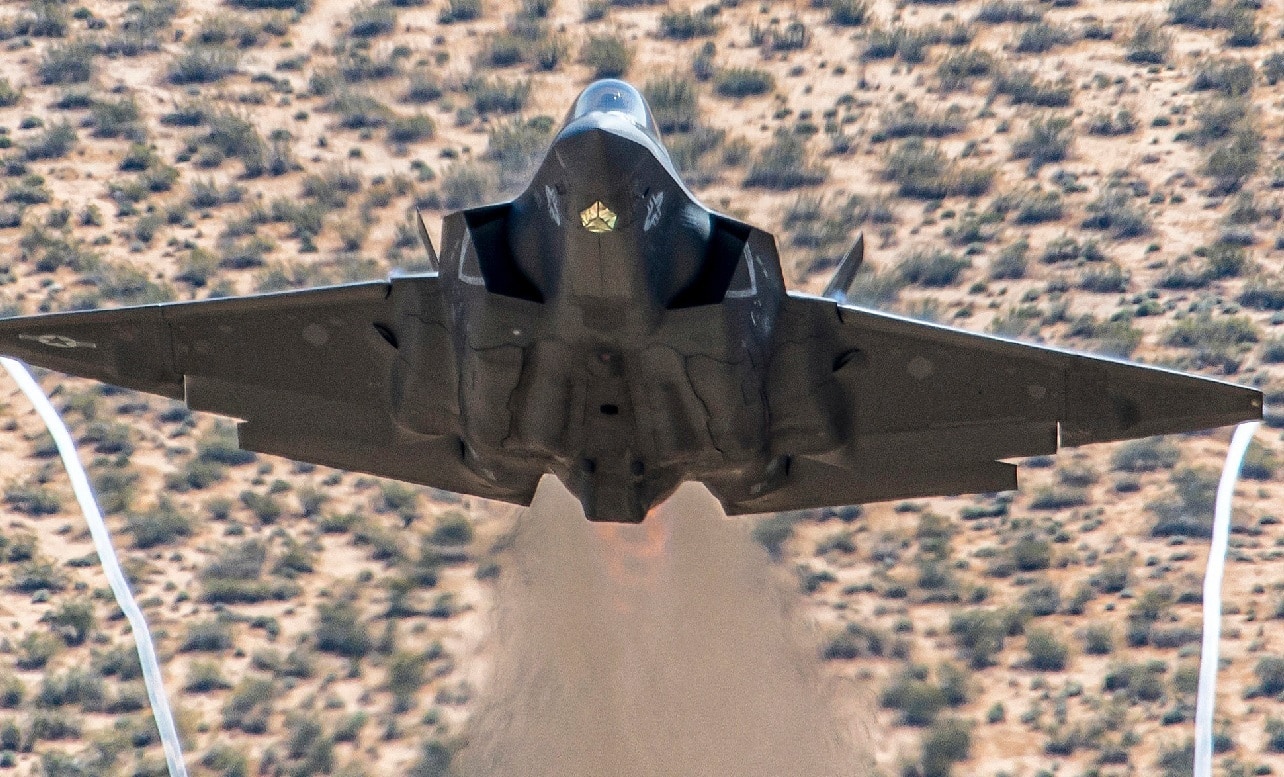
Two F-35C’s from VFA-125 “Rough Raiders”, based at NAS Lemoore, piloted by Major Derek “Shootsbe” Heinz A/C 430 and LT Alex “MoM” Daie A/C 411, Fly Low Level around Freemont Peak near Edwards AFB, Ca., 7 May 2019. The “Rough Raiders” are a Fleet Replacement Squadron flying F-35C Lightning II.
The memorandum requests that a new plan be drawn up with costs and a timetable — meaning the change has not yet been confirmed.
However, in September, reports suggested the Navy had awarded an EMALS support contract and was still seeking supplies for additional EMALS components.
About the Author: Jack Buckby
Jack Buckby is a British researcher and analyst specializing in defense and national security, based in New York. His work focuses on military capability, procurement, and strategic competition, and he produces and edits analysis for policy and defense audiences. He brings extensive editorial experience, with a career output spanning over 1,000 articles at 19FortyFive, and has previously authored books and papers on extremism and deradicalization.