


Seth Bodnar graduated from the U.S. Military Academy at West Point two months before the Sept. 11, 2001, terrorist attacks. It led him to a decade of service as an Army Green Beret, now giving his all to be the next United States senator from Montana.
Bodnar is an independent U.S. Senate candidate in Montana, running against Democrat Alani Bankhead, a U.S. Air Force veteran, and Donald Trump-backed Kurt Alme. Libertarian Kyle Austin is also running. The packed race is one of a handful of Senate contests featuring independent-minded veterans running for some of the highest offices in the land.
Alme resigned as a U.S. attorney and began his candidacy moments before the filing deadline, getting Trump’s swift endorsement to keep the seat red after incumbent Republican Sen. Steve Daines announced he was leaving Congress.
Supporters of Bodnar and Bankhead tussled, notably in the days leading up to the Aug. 10 deadline to withdraw. Bodnar proponents argued that Bankhead wouldn’t win in the general election, and that a two-way race between Bodnar and Alme would provide better odds for the upset come November.
Bankhead refused, however, and stayed in the race. She told Military.com last month that “the whole point was to allow the democratic process to be finished,” accusing “old guard Democrats” of vacating their own party in Montana to create a two-person race and lane on Bodnar’s behalf.
Bodnar spoke with Military.com about his campaign, his chances during a pivotal midterm election cycle, and why he feels the nation is heading in the wrong direction.
Growing Up Under Teachers, Growing Into the Military
Bodnar, 47, was raised by two public school teachers. His mother taught kindergarten as well as first and second grade, while his father was a fifth grade teacher.
“They taught me early that life’s not about what you give; it’s about what you get,” Bodnar said. “And they taught me about the importance of serving your community. That played a big role in shaping my decision to join the military at the age 18.”
He went to West Point and ended up serving a decade on active duty, 101st Airborne Division, and then the First Special Forces Group, along with other roles along the way.
Asked about the values instilled through military service, he said it is about serving the nation—but also serving one another.
“The idea that your service is to this country, your service is to those around you,” he said. “[It’s] the idea that everybody’s got to do their part, we leave nobody behind, and those are some of the things that were just critically important to me.
“Part of the reason I jumped into this race is failure of of leadership. Those of us that have been in the military know that any good leader knows the old adage that a leader eats last. When I took over my first infantry platoon in the 101st Airborne in Mosul, Iraq, in 2003, it was obviously unstated but very clearly known that when it was time to eat and the food came out, the leader went to the back of the line, leaders eat last. And that a leader’s job, to serve those that he or she’s leading.”
That’s antithetical to what he sees, as well as other Americans, as it pertains to the current U.S. political system. Bodnar said that leaders are serving themselves rather than the people who elected them.
Connecting Military Service to a Political Campaign
Bodnar recalled getting ready to actually graduate from West Point and go to U.S. Army Ranger School.
He received advice from an old mentor who talked about the importance of leadership, and he talked about what soldiers care about.
“He told me very clearly, ‘Your your soldiers don’t care about where you went to school. They don’t care about anything you’ve done. They care about two things: No. 1, are you working every single day to take care of them and bring them home safely? Are you working for yourself? Are you working for them? And No. 2, are you good at your job? Are you the best platoon leader that they could have?'” Bodnar said.
Bodnar’s taken those lessons with him throughout his career in leadership, whether that’s leading soldiers or students as the president of the University of Montana. He also studied at Oxford and was a Rhodes Scholar.

Being an advocate for others rather than oneself is a major reason he’s running for office, he said. Being a good leader resonates and people almost always feel more comfortable when they know someone has their back.
“You see people today across the great state of Montana, they’re exhausted,” he said. “They’re exhausted by a broken political system in which they see their elected leaders fighting with each other. They see those elected leaders trading on insider information to enrich themselves while nothing gets better, and they don’t feel like anyone is out there fighting for them. No one is out there working for them.
“They see a political system that doesn’t have competition in it like it should. They see that that’s leading to corruption, that corruption’s driving up costs for all of them, and both of the national parties are complicit in this.”
Not Working for Schumer, Not Afraid of Trump
Bodnar said he is running as an independent because “it’s authentic to who I am.”
“When I raised my right hand at the age of 18 and swore an oath, it was to the Constitution of the United States,” he said. “It wasn’t to a political party. And I’ll tell you, when you’re stacked outside a door as a platoon leader, waiting to kick down the door of a suspected terrorist safehouse in Iraq, you know what question never comes up from anyone? What party are you part of?
“And yet, that’s all that we hear from political leaders in D.C. ‘Is this good for the Democrats? Is this good for the Republicans?’ The only question should be, is this good for Montana? Is this good for the United States of America? Not what’s good for my party.”
He said as president for eight years at the University of Montana, he worked with Republican legislators, a Republican governor, Democratic legislators, and a Democratic governor. The mission was most important for everyone, and it was the way things got accomplished.
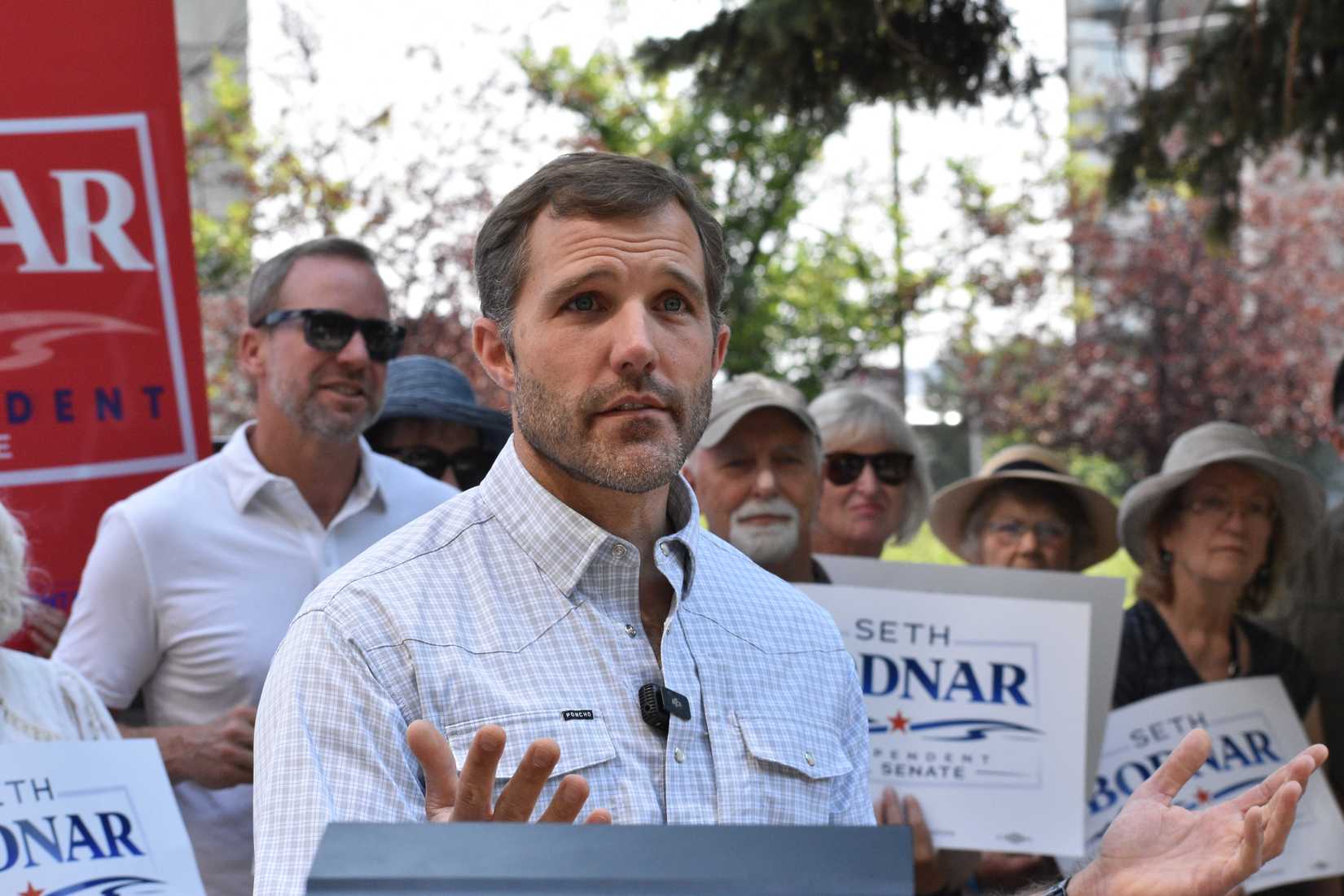
“I think we have a two-party system and toxic partisanship that’s ripping this country apart, and we need leadership who’s going to move us forward. I’ve said repeatedly that Montana deserves a senator who doesn’t work for [Senate Minority Leader] Chuck Schumer, and Montana deserves a senator who’s not afraid of [President] Donald Trump.
“Montana deserves a senator who works for Montanans and nobody else, and that’s my running as an independent.”
Issues That Dominate the Campaign Trail
Bodnar said that in his travels across Montana, meeting voters where they are, he keeps hearing about “an unresponsive, unaccountable system that’s that’s leading to corruption.”
He correlated that corruption with increased costs, pointing blame at both the GOP and Democratic Party for what is taking place.
Bodnar mentioned meeting a married 22-year-old man at a campaign event who had just worked an 18-hour shift on a railroad, and his wife also works full-time. Yet, the man expressed not being able to afford necessities even as they “work ourselves to the bone.”
“People feel like no one’s stepping up to represent them,” Bodnar said. “You see housing costs soaring, nearly doubling over the past seven, eight years in Montana. Healthcare premiums [are] up 26% just in the past year alone. A so-called Big Beautiful Bill that’s that’s going to likely cause almost 30,000 Montanans to lose access to their health care over the next year, putting rural health care in crisis.”
Education remains an issue, he added, saying that many schools in Montana have a 30 to 40% shortage of qualified teachers. Agriculture is also taking a hit due to the cost of diesel and tariffs, with Bodnar saying that ranchers and farmers are being “crushed by nonsensical, non-strategic tariffs while input costs soar for fertilizer.”
Even for cattle ranchers, prices were stable until—as Bodnar pointed out—the Trump administration dumped some 660 million pounds of foreign beef into the U.S. market at 25% below cost.
There’s also, of course, the Iran War that began Feb. 28 and has no apparent end in sight. The U.S. economy has been squeezed, while Bodnar said it should never have happened in the first place.
“The Iran War has been a strategic failure, and it’s due in no small part to the failure of Congress to carry out its constitutional responsibilities,” Bodnar said. “It’s very clear in Article One, Section Eight of the Constitution, whose role it is to declare war, and that’s Congress.
“That’s for a reason. The framers put in place checks and balances to make sure that the commander in chief, who’s responsible for the military…couldn’t send this nation to war unless they’ve got the approval of Congress to make sure that it’s very clear why this is an imminent threat, what the strategy is, what is the exit plan. Congress has failed to do that.”
Defying the Odds
Even as Bodnar laments the two-party system, he faces an uphill battle.
Alme has an 8-point lead over Bodnar with Bankhead and Austin trailing the leader by wide margins, according to a Montana Free Press-Rutgers Eagleton poll earlier this month. When asked who they would vote for if the election were held today, 38% of respondents said they’d vote for Alme, while 30% said they’d vote for Bodnar. Bankhead received 16% and Austin received 5%.

But Bodnar maintains it’s about building a coalition, saying that the largest voting bloc in Montana today is not majority Republican or Democrat but independent, citing a 40% figure.
“Winning this race is about building a coalition of independents, of Democrats, of Republicans, who are fed up with a broken system and nothing but broken promises, and so we’re building that coalition,” he said. “We’ve seen our momentum growing just over the past couple of months. We’ve seen our polling increase by 7 points. The Republican, the Democrat are both on the way down. We’re building momentum. Our events are getting larger and larger.”
He said his independent status matches the wide-ranging electorate across the U.S. that has seemingly become disenfranchised by the two-party system. He derided the extremes on the political spectrum, saying the “loudest voices” don’t match what most Americans really favor.
That feeling of “political homelessness,” as he described, can turn the system on its head. He argues that having just one more independent in a tight U.S. Senate could act as a fulcrum not to stifle legislation but move it forward.
“How do we move this country forward? How do we start to develop common-sense solutions to the massive challenges we face?” he said. “Whether that’s comprehensive immigration reform, whether that’s addressing the national debt, whether that’s real solutions to the crisis of housing and health care that Montanans are feeling and Americans are feeling.
“Americans are hungry for solutions, and I think this independent movement that I’m proud to be a part of is really key to helping us move forward with solutions to address the challenges we face as a country.”