


The LGM-35A Sentinel is intended to replace the LGM-30G Minuteman III as America’s land-based nuclear deterrent. The original projected acquisition cost of the Sentinel was roughly $77.7 billion. But the revised estimate is quite a bit higher: $140.9 billion, or 81 percent more. The cost growth was severe enough to trigger a Nunn-McCurdy breach, the statutory mechanism that requires Pentagon review when a major acquisition program drastically exceeds its approved budget baseline. But rather than cancel the program, the Pentagon certified the Sentinel as essential to national security. This raises an important question: how does replacing one ICBM with another turn into a $140 billion project? It’s because the USAF isn’t just replacing an ICBM but also rebuilding much of the physical and digital infrastructure that underpins the entire leg of the nuclear triad.
The Minuteman III is Old
The Minuteman III entered service in 1970.
A three-stage solid-fuel ICBM, the Minuteman measures 60 feet long and has a range exceeding 6,000 miles.
Roughly 400 operational missiles are deployed across Montana, North Dakota, and Wyoming, while associated infrastructure extends into Nebraska and Colorado.
The Minuteman has been continuously modernized over the years, with upgrades to its propulsion, guidance, electronics, warheads, and command-and-control systems.
So the contemporary Minuteman is not your basic 1970s missile. But the underlying architecture does date back to the Cold War. And the Air Force knows it can’t maintain that architecture indefinitely.
Introducing the Sentinel
The Sentinel is also a three-stage solid-propellant ICBM. Designed for intercontinental range, the Sentinel is believed to have a 6,000-mile range. The modern composite motor cases replace much older construction techniques found on the Minuteman.
Northrop Grumman is the prime contractor.
The first- and second-stage propulsion systems are designed by Northrop, while the third-stage motor is courtesy of Aerojet Rocketdyne. The new composite structures reduce inert mass while retaining strength under enormous motor pressures.
Sentinel ICBM U.S. Air Force
The design features less dead structural weight, which should translate into greater performance and payload margins.
Three Stages
The basic ICBM sequence is as follows: Stage 1 ignites in the silo and accelerates the missile upwards before Stage 1 separates; Stage 2 continues acceleration outside the thicker atmosphere; then Stage 3 supplies the final boost; the post-boost system precisely orients the payloads; finally, the reentry vehicle follows a ballistic trajectory towards the target.
Most of the ICBM’s flight occurs outside of the atmosphere. The reentry vehicle returns to the atmosphere at extreme hypersonic velocity. The entire flight, from the continental United States to intercontinental destinations, takes tens of minutes. It’s an immediate response option. But unlike a bomber, an ICBM cannot be recalled after launch.
If you fire it, it’s going all the way to the target. There’s strategic value in that—people aren’t likely to fool around in the face of a weapon that can’t be turned around—but also controversy.
The Digital Upgrade
The Sentinel isn’t revolutionary because the solid rockets are new—they’re not, of course.
The major improvement, rather, is the replacement of decades-old architecture with contemporary guidance, electronics, communications, command-and-control, cybersecurity, and maintainability.
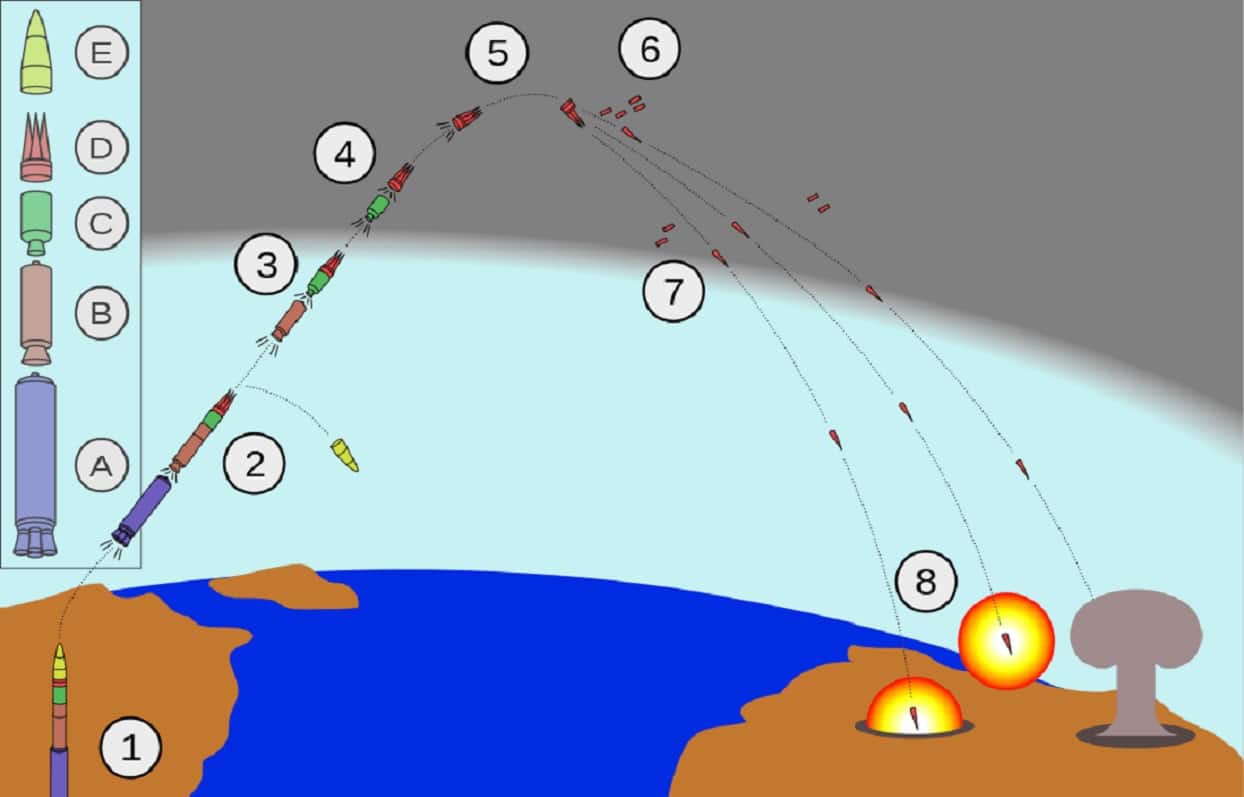
ICBM attack diagram. Image: Creative Commons.
Like so many modern military systems, the Sentinel emphasizes modular and open-system architecture. In theory, this will allow for components of the system to be upgraded over the next few decades without needing a full-on redesign.
That should help the USAF reach its goal of keeping the Sentinel in service until 2075.
Bad Calculations
The fiscal calculations were way off because the original concept assumed the Sentinel would rely on existing Minuteman infrastructure.
That hasn’t been the case. The existing launch facilities date to the Cold War and require extensive modification and reconstruction.
The Sentinel therefore became a massive civil-engineering program, encompassing 450 launch facilities spread across vast portions of the American West and the Great Plains.
So the ICBM upgrade isn’t really an ICBM upgrade as much as it’s a silos and launch-control infrastructure upgrade.
And while it may seem tempting to just stick the new Sentinels in the old Minuteman silos, that won’t work.
The Sentinel demands different dimensions, environmental requirements, electrical architecture, communications, and maintenance practices. The modern nuclear command infrastructure also requires updated cyber and physical security standards.
But does America still need 400 silo-based nuclear missiles? That’s the bigger question at the heart of the Sentinel debate.
About the Author: Harrison Kass
Harrison Kass is a writer and attorney focused on national security, technology, and political culture. His work has appeared in Tablet, City Journal, The Hill, The Spectator, and The Cipher Brief. He holds a JD from the University of Oregon and a master’s in Global & Joint Program Studies from NYU. More at harrisonkass.com.