
When an SR-71 Was So Fast People Thought It Was A Meteorite – The SR-71 Blackbird has gone down in history as one of the most impressive aircraft ever built. Its 50-year-old speed record stands to this day, and there are countless amazing stories from the pilots who flew it. Among them is one so incredible it seems fake: an SR-71 Blackbird once produced a shock wave so big that a Pennsylvania State University expert reportedly suggested that it might have been caused by a meteorite entering Earth’s atmosphere.
An American military aircraft was mistaken for a literal meteorite.
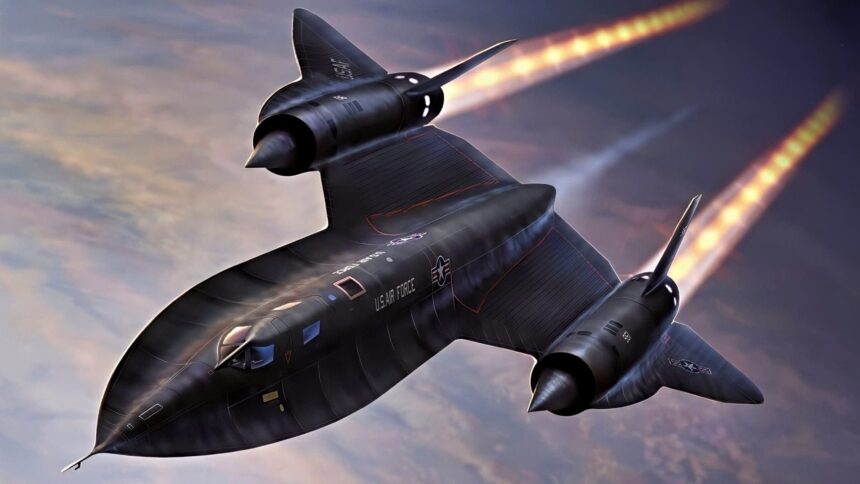
SR-71 Blackbird. 19FortyFive.com original image.
The story begins in October 1973, when an SR-71 traveled from Beale Air Force Base in California to Griffiss Air Force Base in New York.
The aircraft was being prepared for an important reconnaissance mission over the Middle East during the Yom Kippur War.
Lt. Col. James “Jim” Shelton was piloting SR-71A 61-7979 with Lt. Col. Gary Coleman, who served as his reconnaissance systems officer (RSO).
They were traveling at Mach 3 — around 2,000 miles per hour — and at around 80,000 feet when they generated sonic booms that echoed across several states.
SR-71 Blackbird Heading to New York
The SR-71 was originally developed to collect intelligence, as it flew too high and too fast for contemporary fighters to engage it or for surface-to-air missiles to intercept it.
It was built with advanced cameras and sensors capable of observing large areas without requiring the aircraft to slow down or descend into hostile territory or defenses.
The Blackbird entered service in 1966 and was soon flying missions over Asia — but this flight to Griffiss was related to an emerging crisis in the Middle East.
On October 6, 1973, Egypt and Syria attacked Israel and the Yom Kippur War began. Washington sought reliable intelligence on the fighting, but plans to operate the Blackbird through the Royal Air Force base at Mildenhall in Britain posed political difficulties.
The Air Force chose instead to prepare the launch from Griffiss.
Shelton later described the positioning flight in the book SR-71 Blackbird: Stories, Tales, and Legends:
“On short notice, we took off in SR-71 #979 and headed for Griffiss Air Force Base with one in-flight refueling over Nevada as we headed east at Mach 3 at 80,000 feet. Our route took us south of Chicago and north of Indianapolis. Passing south of Chicago, I said to Gary, ‘I can see the lights of Chicago out the left window.’ The lights of Indianapolis on the right were so clear that we must have been creating quite a sonic boom that was touching the ground and disturbing many people,” he recalled.
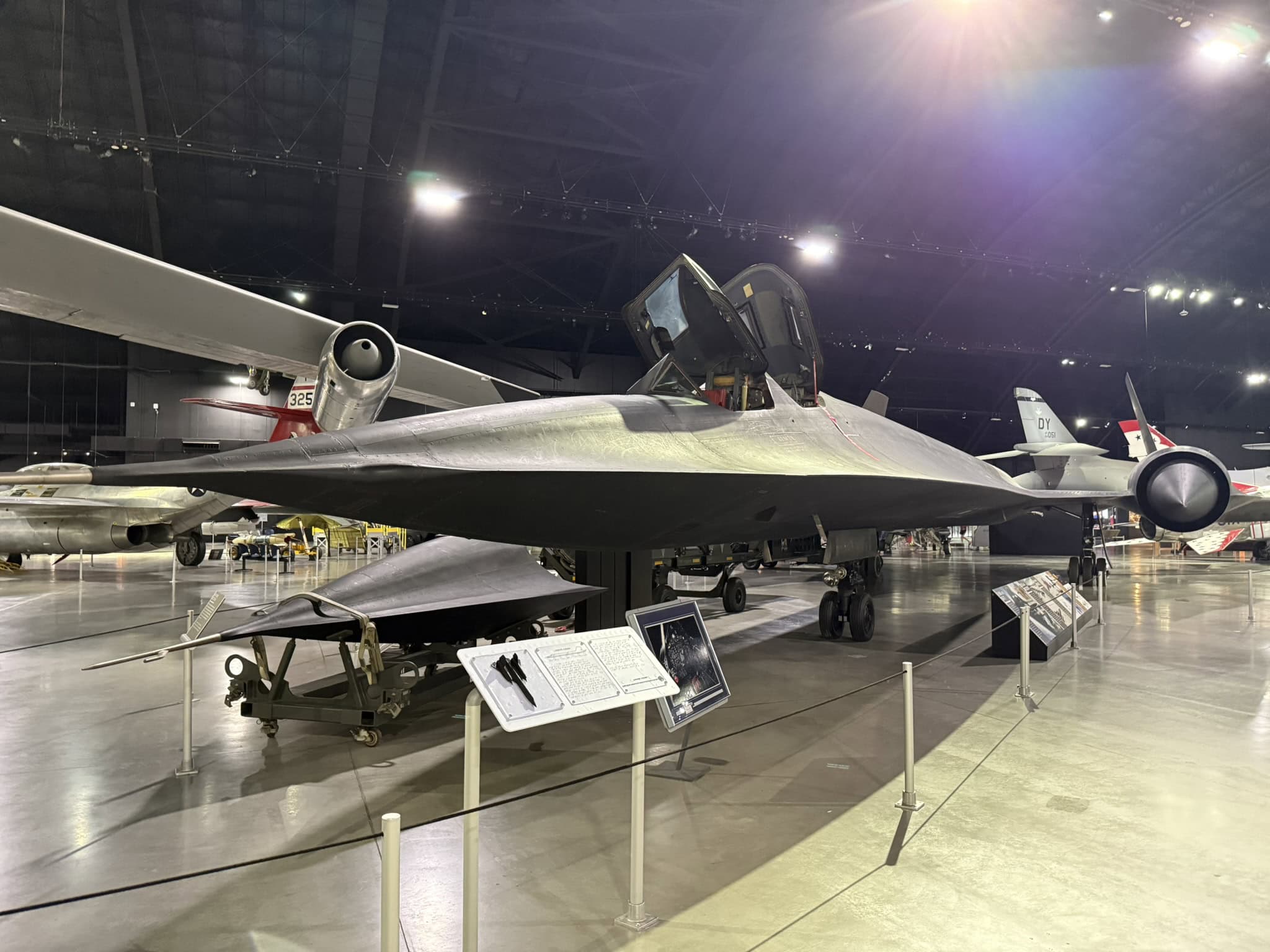
SR-71 Blackbird. 19FortyFive.com Image.
The Boom Was Huge
Sonic booms occur when an aircraft passes the sound barrier, but that’s not the only reason. An aircraft that is traveling supersonically continuously also generates pressure waves that form a cone behind it. As the aircraft keeps moving, that cone eventually sweeps across the ground, creating what’s known as a “sonic-boom carpet.” The route of that carpet can extend for hundreds of miles if the aircraft keeps flying at supersonic speeds.
The Blackbird wasn’t just creating sonic booms everywhere it went, though, or at least generating sonic booms that most people could hear.
It was flying too high for that. But, even so, the altitude only reduced the intensity of the boom experienced at any single location.
That altitude also allowed the pressure waves to spread over an unusually large area; however, clear atmospheric conditions likely helped the shock waves reach the ground along a long section of the aircraft’s route.
It meant that several states heard the same boom at the same time.
Shelton explained:
“However, it turned out to be worse than I thought, as indicated by the articles that appeared in the newspaper on October 12, 1973, when the shockwave stretched from Indiana to New York State; Jim says he laughed at the media quotes when Dr. Alexander, a Penn State Expert, said it was conceivable it could’ve been a meteorite entering the Earth’s atmosphere.”
“Do you think that we were going to tell the world that they were wrong that it was really an SR-71 going to Griffiss Air Force Base?”
The US Air Force Changed the Route
The scale of the disturbance was significant, and that was clear almost immediately.
A second SR-71 had been scheduled to follow Shelton and Coleman about an hour later, but controllers stopped it before it could take off.
It was then assigned a new route that kept it away from densely populated areas, due to fears that the same boom might occur again.
According to Shelton, authorities had already received numerous complaints about sonic booms and even some broken windows.
Initially, the Air Force promised to investigate, but the public suggestion that a meteorite was responsible gave it a convenient explanation, and officials never corrected the record.
It meant that the true cause, an SR-71, was hidden from the public for decades.
About the Author: Jack Buckby
Jack Buckby is a British researcher and analyst specializing in defense and national security, based in New York. His work focuses on military capability, procurement, and strategic competition, producing and editing analysis for policy and defense audiences. He brings extensive editorial experience, with a career output spanning over 1,000 articles at 19FortyFive and National Security Journal, and has previously authored books and papers on extremism and deradicalization.