

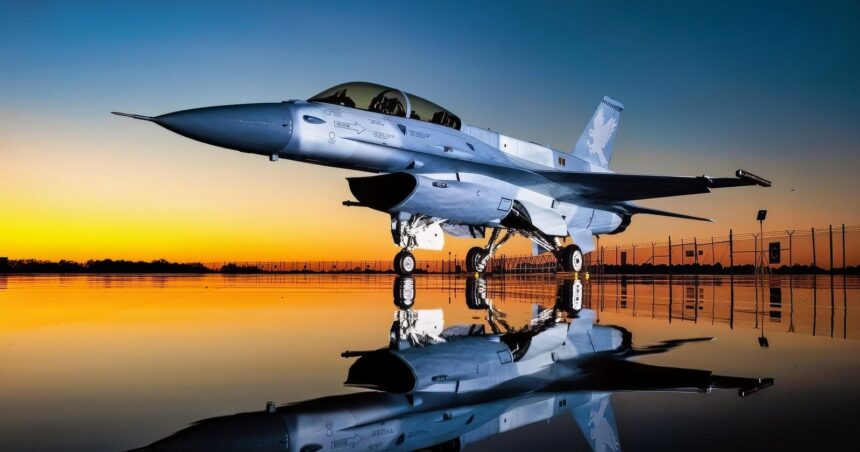
Here Comes the F-16G Fighter: Lockheed Martin shocked everyone recently when the company behind the F-35 Lightning II and the F-22 Raptor started pitching an advanced, updated version of the F-16 Fighting Falcon. To be clear, the F-16 is a fourth-generation warplane that the United States Air Force stopped purchasing 20 years ago. Despite its age, the iconic warplane may be the Air Force’s most important fourth-generation aircraft. For years, the Air Force has been transitioning many F-16 pilots into the F-35 fighter training program because the plan was always to retire the F-16 soon.
Increased Demand
Yet the Iran War and ongoing defense-industrial-base woes have forced the Pentagon to rethink many of its long-held assumptions, including the need to retire the F-16.
F-16 Viper. Image Credit: Lockheed Martin.
Plus, Lockheed has an added incentive to squeeze as much money and contracts out of the Air Force now that Boeing was selected to build the Air Force’s F-47 sixth-generation stealth warplane (and now that Boeing and Northrop Grumman are the two contenders to build the Navy’s sixth-generation F/A-XX warplane).
Known as the F-16G, Lockheed’s newest iteration of an older airframe may be just what the Air Force needs to handle a crisis of basic arithmetic for the USAF fleet: increased global threats mean the Air Force needs more fighters.
Its existing F-16 fleet is aging.
What’s more, new production lines for aircraft meant to replace the retiring F-16s cannot be stood up fast enough.
Gaps will form in the Air Force’s fleet. Indeed, gaps are already forming.
The Air Force has around 826 F-16s, including 484 operated by the Active-Duty force. The average lifespan of each airframe is around 34 years.
The newest F-16 entered service in 2005. A recent Air Force review of force structure concluded that current demand requires substantially more fighter production.
So, the Air Force discussed increasing its fighter inventory from 1,098 aircraft to 1,558 by Fiscal Year 2035.
To meet such a lofty goal, the Air Force must now decide whether to keep extending the service life of increasingly old warplanes, wait for more F-35s and F-15EXs, or buy something else entirely. Enter Lockheed’s pitch: the F-16G.
Lockheed Martin F-16F Fighter: A Good Move?
Based on Lockheed’s current F-16 Block 70 production line, the F-16Gs would be an upgrade rather than a total overhaul.
For example, the proposed F-16G would incorporate conformal fuel tanks and 600-gallon external tanks.
It would include an infrared search-and-track system and a Sniper targeting pod.
The F-16G would have the AN/ALQ-257 Integrated Viper Electronic Warfare Suite, providing radar warning, active jamming, and threat detection (along with critical geolocation).
The Block 70 airframe, on which the F-16G will be based, has a designed structural life of 12,000 flight hours.
That would give the Air Force entirely new airframes with entirely new service lives.
Combined with advanced electronics and radar, the F-16G could be a critical component of the Air Force.
One key selling point of the F-16G is that the Air Force needs to plug the gaps created by massive retirements. Lockheed already has an active F-16 facility in Greenville, South Carolina.
Therefore, the company could expand the production line there.
Although the United States Air Force stopped purchasing the plane 20 years ago, the South Carolina facility is producing Block 70/72 fighters for various foreign customers that rely on the legendary American warplane.
And because Lockheed reported a backlog earlier this year, the company has already begun expanding its production line.
Expanding it to accommodate a new order from the US Air Force for the F-16G would not be as difficult a task as starting a production line shuttered 20 years ago.
At the same time, though, the concerns over America’s production capacity remain high.
Even with Lockheed expanding its Greenville facility to clear backlogs in its production of F-16s for foreign buyers, the US defense industrial base, in general, remains in dire straits.
It simply cannot keep up with current demand in the near term — let alone address new demand, such as building a variety of expensive, complex fighters en masse.
Many Questions and Concerns Remain
Plus, many are rightly concerned that Washington risks spending billions of dollars it doesn’t really need to procure fourth-generation fighters at a time when it is already purchasing fifth-generation F-35As for the Air Force (and the Air Force badly wants to transition from the F-16 to the F-35A).
There is also precedent for returning to an aircraft family the Air Force once appeared ready to abandon but is now switching back to.
The service did the same thing with the F-15EX Eagle II. The F-16G proposal follows similar logic to the F-15EX.
The real concern is not whether the F-16G would be a good plane.
It would be.
The real questions are: can Lockheed build this within a reasonable timeframe and on budget; does the Air Force have the budget to do so; and how will building this plane affect efforts to transition to fifth- and eventually sixth-generation fighters?
About the author: Brandon J. Weichert
Brandon J. Weichert is the Senior National Security Editor at 19FortyFive.com. He also manages The Weichert Brief on Substack. Weichert also hosts “National Security Talk” on Rumble. He is the author of four bestselling national security books, most recently A Disaster of Our Own Making: How the West Lost Ukraine (Encounter Books). Follow him via Twitter/X @WeTheBrandon.