

Summary and Key Points: Albert Einstein did not write the letter that helped start the Manhattan Project. The Hungarian physicist Leo Szilard did, and he brought it to Einstein for one reason: a letter signed by Albert Einstein was a letter Franklin Roosevelt would actually read. It was dated 2 August 1939, a month before Hitler invaded Poland, and it urged the president to secure a supply of uranium ore and fund work that was still confined to university laboratories.
Einstein and His Nuclear Weapons Regrets
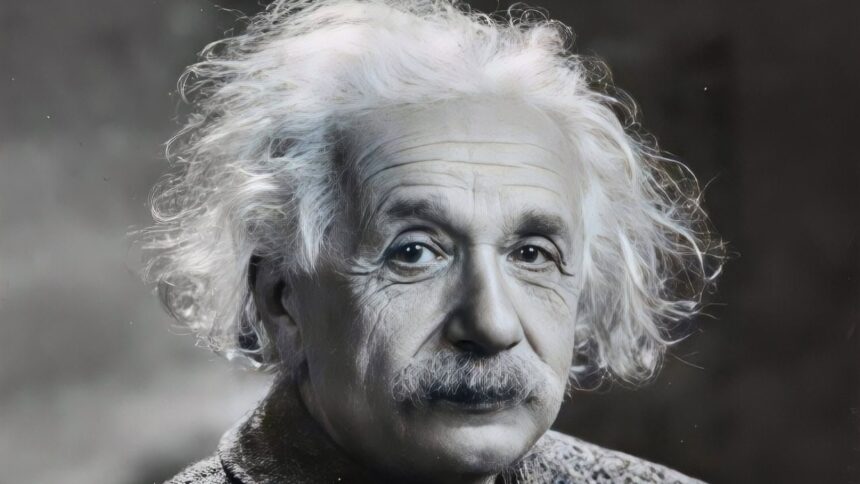
Albert Einstein and Atomic Bomb. Image Credit: Creative Commons.
“I made one great mistake in my life, when I signed a letter to President Roosevelt recommending that atom bombs be made.”
As anyone who has seen Christopher Nolan’s film Oppenheimer knows, the thinking during the early part of World War II was that the United States needed to develop an atomic bomb before the Nazis could develop one themselves.
In 1939, before Hitler’s invasion of Poland, Albert Einstein wrote a letter to President Franklin Delano Roosevelt expressing that sentiment.
“Recent work in nuclear physics made it probable that uranium may be turned into a new and important source of energy,” Einstein wrote in that 1939 letter.
According to Christie’s auction house, which auctioned an earlier version of the letter, the idea of sending it had been initiated by Hungarian-born physicist Leo Szilard, who had been Einstein’s student, and Szilard knew that Einstein’s name on the letter would carry great weight.
Einstein’s letter urged the president to ask government departments to prioritize acquiring a supply of uranium ore to “speed up the experimental work,” which at the time had mostly been confined to university laboratories, and to provide government support.
Dr. Alexander Sachs, an economist close to Roosevelt, delivered it to the White House. This ultimately led to the establishment of the Manhattan Project, which developed and built the first atomic bomb.
Peter Klarnet of Christie’s told the BBC at the time of the auction that the letter represented “a key inflection point in the history of science, technology and humanity,” and that it led to the first time the U.S. government participated in major funding of scientific research.
“The letter set the ball rolling to allow the United States to take full advantage of the technological transformations that were taking place.”
And while the president ultimately heeded the letter and agreed to support research into the bomb, Einstein would later regret his role in building the bomb.
A Genius’ Regrets
Soon after, Einstein distanced himself from the atomic bomb effort.
In 1946, he helped found the Emergency Committee of Atomic Scientists.
In 1947, he told Newsweek that “had I known that the Germans would not succeed in developing an atomic bomb, I would have done nothing for the bomb.” Indeed, as noted by the BBC, not only did the Nazi effort to build a bomb fail, but Germany, to this day, still does not have nuclear weapons.
The great scientist spent the rest of his life advocating against nuclear proliferation.
By 1954, Einstein told Linus Pauling that “I made one great mistake in my life when I signed the letter to President Roosevelt recommending that atom bombs be made,” although he added that “there was some justification — the danger that the Germans would make them.”
In 1955, Einstein signed the Russell-Einstein Manifesto, which also called on nations to resolve their conflicts peacefully. Signing the manifesto was one of Einstein’s final public acts before his death on April 18, 1955.
“We urge the governments of the world to realize, and to acknowledge publicly, that their purpose cannot be furthered by a world war, and we urge them, consequently, to find peaceful means for the settlement of all matters of dispute between them,” the manifesto said.
However, the famous final scene in Oppenheimer, in which J. Robert Oppenheimer tells Einstein in Princeton that he believes their work on the nuclear weapon had started a chain reaction that “would destroy the entire world,” and “I believe we did,” is a work of fiction.
A Bomb Without Einstein?
In a 2014 post on his blog, “Restricted Data: A Nuclear History Blog,” historian Alex Wellerstein examined whether the bomb would ever have been built if Albert Einstein had never been born.
While the 1939 letter, Wellerstein writes, is mentioned in nearly every history of the Manhattan Project and the development of the bomb, “neither E=mc² nor the Einstein-Szilard letter were as central to the Manhattan Project’s success as people realize — either scientifically or historically.
That’s because the establishment of nuclear weapons technology is not that directly connected to Einstein’s physics work. Even the letter, Wellerstein writes, was not the first time that President Roosevelt had been made aware of “ the possibility of nuclear fission.” More importantly, Wellerstein argued, the British MAUD Committee’s work had provided a separate, unrelated push for U.S. development of such weapons.
About the Author: Stephen Silver
Stephen Silver is an award-winning journalist, essayist, and film critic, and contributor to the Philadelphia Inquirer, the Jewish Telegraphic Agency, Broad Street Review, and Splice Today. The co-founder of the Philadelphia Film Critics Circle, Stephen lives in suburban Philadelphia with his wife and two sons. For over a decade, Stephen has authored thousands of articles that focus on politics, national security, technology, and the economy. Follow him on X (formerly Twitter) at @StephenSilver, and subscribe to his Substack newsletter.