
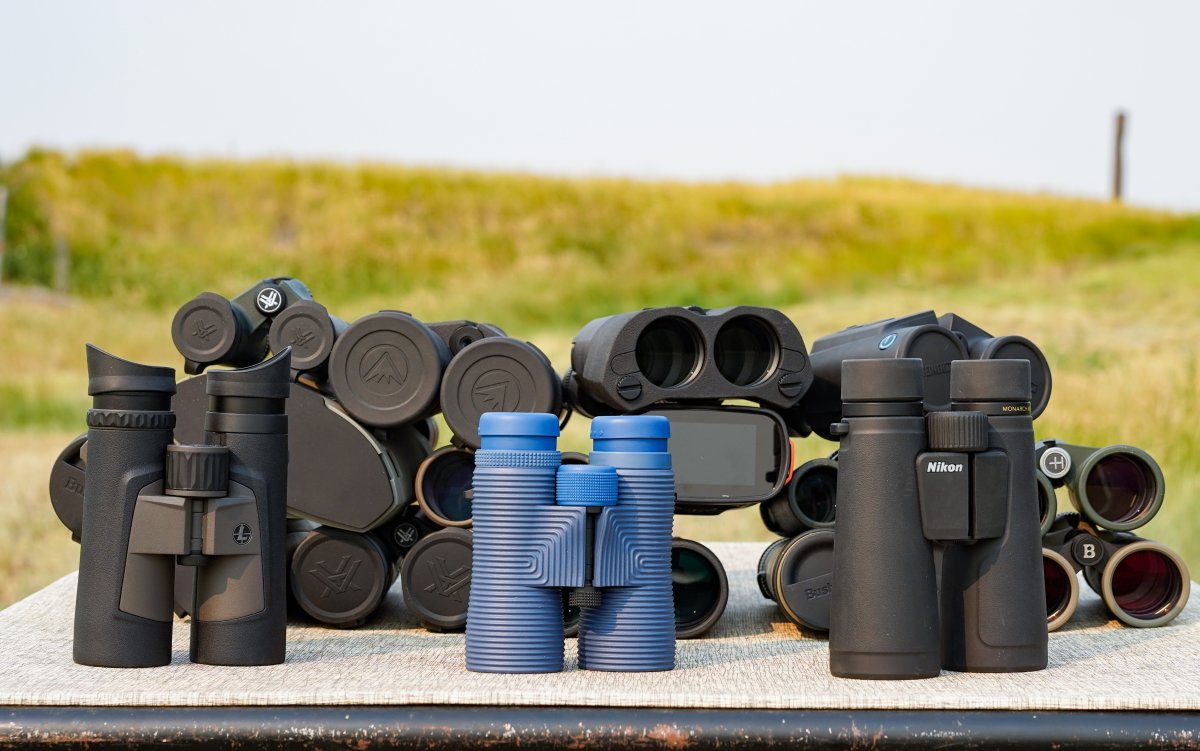
New price-point entries from Leupold, Nikon, Sig Sauer, and Vortex are durable, capable, and cost well under $400, with half the budget binoculars in this year’s Outdoor Life optics test costing less than $200.
The optics industry is leaning into these budget binos because that’s where the market is. But hunters, shooters, and birders have also realized the abundant value in binoculars priced below $500. Most have good-enough glass and coatings, and the lifetime warranties that most brands extend to these products mean buyers aren’t stuck with a clunker.
That’s not to say that all these price-point optics are worth the money. Our test revealed some pretty poor designs and headache-causing glass. But generally the level of quality of a $300 binocular today is on par with that of a $600 binocular just a few years ago. The optics industry has gotten so good at sourcing decent components and leveraging supply-chain efficiencies that it’s the rare budget optic that behaves like one.
Read on to find the budget binocular for your next hunt.
The Best Budget Binoculars (Shockingly Good Glass for the Money)
Best Budget Binoculars of 2026
Jump to the Test Protocol
The Best Budget Binoculars: Reviews and Recommendations
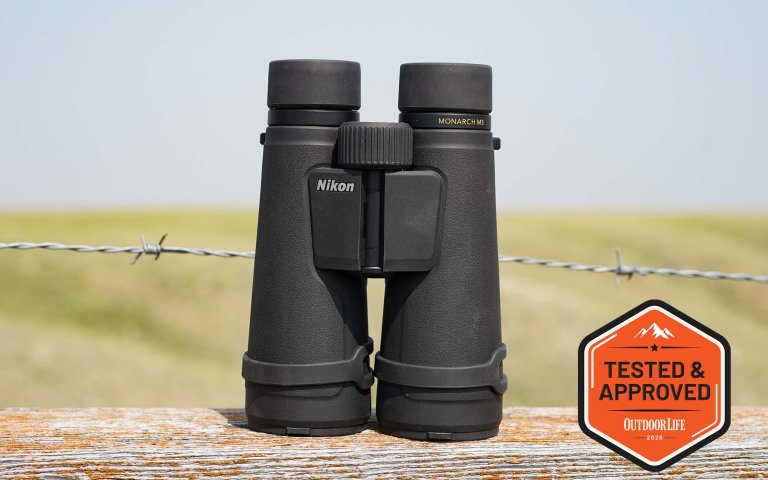
Nikon Monarch M5 10×50 (Editor’s Choice)
See It
Pros
- At 22.6 ounces, lightweight
- Fiberglass-reinforced polycarb chassis
- Excellent ED glass and premium coatings
- At $349, fairly priced
Cons
- Square eyecups don’t fit all faces
- Disappointing close focus
Key Features
-
Extra low-dispersion glass -
Closed-hinge design -
Right-barrel diopter -
¼-20 tripod adapter -
3-position eyecups -
Lifetime warranty -
Price:
$390
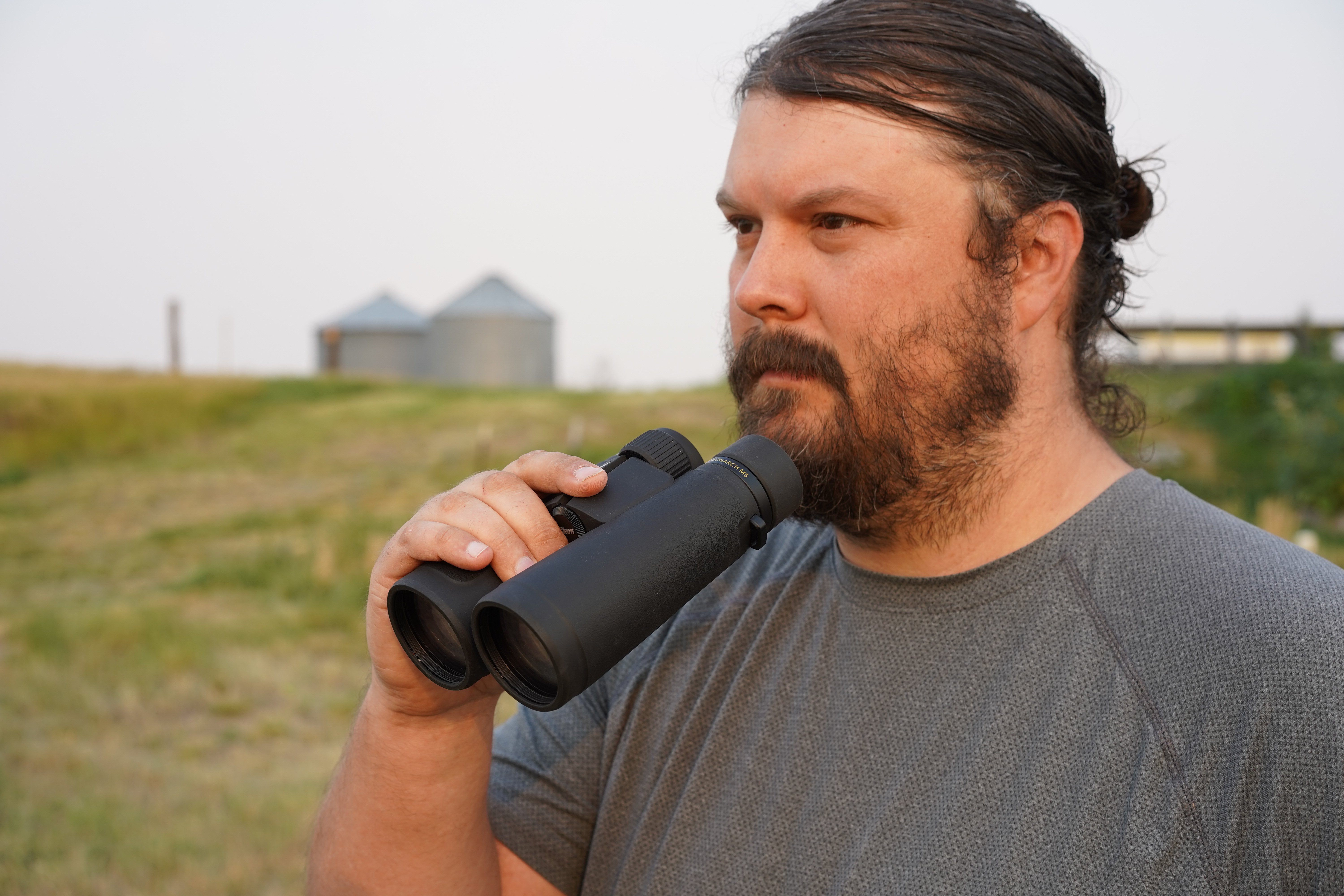
That there’s little to say about this binocular except its pretty good image and nice handling says everything about it. It’s not trying too hard to wow you with boutique glass, or seduce you with racy styling. It’s about as plain Jane as a binocular gets, and yet Nikon’s Monarch M5 won our Editor’s Choice award as the top binocular of 2026 by being reliable, bright and crisp enough, and affordable.
The 10×50 version we tested has a little more image brightness than a 10×42, and the 6 ½-inch tall chassis is a handful. But the image is crisp right to the edge with excellent color rendition and contrast, the controls are pleasingly responsive, and the ergonomics encourage you to glass all day. The 10×50 Monarch M5 sells for $390, which we think is a bargain.
By stacking performance, value, and utility in a durable package, Nikon topped 14 other new binoculars to take our top award.
Testers especially liked the image quality and solid hand feel, but wished for a locking diopter. The 3-position eyecups are a little too square for some testers’ faces, but the lightweight 22-ounce build — the chassis is fiberglass-reinforced polycarbonate — balances nicely in hand and in a chest harness.
“It’s an all-day hunting binocular,” noted tester Nate Ward. “The image quality is surprisingly good for the price.”
The Nikon fared poorly in our low-light test, despite its big 50mm objective lenses. That may be evidence of sub-par glass, but in daylight conditions we could find no flaring, optical aberrations, or color shifting.
For a workaday binocular that is durable, reliable, bright, and affordable, we can’t recommend Nikon’s Monarch 5 10×50 strongly enough. The consensus of our test team is that Nikon doesn’t charge enough for it.
Nikon Monarch M5 10×50 Specs
- Magnification: 10-power
- Objective Lens: 50mm
- Stated Light Transmission: N/A
- Exit Pupil Diameter: 5.0mm
- Twilight Factor: 22.36
- Field of View: 315 feet at 1,000 yards
- Close Focus: 14.8 feet
- Weight: 22.6 ounces
- Length: 6.5 inches
Read Next: What Do Numbers on Binoculars Mean?
Nocs Provisions Field Issue 8×42 (Great Buy)
See It
Pros
- Fun, distinctive colors
- Full-chassis ribbing
- At under $200, fairly priced
- Excellent close focus
- Contoured eyecups
- Lifetime warranty
Cons
- Uncoated internal lens surfaces
- Focus wheel a bit too close to eye
Key Features
-
Distinctive colors result from collaboration with Audubon Society -
3-position eyecups -
Field of view: 394 feet at 1,000 yards -
Front-hinge tripod mount -
Also available in 10×42 version -
Price:
$200
-
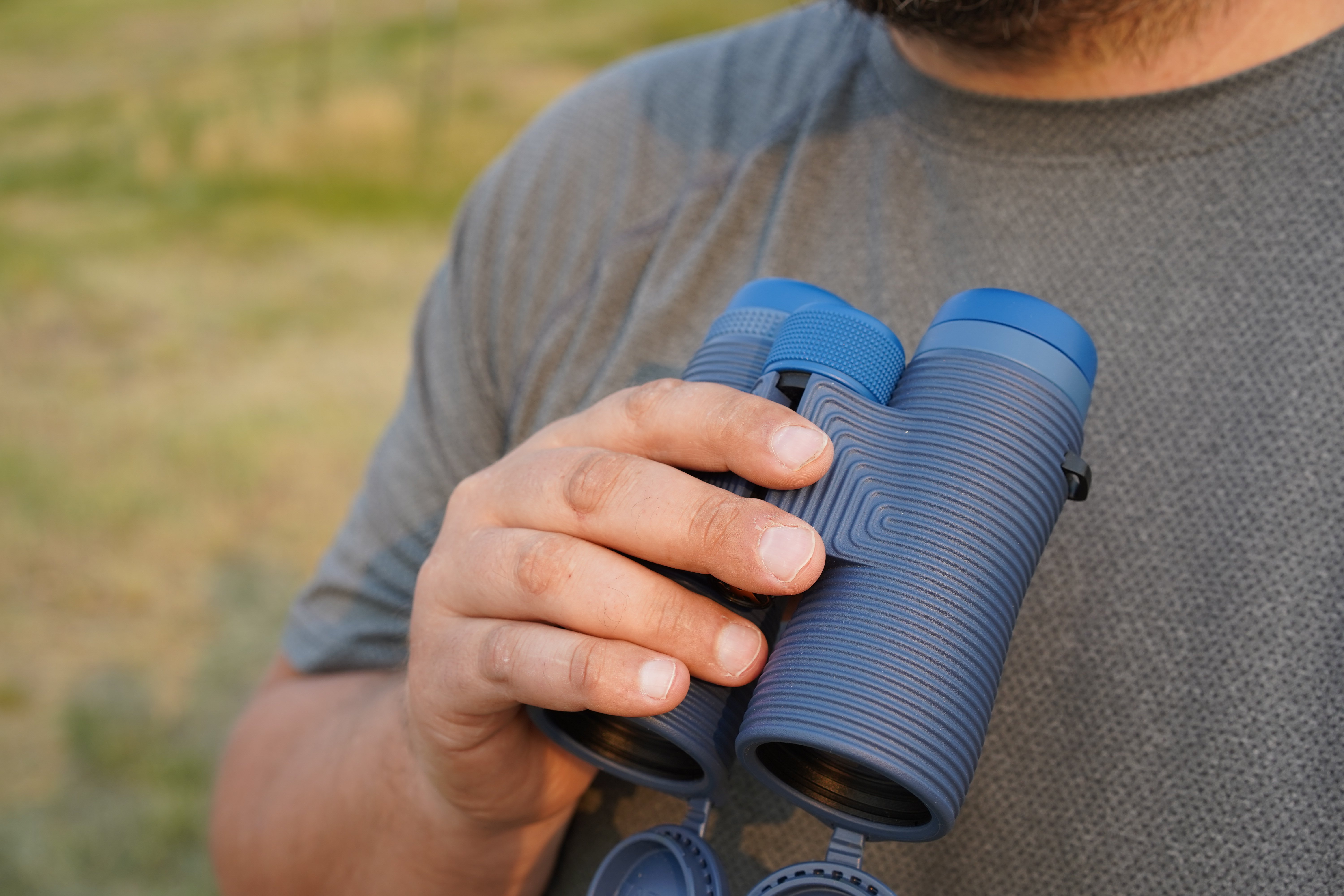
The rubber-coated exterior is comfortable. -

“Watch what you see” is written on the inside of the objective lens covers.
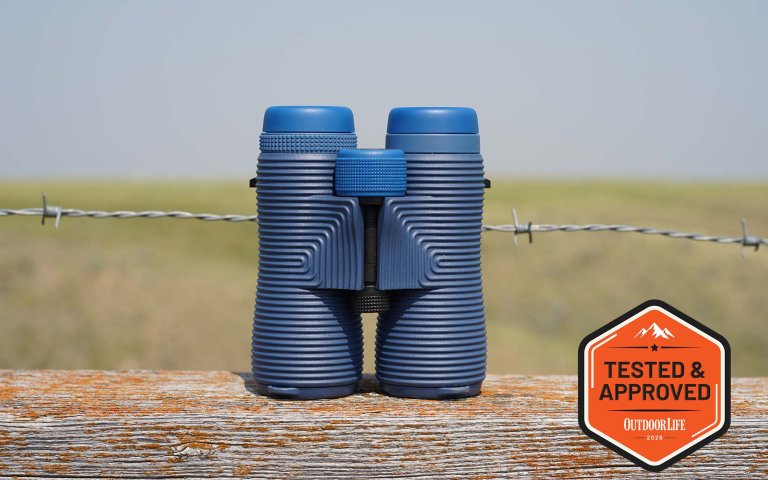
The box that holds this distinctive, ribbed-for-pleasure binocular has instructions about how to use it, an illustrated guide to twisting out the eyecups to your liking and setting the diopter focus. That tells you a bit about the Nocs Provisions’ audience: This might be their first encounter with a binocular.
First-timers, or anyone else for that matter, makes a good choice with this fun but hard-wearing and very good do-everything binocular. It might be intended for bird-curious bro-dudes, but it’s right at home in a whitetail stand or as a walk-about optic for serious hikers or backcountry hunters.
We tested the Eddy Blue colorway, but you can get this in Jade Green, Audubon Crested Caracara (Google it), or 10×42 versions in Sage, Brick Red, or Great Cormorant (again, Google). Nocs Provisions, a fresh presence in the optics world, collaborates with the Audubon Society on conservation initiatives, and features bird plumage in its colorways. If that’s off-putting to you, Nocs doesn’t care. They’re more interested in producing optics that function well, are durable, and are priced right.
Priced at under $200, this Field Issue 8×42 delivers so much utility and style that it earned our Great Buy award as the binocular in this year’s test with the highest price/value score. That it beat out seven other budget binoculars priced under $400 for the award says a lot about the Field Issue’s chops.
“Nice balance and in-hand feel, and I love the aesthetic,” noted one Outdoor Life tester, who praised the Field Issue’s wide field of view.
“Insanely close focus – this would be a good butterfly binocular,” said another, who noted that not all internal lens surfaces are fully multi-coated, creating a bit of flaring when pointed toward the sun.
Another tester noted that the focus control and barrel-belly thumb indentations were a bit too far back for his hands, but he allowed that they’d nicely fit most women and smaller-handed men. Maybe that’s intentional, as Nocs’ brand vibe seems to be to outfit anyone interested in looking carefully at the outdoors, regardless of glove size or adventure destination.
Nocs Provisions Field Issue 8×42 Specs
- Magnification: 8-power
- Objective Lens: 42mm
- Light Transmission: Not available
- Exit Pupil Diameter: 5.4mm
- Twilight Factor: 18.3
- Field of View: 394 feet at 1,000 yards
- Close Focus: 6.6 feet
- Weight: 21 ounces
- Length: 7.5 inches
Honorable Mention: Leupold BX-3 Alpine HD 10×42
See It
Pros
- Durable magnesium chassis
- Interchangeable Form-Fit eyecups
- Scratch-resistant coatings
- Front-hinge tripod mount
- Transferable lifetime warranty
- At under $300, priced right
Cons
- Noticeable edge distortion
Key Features
-
Ships with three eyecups -
3-position eyecups -
Oversized focus wheel -
Ships with binocular harness -
3-position eyecups -
Open-barrel design -
Price:
$300
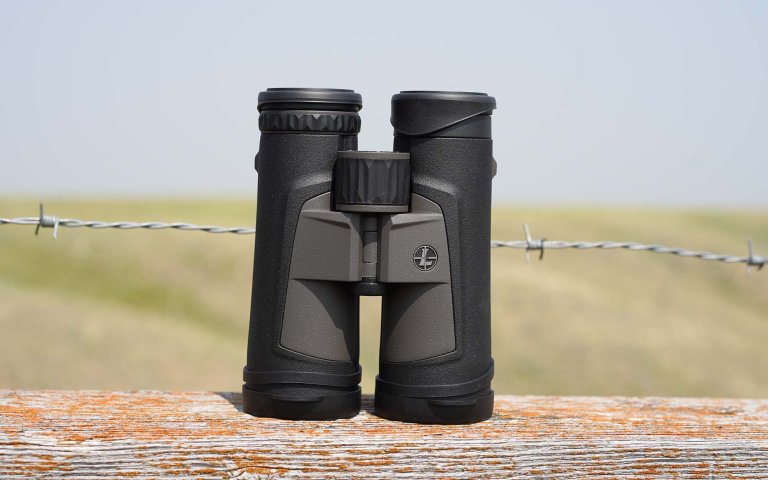
For years now, as Leupold has trotted out its BX-4 Pro Guide and even some configurations of its premium BX-5 Santiam binoculars, we’ve felt they were either overpriced or underperformers. Sometimes both. But with the BX-3 Alpine HD, Leupold has produced a binocular that’s worth every penny by simply and solidly checking the boxes of price, performance, and style.
“This is the best Leupold budget bino I’ve seen in the past few years,” noted tester Dale Manning. “The eyecups lock well with solid detents, and the focus control is smooth and precise.”
The BX-3 Alpine HD is built around a durable magnesium chassis, which lends it a heavyish but settled in-hand feel. It also comes with Leupold’s Form-Fit eyecups, with a square and batwing pair to go with the contoured cups that it ships with. Those features, and the very good bino harness that comes with the optic, are premiums you don’t expect at the sub-$300 price.
The Leupold was the highest-finishing 10-power binocular in our low-light test. We liked the image of both the 10×42 and the 10×50, though we detected some blue color fringing and slight edge distortion in both models. We’d recommend the 10×50 for open-country Western hunting. The 10×42 is compact and nimble for any need, but it’s best suited for mobile hunters who want a fast, durable, unfussy optic that won’t break their budget.
Leupold BX-3 Alpine HD 10×42 Specs
- Magnification: 10-power
- Objective Lens: 42mm
- Light Transmission: Not available
- Exit Pupil Diameter: 4.1mm
- Twilight Factor: 20.5
- Field of View: 342 feet at 1,000 yards
- Close Focus: 6.2 feet
- Weight: 22.6 ounces
- Length: 5.7 inches
Best for $100: Vortex Triumph HD
See It
Pros
- Very affordable
- Ships with bino harness
- Fully transferable lifetime warranty
Key Features
-
Available in 10×42, 10×28, and 12×50 configurations -
Oversized focus wheel -
Contoured eyecups
Vortex is filling out its entry-level Triumph HD line of binoculars, introduced with its 10×42 in 2023, with new 12×50 and 10×28 configurations. Their value proposition is outrageous: fully warranted field-worthy binoculars for under (or just over) $100, decent binocular harness included.
10×42
The class of glass inside the Triumph HD is predictably cheap. The Vortex received uniformly downbeat assessments in optical performance; it scored near the bottom in low-light brightness, and its resolution score was just below the median. Testers further complained about blue color fringing, noticeable edge distortion, and blurry focus.

But we also recognized that you shouldn’t expect world-beating glass inside a $100 binocular, and that same realism pervaded our assessment of the Triumph’s mechanical performance. The diopter adjustment is stickier than we’d like, and the overall build feels flimsy. But the tapered eyecups move with positivity and the focus wheel is tight and responsive. The texturing, balance, and overall design is better than we’d expect for the price.
On the value side of the ledger, the GlassPak case and integrated harness confirms the best value designation we gave the Triumph HD. This would make a very good first optic for a hunter, birder, or shooter, and if treated gently is a good choice to throw in a pickup or cabin. We’re not sure how much rough handling this bino can take, but Vortex’s excellent warranty and customer service is a cheering consolation.
10×28
Unfortunately the image and build in the 10×28 aren’t quite up to our expectations.
The little Vortex finished last in our low-light test, which was expected given its small 28mm objective lenses. But even in full daylight the image was slightly dim and milky, possibly the result of some uncoated internal lenses. Edge clarity is surprisingly sharp, but the field of view is narrow, and some testers couldn’t get the binocular to focus while wearing glasses. That’s because the eyecups, even at the lowest setting, are still fairly proud, meaning they keep spectacled users’ eyes fairly far from the ocular lenses. Plus, the 10×28 configuration delivers a stingy 2.8mm exit pupil, which is hard to center in the eye, whether you wear glasses or not.
The closed-hinge design doesn’t balance well in hand, and we worry about the durability of the polycarb chassis.
At a wispy 13 ounces, the 10×28 Triumph HD is a go-anywhere optic that should be in every whitetail hunters’ pack, and with a real-world street price of well under $100, the Vortex fits nearly every budget. But we think this version of the Triumph HD would be better suited as an 8-power.
12×50
The biggest member of the Triumph HD family, this 12×50 is positioned as a price-point bino for Western hunters. The 12-power build can be hand-held, but it’s more useful as a tripod-mounted optic for hunters who pick apart big landscapes.
Unfortunately, we found we didn’t want to spend much time behind this binocular because its image is slightly off and we struggled to get a tack-sharp focus. Given its extremely appealing price — around $125 street price — we expected underwhelming glass, and confirmed some uncoated lenses and a slightly dark image. On the upside, the edge clarity is good, and the 12×50 build finished in the top third of the field in our low-light test.
But the binocular feels plasticky, and its controls — 2-position eyecups and diopter and focus controls — are indistinct. Like the 10×28 Triumph HD, the 12×50 version is hard to use with eyeglasses.
“I was impressed with the 10×42 Triumph HD, so expected that the larger frame and higher mag 12×50 would build on its performance,” noted tester Nate Ward. “Unfortunately, high magnification and inexpensive are two things that clash in the binocular world.”
Best Compact: Hawke Vantage HD 8×34
See It
Pros
- Open-barrel design enhances one-hand operation
- Great travel optic
- Lightweight polycarb body
- At 15.2 ounces, very lightweight
- Tripod mountable
- At about $170, priced right
- Lifetime warranty with registration
Cons
- Some uncoated internal lens surfaces
- Spongy focus
Key Features
-
Dual-hinge, open-barrel design -
2-position eyecups -
Front-hinge tripod adapter
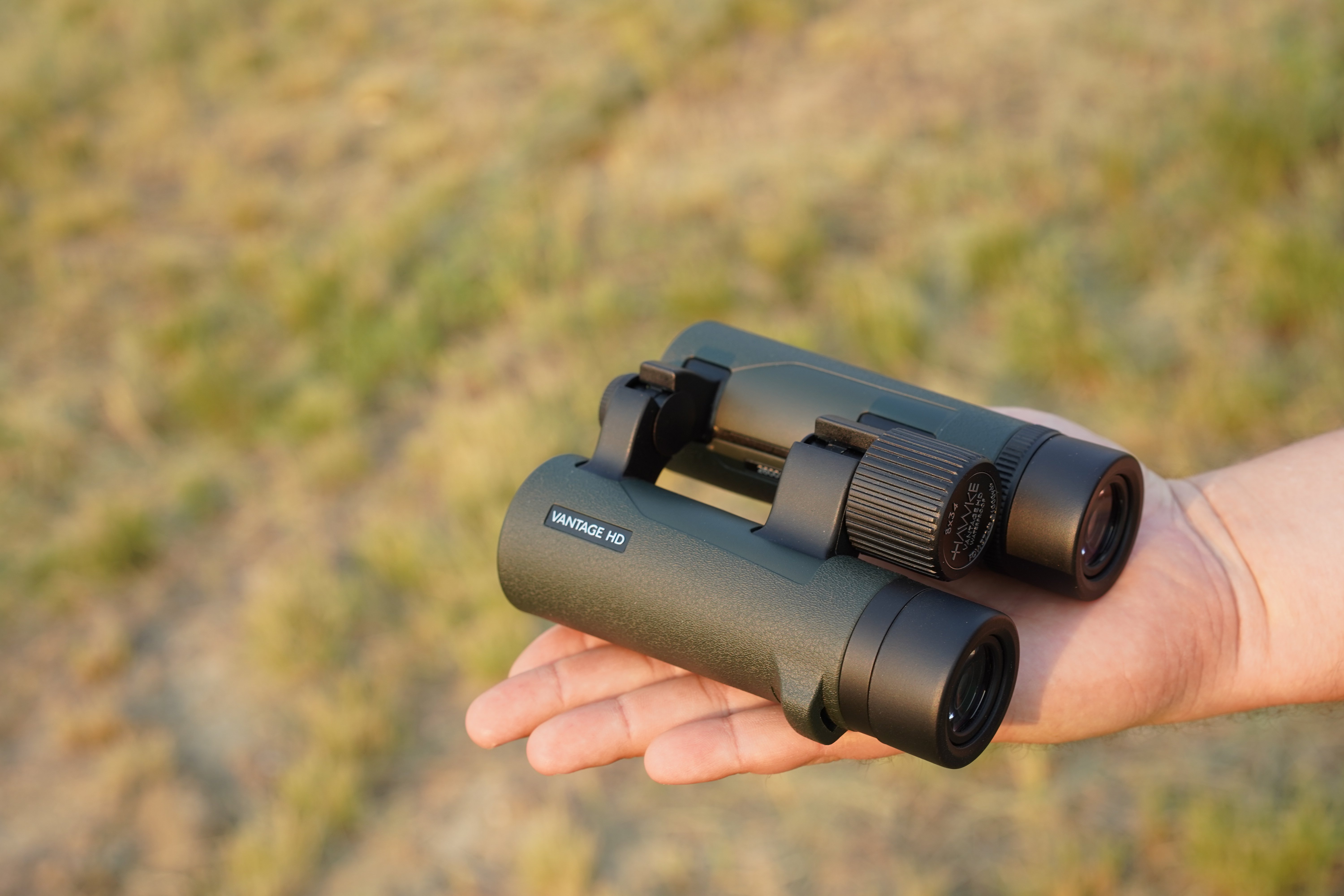
For walk-about bowhunters, a binocular that enables one-hand operation is a gift. The alternative of two-hand deployment means they have to set their bow down on the ground or place it in a belt rest or somehow free up their other hand.
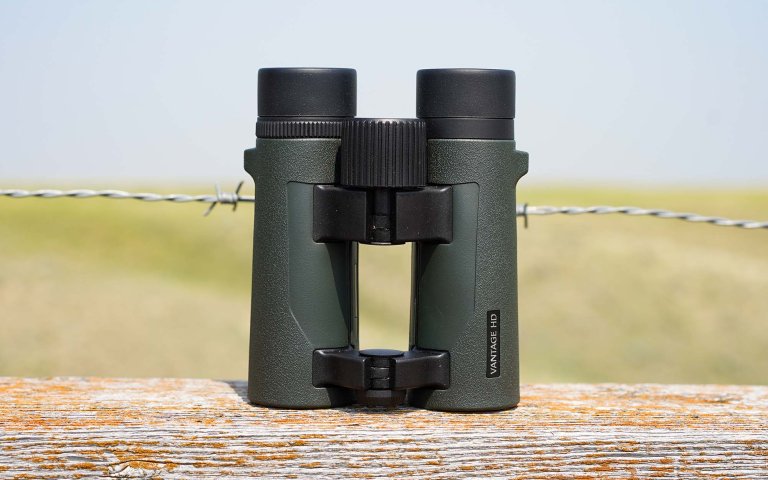
Hawke’s new super-compact 8×34 Vantage HD is the ultimate one-hand binocular. Its open barrels allow users to confidently grip the bino, and it’s so lightweight (less than a pound) and compact that it’s easy to grab out of a harness or a jacket pocket. This little powerhouse might also be the ultimate travel optic, easy to pack and produce when you want to see the details of a gargoyle gracing a Medieval cathedral, for one instance.
I packed this binocular on an Argentine dove hunting expedition, and used it to identify birds that were similar to their North American cousins, but just different enough that I spent nearly as much time observing birds as I did shooting them.
Hawke has wisely noted that 8-power is the perfect magnification for this super-compact build. Many brands put 10-power magnification in this micro frame, but that’s wrong, since it produces a tiny exit pupil and it’s hard to hold the powerful magnification in a chassis that doesn’t have hand-filling heft.
We worried about the durability of the polycarbonate chassis and noted some uncoated internal lens surfaces, but at about $170, this binocular is priced right for its abundant utility and outrageous per-pound performance.
Hawke Vantage HD 8×34 Specs
- Magnification: 8-power
- Objective Lens: 34mm
- Light Transmission: Not available
- Exit Pupil Diameter: 4.25mm
- Twilight Factor: 16.5
- Field of View: 372 feet at 1,000 yards
- Close Focus: 9.8 feet
- Weight: 15.2 ounces
- Length: 5.2 inches
Sig Sauer ZULU4 HD 10×42
See It
Pros
- Durable magnesium chassis
- Distinctive flat dark earth colorway
- Features Sig’s proprietary optical coatings
- Low-profile contoured eyecups
- Priced under $400
- Unlimited lifetime warranty
Cons
- 2-position eyecups
- Blue color fringing
Key Features
-
Non-locking diopter ring -
“Precision contour overmold” on focus control -
Front-hinge ¼-20 tripod thread -
Sig’s HDX glass -
Anti-reflective coatings -
Price:
$450
While Sig Sauer’s optics division invests in cutting-edge laser rangefinding, ballistic solving, and stabilization, it also produces some very good lower-end optics that allow users to enter the Sig ecosystem with minimal investment. The TANGO-SPR that won last year’s Great Buy riflescope award is a good example. So is this year’s excellent ZULU4 HD 10×42 binocular.
The ZULU4 HD doesn’t do any single task remarkably well, but it does a little bit of everything — portability, ergonomics, image quality, low-light performance, durability — capably enough that it was a contender for our Great Buy award. Priced under $400, this is a Sig that anyone can afford and benefit from using.
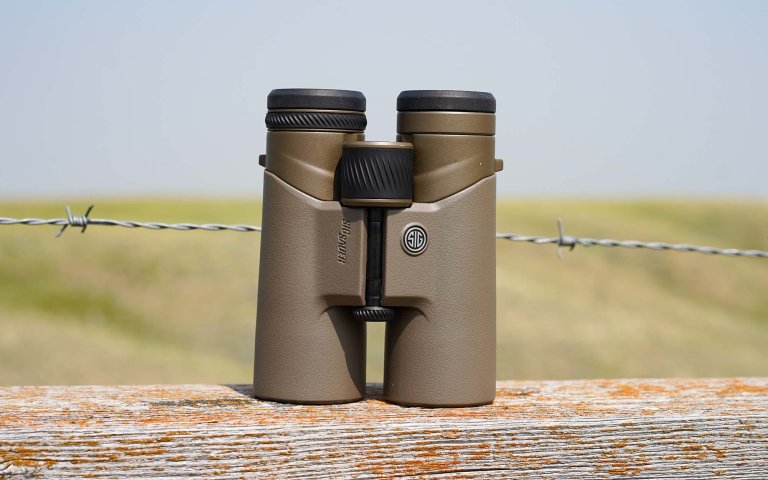
We liked the liberal eyebox that enables all-day glassing, the nicely contoured eyecups, and the magnesium chassis that settled nicely in hand. The rubberized focus wheel is grippy and turns with authority, and while the image is sharp and pretty clear, we detected some blue edge flaring, especially when we glassed sharp edges of mid-range objects.
“It’s comfortable to hold in a small, compact package,” noted tester Nate Ward. “It feels like an optic that should cost more than it does.”
Sig Sauer ZULU4 HD 10×42 Specs
- Magnification: 10-power
- Objective Lens: 42mm
- Light Transmission: Not available
- Exit Pupil Diameter: 4.2mm
- Twilight Factor: 20.5
- Field of View: 315 feet at 1,000 yards
- Close Focus: 6 feet
- Weight: 26.7 ounces
- Length: 5.75 inches
Best Image-Stabilized: Kite APC Stabilized 16×42 ED
See It
Pros
- Small size for stabilized binocular
- Fits most binocular harnesses
- Excellent ED glass
- Powered by twin AAA batteries
- Tripod mount on belly
- Limited lifetime warranty
Cons
- Narrow field of view
- Small and awkwardly placed focus knob
Key Features
-
Electronically stabilized -
120-hour run time -
Bottom-mounted ¼-20 tripod thread -
Motion-adjusted stabilization engine -
3-position eyecups -
Easy one-hand operation
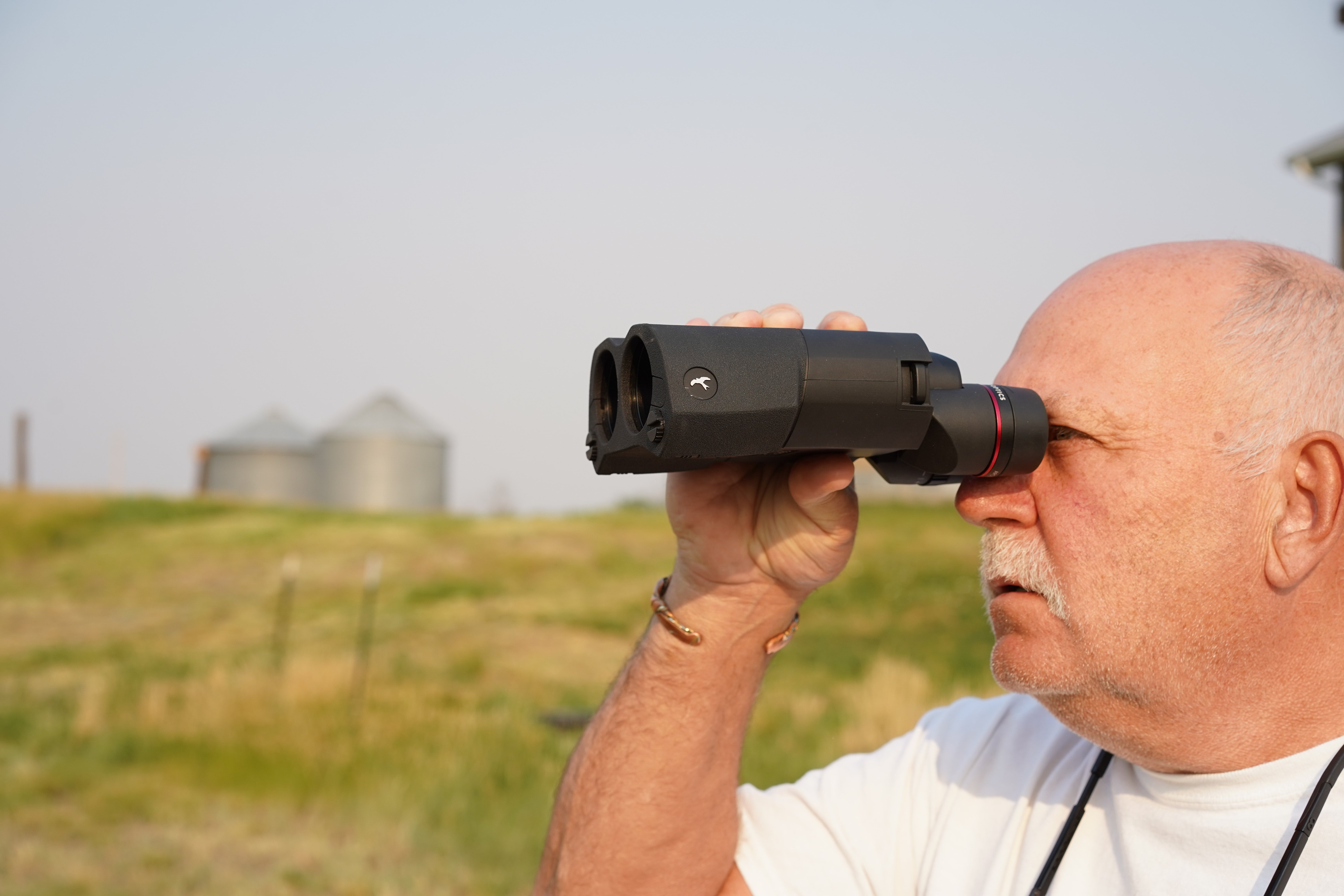
Along with Sig Sauer, Kite is aiming to own the new and necessary category of stabilized optics. Both brands have multiple configurations of their flagship stabilized binoculars, but by bringing a true walk-about binocular, Kite may have surged to the lead.
The 16×42 APC capably fills the gap between high-magnification conventional binoculars and compact spotting scopes. That it does it in a small enough form factor to fit in a chest harness and brings excellent glass as well makes this a standout optic. The Belgian company has 12×42 and 20×42 versions of this platform.
Like the Sig stabilized binoculars, the Kite runs on standard AAA batteries (the company also sells a version that runs on rechargeable lithium-ion batteries). It has an astonishing 120 hours of run time and a responsive gimbal that adjusts to movement to tame micro shakes and vibrations. The result is a smooth, almost cinematic, view of the world.
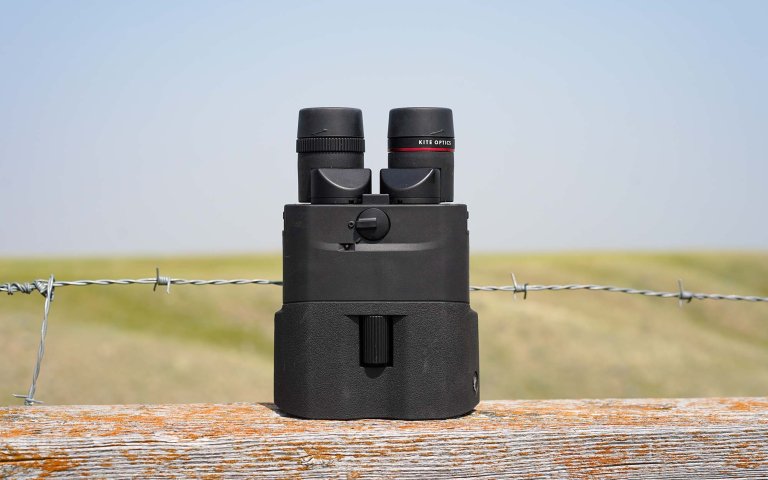
The 16×42 Kite APC is made for hand-held viewing, but the image is even more chill when the unit is mounted to a tripod. We worried a little about the square, blocky handling after a long day in the field, and some testers had to stretch their pointer finger to reach the focus knob. The Kite is pricey, with a real-world street price of about $1,350. But for hunters who want more reach than a standard 10-power binocular without the bulk of a higher-mag stabilized optic, this 16×42 is a smart choice.
Kite APC Stabilized 16×42 ED Specs
- Magnification: 16-power
- Objective Lens: 42mm
- Light Transmission: 85%
- Exit Pupil Diameter: 2.6mm
- Twilight Factor: 25.9
- Field of View: 240 feet at 1,000 yards
- Close Focus: 9.5 feet
- Weight: 30 ounces
- Length: 7.5 inches
Read Next: Best Spotting Scopes
Best Large-Frame: Burris Signature HD 15×56
See It
Pros
- Excellent glass
- Durable build
- Grippy armor
- Fully transferable lifetime warranty
Cons
- Blocky eyecups
- Tripod mount can be pinched by objective lenses
Key Features
-
Closed-bridge, closed-hinge design -
3-position eyecups -
Oversized controls -
Magnesium-alloy chassis -
Ships with soft bino harness
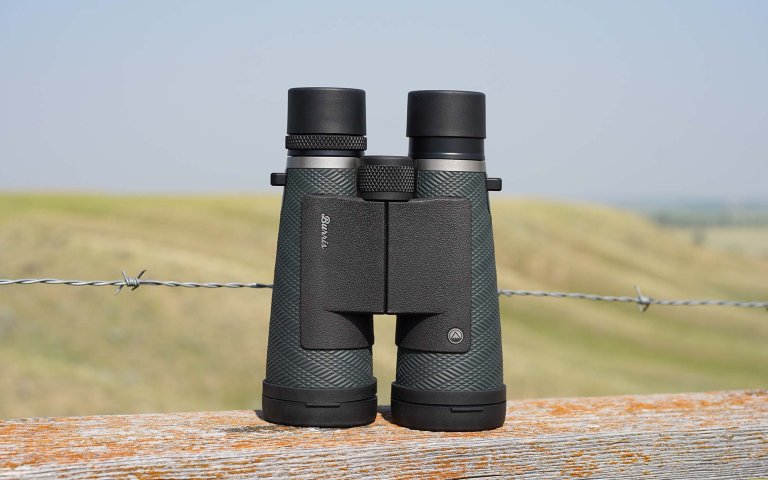
Like the 10×50 Nikon, there aren’t many distinctions about this big, tripod-mountable bino from Burris, which unlike the new-for-year optics in our test was introduced in 2025. But beneath that modest frame is very good Japanese glass and a tight, durable build.
This isn’t intended as a handheld optic. Instead, mount it to a tripod to get the best of its prodigious magnification, decent field of view, and liberal eyebox. The Burris became our main range spotter during the optics test, when we walked hunting scopes out to 700- and 800-yard steel. It also won our low-light test, tying for top honors with the 15×56 Bushnell R7.
Of course we have some quibbles. The eyecups are a little square for some faces, and the close focus sucks. But you buy these to soak behind for hours at distant targets, and the Burris Signature HD 15×56 is very good at that task, and far better than its peers in the test.
Burris Signature HD 15×56 Specs
- Magnification: 15-power
- Objective Lens: 56mm
- Light Transmission: Not Available
- Exit Pupil Diameter: 3.7mm
- Twilight Factor: 28.9
- Field of View: 215 feet at 1,000 yards
- Close Focus: 23 feet
- Weight: 43 ounces
- Length: 8 inches
Bushnell R7 10×42
See It
Pros
- Handy one-hand operation
- Tripod can be mounted on either hinge
- Interchangeable eyecups
- Excellent close focus
- Proprietary Bushnell exterior coatings
- Lifetime warranty
Cons
- Spongy focus
- Some uncoated interior lens surfaces
Key Features
-
ED Prime glass -
Bushnell EXO Barrier coating -
Field-flattener optical design -
Magnesium-alloy chassis -
2-position eyecups -
Locking diopter control
Bushnell has reinvented its Good/Better/Best product lineup (remember the Prime/Engage/Forge, and before that the Trophy/Legend/Elite?) with new sibling groups in its binocular family. We had the R3 two years ago, the R5 last year, and this year the R7 promises Elite/Forge-level optical performance with five new configurations: 8×42, 10×42, 10×50, 12×50, and 15×56.
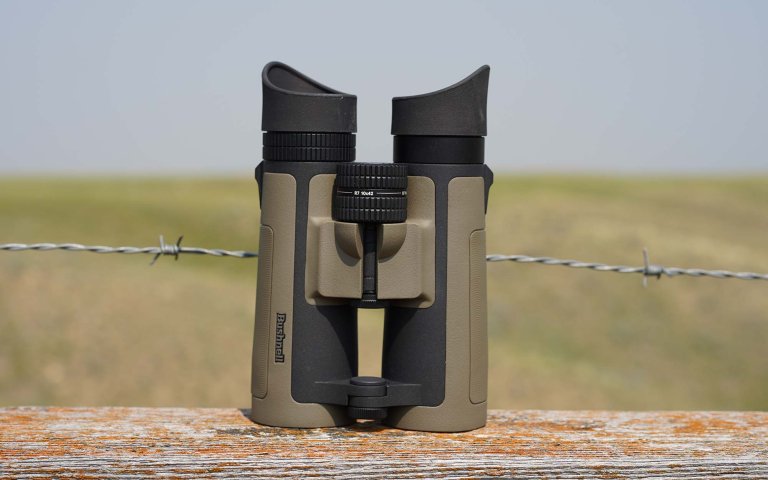
Of the group, this 10×42 R7 is the best expression of the new “best” platform. It features very good glass, nice handling in a dual-bridge, open-barrel design, and premium features like a locking diopter control and interchangeable eyecups.
The design and handling justify the $600 price, but the glass doesn’t quite keep up with excellent housing. While the center of the image has a crisp, bright “sweet spot,” we detected a fuzzy blue aberration around edges, and at least one uncoated internal lens surface. The 10×42 R7 finished near the bottom of our low-light test, a surprise considering it’s built around Bushnell’s ED Prime glass, which has been one of the most consistently clear and bright optics in the industry.
On the upside, the build on a durable magnesium chassis is among the best Bushnell of the last decade. The binocular balances nicely in hand, and one-hand operation is a cinch with the grippy open barrels. We like the positive locking diopter and the 2-position eyecups, which can be replaced with square, contoured, and batwing options. Users can mount a tripod to either the front or rear hinge, and the close focus of 5 feet is the best of any entry in this year’s test.
The R7 ships with Bushnell’s excellent Vault LITE binocular harness, making it a great walk-about optic right off the shelf. Given its excellent controls and amenities, this 10×42 would have competed for our top award if it had turned in better image scores.
Bushnell R7 10×42 ED Specs
- Magnification: 10-power
- Objective Lens: 42mm
- Light Transmission: Not available
- Exit Pupil Diameter: 4.2mm
- Twilight Factor: 20.5
- Field of View: 345 feet at 1,000 yards
- Close Focus: 5 feet
- Weight: 27.2 ounces
- Length: 5.9 inches
Hawke Frontier ED X 10×42
See It
Pros
- Durable magnesium-alloy chassis
- Premium low-dispersion ED glass
- Comfortable contoured eyecups
- Classy styling
- Lifetime warranty
Cons
- At about $600, overpriced
- Some edge distortion
Key Features
-
3-position eyecups -
8.2-foot close focus -
Field of view: 336 feet at 1,000 yards -
Textured focus control -
Front-hinge tripod mount
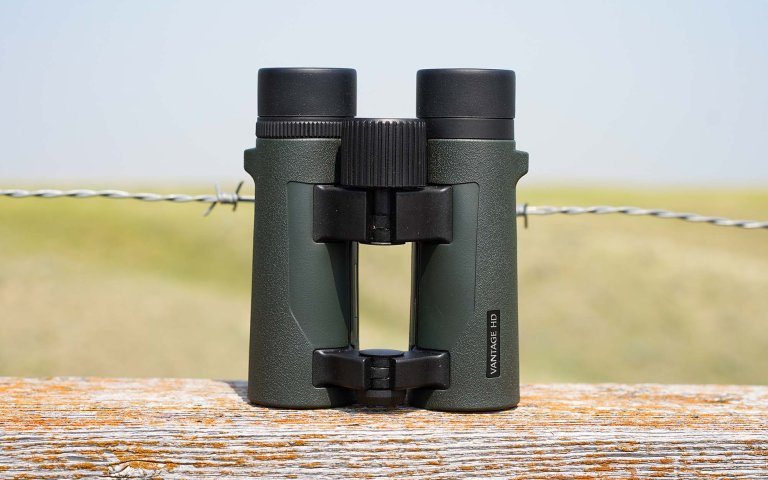
One look at this handsome, balanced, and trim entry from the British optics firm Hawke, and you’d think it was the perfect entry between forgettable budget-bin binos and premium models. Its price, about $600, confirms that in-between positioning.
But testers noted that the Hawke’s glass isn’t on par with its exterior styling. We recorded noticeable color fringing and flaring on the edges of hard-sided objects, evidence of inadequate lens coatings.
“This is a solid bino but feels like it is not as good of a bang for your buck than others in this price range,” noted one tester. “The glass is not as good as I would have hoped for the price. Feels like there is a bit of veiling on the edge of images, like I can’t quite get the interpupilary distance correct.”
The Frontier ED X handles on par with its promise. The focus and diopter controls are smooth and positive, the contoured eyecups are finely rendered, and the balance is that of a premium optic. If only the glass kept pace with the build, this would be a mid-priced gem, indeed.
Hawke Frontier ED X 10×42 Specs
- Magnification: 10-power
- Objective Lens: 42mm
- Light Transmission: Not available
- Exit Pupil Diameter: 4.2mm
- Twilight Factor: 20.5
- Field of View: 336 feet at 1,000 yards
- Close Focus: 8.2 feet
- Weight: 25 ounces
- Length: 5.5 inches
Buk Ops Buknoculars
See It
Pros
- Digital device enhances low-light visibility
- Tripod mount on belly
- 4K HD video capability
- 2.95-inch viewfinder
Cons
- Destroys your natural night vision
- Poor low-light resolution
Key Features
-
25mm objective lens -
1-5-power zoom range -
Runs on 4 AA lithium batteries -
Requires SD card to record media -
2-year warranty
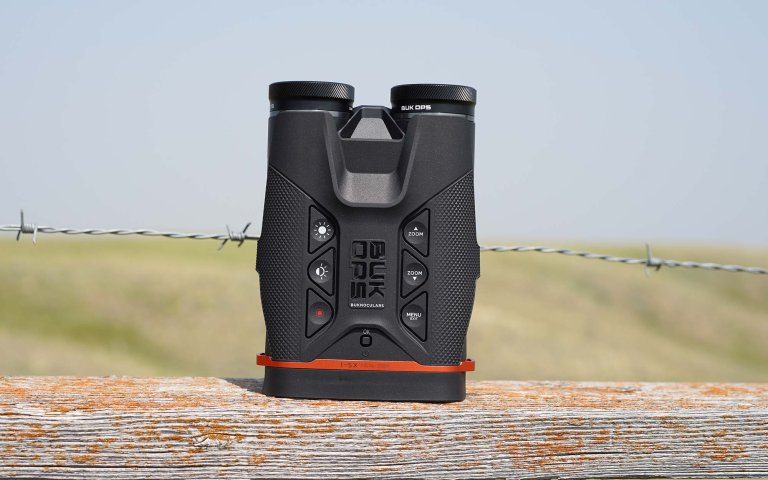
The Outdoor Life optics test team had the equivalent of a domestic dispute over this unorthodox entry in the binocular field.
Some testers felt it belongs as a hunting-forward observation device, one that converts objects into a digital rendering instead of an optical image. But other testers felt that the “Buknocular” is more of a gimmick than a serious hunting optic.
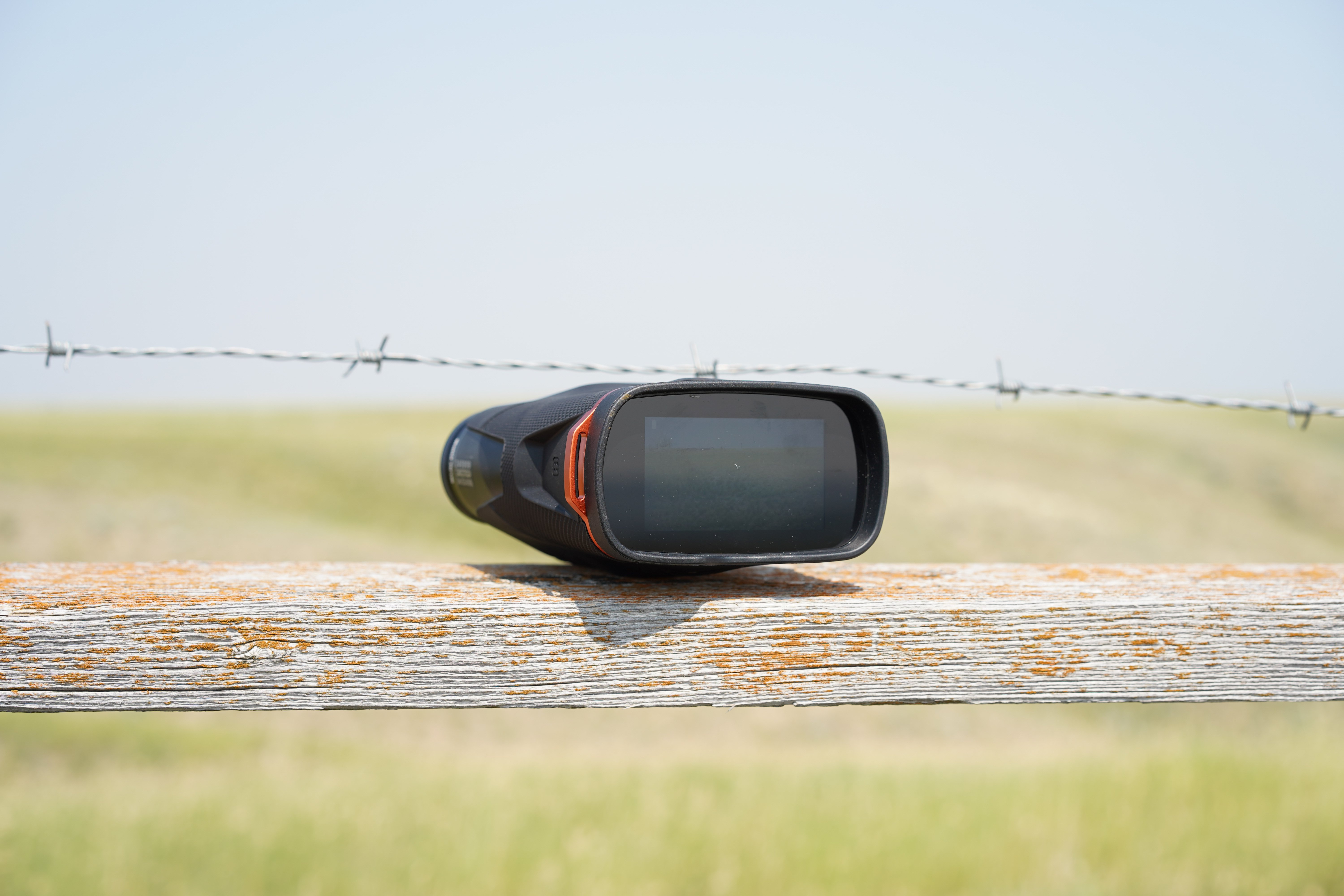
We put that debate to the test. Given our optics-centric testing methodology, which puts a premium on image quality, low-light performance, and field durability, the Buck Commanders’ Buk Ops device was a miss. Its digital image is bright without the detail we expect from conventional optics. And we worry about the durability of the plasticky build, which is so unbalanced that it’s like holding a hoagie sandwich.
That’s not to say this is a waste of our time or your money. When we mounted the Buknocular to a tripod, and used the 1-5-power zoom feature, we found we could get decent images in both full daylight and low light. The device uses what Buck Commanders calls “Primetime Color Vision” that’s neither thermal nor infrared to enhance low-light conditions. But the filters and image treatment create so much white noise that detail and resolution are pretty lousy. We tried to test the Buknocular in our low-light test, but the screen gave us such night blindness that we removed it from the lineup because we couldn’t see well enough to test the conventional binoculars.
Our experience forced us to question the use-case for this device, especially because the Buknocular doesn’t have a laser rangefinder or connection to a mobile app to stream images or capture photos or video. Our conclusion: It’s not a bad scouting tool, as it can capture images and store them on an on-board SD card. And it’s a useful way to share a hunt or other experience. We pictured this device mounted on a tripod in a box blind, giving a restless companion a way to participate in a hunt by sharing the image and experience with a hunter behind a crossbow or a rifle. Is that worth the $550 price? That’s not for us to decide.
BukOps Buknoculars Specs
- Magnification: 1-5-power
- Objective Lens: 25mm
- Light Transmission: Not available
- Exit Pupil Diameter: 25-5mm
- Twilight Factor: 5-11.2
- Field of View: Undetermined
- Close Focus: @18 feet
- Weight: @22 ounces without batteries
- Length: 6.2 inches
The Test Protocol

How We Low Light Test Optics
We put all submissions to our annual binocular test through the same criteria. First, we measure optical resolution, using the diminishing black-and-white lines of a 1951 Air Force Resolution Target to score the optical performance of each submission. We also measure the low-light performance of each binocular by mounting them to tripods and focusing them as a group at 200 yards at a black-and-white resolution target starting at twilight and then well into the gathering dark, all in order to measure the brightness of the glass. This is an important consideration for both hunters and wildlife watchers, since animals are more visible in the early morning and late evening than at any other time.
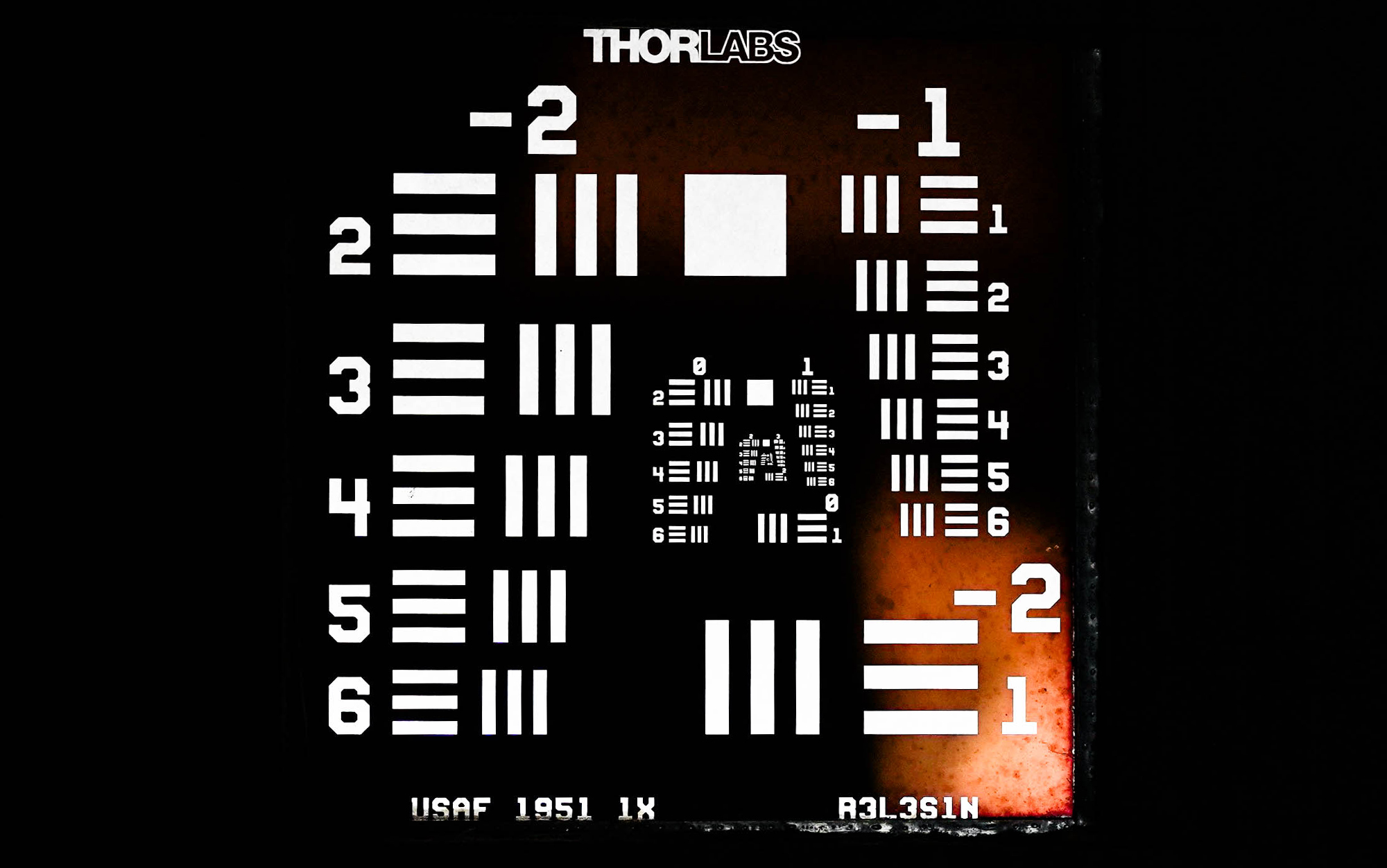
The binocular that can “see” the longest into the dark gets top marks. The model that loses its night vision earliest gets the lowest score. Binoculars in the middle receive weighted scores somewhere between those two poles. We averaged the results over at least three nights, with a different pair of eyeballs behind the binoculars each night, to arrive at our adjusted score.
How We Scored the Results

We break our 10-point scoring into four general categories: optical performance, mechanical performance, design, and value. The average of these categories is the basis of our grades, detailed below.
Optical performance includes the resolution and low-light tests plus the more subjective assessments of image quality and brightness. Mechanical performance assesses the durability of the submission along with its controls: focus and diopter controls, eyecup extension, and comfort. In the case of rangefinding binoculars, it also factors the electronic interface and performance. Design considers the exterior finish, interior blacking, tripod mount, and its innovation and versatility, along with its comfort. We ask testers to evaluate this critical question: how long could you glass with this binocular?
And then our price/value score rates how much optic—along with warranty and amenities such as carrying case or harness—you get for your money. The binocular that gets the highest overall score wins our Editor’s Choice award for the best in the category; the optic with the highest price/value score wins our Great Buy recognition.
Our 10-point evaluation adds up to a total numeric score, but we translate those to grades for each submission. The optical performance grade combines the scores from resolution, low light, image, and brightness. Our mechanical performance grade aggregates the mechanics and durability score. The design grade considers construction, innovation, versatility, and comfort. And then the price/value grade is our value grade.
To earn an “Excellent” grade, the average of that category must be 9 or higher, which is extremely hard to achieve. “Very Good” is an average score of 7 to 9. A “Good” grade is 5 to 7. Our “Fair” grade is 3 to 5, and “Poor” is anything under 3.
Read the full article here