
There was no hint of trouble in weather or sky as the thirty-foot trolling boat Roamer cast off her lines, backed away from the dock, and moved out across Munising Bay. Her skipper, Capt. Fred Lukowski, was at the wheel and Donald Martin, the fourteen-year-old helper and cabin boy, was busy coiling lines and making things shipshape. The seven of us who were aboard for a fishing trip started to get our deep-trolling gear ready.
A brisk wind had blown earlier in the morning, holding us temporarily at the dock, but it had died down to a light breeze. We had no reason to think, as we crossed the blue, wind-ruffled bay, that this would be anything but a pleasant fishing trip for big lake trout on the Lake Superior reefs a few miles offshore. Actually we were headed for an ordeal which, but for the grace of God, could have brought death to all of us.
I’d done considerable deep trolling for lakers. It’s a sport I prefer to any other, and Munising, in the upper peninsula of Michigan, on the south shore of the lake 150 miles west of Sault Ste. Marie, was my favorite trolling port. I had brought six novices along this time. Five of them, Fred Fendt, Walt Gottleber, Westal Riddick, Charlie Lea, and Eddie Williams, worked at the tool manufacturing plant I operate in the village of Holly, fifty miles out of Detroit. The sixth was Maurice Johnson, a friend of mine from Flint.
We’d planned the trip several weeks ahead, as a Fourth of July outing, and reached Munising a day early. Now, shortly before noon on July 3, we were on our way to the trolling grounds, as carefree and hopeful a party of fishermen as you could have found anywhere.
Outside Grand Island, seven or eight miles offshore, we came in over the reefs where I landed some top-notch lake trout on previous trips, and Capt. Lukowski gave us the nod to put our spoons down. He cut the speed of the Roamer, and we paid out the metal lines from the heavy trolling rods and settled down to the patience-trying job of waiting for a strike from a trout on the bottom of the lake, fifty to seventy-five feet below.
It was soon apparent that we’d picked a poor day for trolling. The weather looked favorable, the wind was right, the water wasn’t too rough—but the lakers weren’t having any. We kept the spoons down deep, where they tapped the rocky reefs every now and then, and the skipper angled back and forth over the trout grounds for two or three hours. The Roamer rolled lazily in the light swell that was coming in from the open lake, and our rod tips dipped and rose, but nobody got a strike.
Two other boats were trolling not far away, and as far as we could see their luck was not better than ours. It was the poorest fishing I’ve ever encountered on those grounds, and at the end of three hours I was fed up with it. I was about ready to suggest that we give up and go in, but while I was still mulling it over things happened which took the situation abruptly out of my hands.
We heard a sudden far-off roll of thunder in the southeast, over the land, and when we looked that way we saw an odd black cloud rolling up above the hills behind Munising. It grew and climbed fast. I watched it for a minute or two and turned to Lukowski.
“That looks dirty,” I suggested. He nodded. “Squall,” he grunted. “Better get your lines in.”
He swung the wheel over and the Roamer came around and put her nose toward the wide channel between Grand Island and Wood Island. There were two or three miles to cover before we’d have any kind of lee. Meanwhile, we had a grandstand seat to watch the oncoming storm. I glanced off to the west, looking for the two other boats that had been out with us. They, too, had turned and were running for the shelter of Wood Island. As things turned out, they were luckier than we. They didn’t make harbor before trouble hit, but the way the wind veered around the island broke the force of the storm for them.
Our skipper poured gas to his engine and we hammered down into the channel. The squall was moving off to the northwest, passing around us and traveling with frightening speed, but we decided we were going to outrun it safely. It slashed by a mile or so to the north of us, a pitch-black cloud mass veined with lightning flashes. The wind freshened sharply and rain started to pelt down.
We didn’t realize it then, but what we were heading into was a real tornado. Later we learned that it had come up suddenly, and swept through Munising where it had wrecked docks and ripped the roofs off buildings. On Grand Island it picked up a summer cottage, rolled and twisted it across the beach, and slammed it down on top of another.
While we eyed it apprehensively, the compact black cloud wheeled around into the southwest, turned suddenly, and bore down on us like a live thing, driven by a screaming wind out of the west!
“It’s coming,” somebody yelled. “We better get life jackets on!”
The Roamer, an average inshore troller, was not equipped for serious trouble like this. It had life jackets, of course, but they were in the cabin and not easy to get at in a sudden emergency. But we clawed them out and tied them on. I remember one of us helping the skipper into his while he stood braced at the wheel.
When the core of the storm struck us we felt we’d been hit by a gigantic sledge hammer. A solid wall of wind and rain crashed down, and the big seas came with it, roaring and foaming, their black-green crests smoking with spray. There seemed to be two or three smaller waves ahead of it, and then a mountain of dark water picked us up and slammed us down.
I realized in that first wild rush of wind and sea and rain that we were in serious trouble. The storm had caught our little thirty-footer broadside and she was wallowing in the trough of those heaving hills of water. It was too late now to bring her around and head her into the wind. I remember thinking that if she lived five minutes there in the trough it would be a miracle. We’d be either swamped or smashed like an eggshell by the tons of solid water pouring over us.
A second huge sea hit us, and I heard a shout from the stern deck. I looked back in time to see Maurice Johnson, clawing and fighting for a handhold, being swept overboard. Johnson was the only man in our party unable to swim, and as I saw him go I gave him up for lost. But even as two or three of us lunged toward the rail in the hope of helping him, the lake relented. A following sea slewed the stern of the boat around to where he floundered in the water, and with our help he grabbed a post and hauled himself back on board. A minute later he dived headlong off the crazy, tilting, careening deck of the Roamer of his own accord, along with the rest of us!
The boat went down under us like a stone. I don’t know yet whether she rolled over entirely. It seemed so to me, but experienced seamen tell me it isn’t likely. At least she went far over on her beam ends, with a giant sea breaking against her hull, and rolled out of sight. I flung myself as far from her as I could, felt stinging cold water close over my head, and fought to get back to the surface where there was air to breathe.
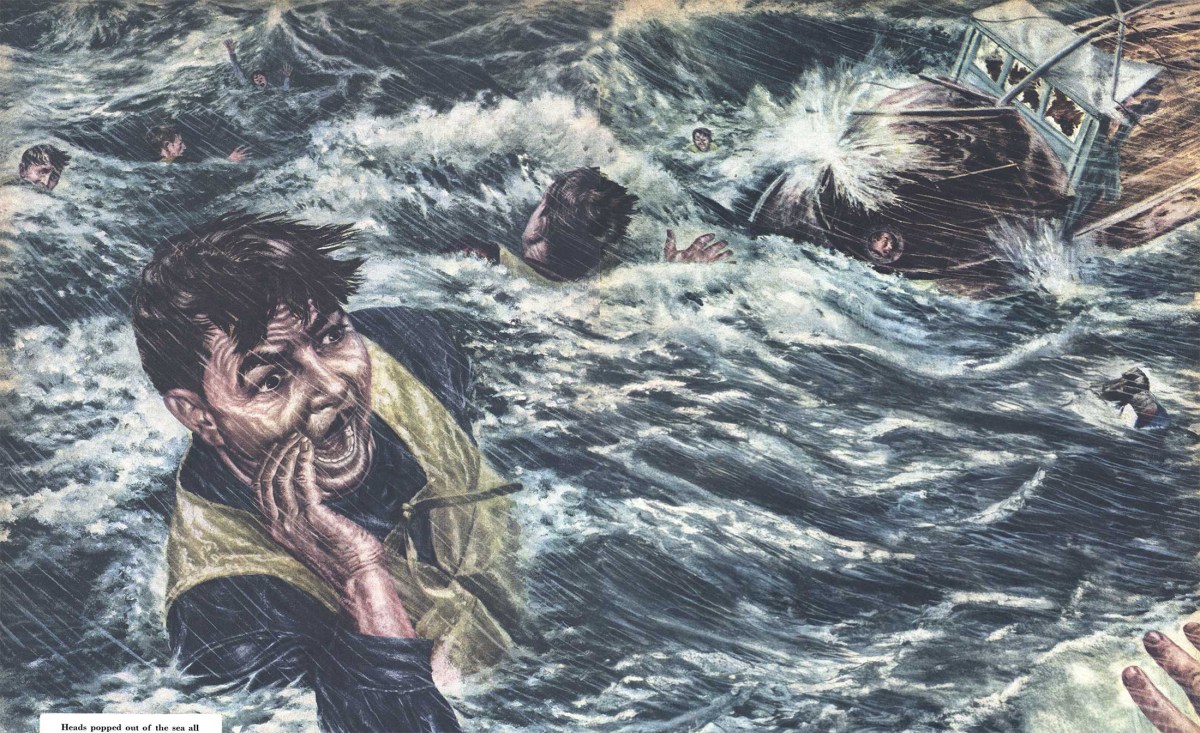
I came up, gulped a lungful, and saw heads popping out of the water all around me. The boat rolled up out of the sea, but was practically submerged, swamped and sluggish, and the skipper floated free of her. Even in that minute of initial panic it struck me there was something wrong with him. He didn’t seem able to do much for himself.
I battled my way upright, treading water and supported by my life jacket, and took a quick count. I could find only seven bobbing heads—not counting my own, of course. In the roaring confusion of the storm I managed to get a glimpse of one face after another. Charlie Lea was missing.
“Where is Charlie?” I bawled, and a voice shouted back that he must still be in the boat. I started for the Roamer and as it heaved up on the crest of a frothing sea I saw Lea’s head through one of the cabin windows.
I flung myself toward the boat, grabbed a railing near the bow, and fought my way aft to the cabin. Two or three other fellows were hanging on to the boat by that time. I’ll never know exactly what happened, but the cabin roof was built of plywood and they tell me I ripped it away with my hands. I have no memory of it. All I know is that somehow I smashed my way in and dragged Charlie out to the momentary safety of open water. Then I ripped the rest of the cabin top away and started to help some of the others find a handhold on it. It was a poor, makeshift raft, but better than none at all.
We were in a bad spot. Superior is the biggest body of fresh water in the world. Maybe it isn’t the coldest, but it couldn’t be much colder and still be water. So clear and pure that the big freighters pump their drinking tanks full in midlake, it maintains a year-around temperature close to that of spring water, never varying far from 45 degrees. They’ll tell you, in the little fishing villages around the shore, that the lake never freezes over entirely in winter, and that’s true. Ice fields extend out ten to twenty miles, but there is always open, restless water in midlake. They’ll also tell you that it never thaws out completely in summer, and that comes close to being true, too.
It’s so cold that the water is reputed never to give up the bodies of those who drown in it. When I felt the icy chill bite through my heavy clothes in those first few minutes, I knew that numbing cold was one of the worst dangers we faced.
On top of that I was the only real swimmer in our party. In my younger days I had swum as far as six miles at a stretch, and I had no fears for myself. Johnson couldn’t swim at all, as I have said, and the others were far from expert. Whether they could keep afloat, even with the help of their life jackets, I had grave doubts.
For the first few minutes we were in the water everything was confusion and panic. I have no clear memories of it, but I know I helped two or three men to our improvised raft and saw to it that they had a handhold somewhere. I recall marveling at the courage and coolness of the fourteen-year-old Martin boy. He asked for no help, and did no whimpering.
I was scared, too scared to think very clearly, and so were the rest, I suppose. But after I swam around the swamped boat a couple of times, and made sure that everyone was accounted for and had hold of some kind of floating wreckage, it occurred to me that I was not as cold as I had expected to be. In fact, I wasn’t cold at all, and so far the experience was less dreadful than I’d anticipated. I began to think that maybe we’d all get out of it alive, after all.
I came to one conclusion in that first quarter hour. A man dressed warmly in woolen clothing, as I was, has little to dread from the cold water of Superior as long as he keeps moving. If he is a fairly strong swimmer and is supported by a life jacket, he can survive hours in the lake without any real ill effects. I know, for I did. But if a man can’t swim or if he gives up and floats helplessly in one place, the cold will finish him in a fairly short time.
Looking back now on our ordeal, the thing seems like a nightmare in slow motion. There was nothing to do but hang on and wait. The seas ran twenty to thirty feet high. One minute we were thrown up on a crest and could see the inferno of foaming water stretching away on all sides. The next we were down in a deep hollow, surrounded by heaving walls of water topped by an arc of stormy sky.
Everyone kept a grip on something. Most of us were clustered around the wreckage of the cabin. The Roamer was still afloat, with three or four feet of her prow showing above water, her cabin awash and her stern out of sight. Eddie Williams was taking a merciless pounding against her planking as the sodden wreck heaved and rolled.
Nobody said much. The noise of wind and water made talking difficult, and we were all saving our breath and our strength. There was some praying done, I know, but most of it was silent. Every few minutes, or as often as I began to feel chilly, I let go the raft and swam around it, or over to the wreck and back, to keep my blood going. I was in the water close to three hours, and at no time did I really suffer. That’s more than can be said for the others.
The howling gale blew for close to an hour after we swamped. Then it started to fall away, although it was still blowing hard, and the seas came at us a little less savagely.
We had been in the water maybe two hours when Captain Lukowski just let go of the raft and floated away. None of us realized at the time that he was dead, and I can’t remember that we thought much about it. I suppose we were too numbed and too preoccupied with our own troubles to feel a great deal of concern. He had seemed dazed, and I had not heard him speak all the time we clung to the wreckage. I decided afterward, when we learned he died of a heart attack, that he had been stricken at the wheel when the squall first struck the Roamer, and had hardly known what was happening after that.
All the time we floated in the water the timbered shore of Grand Island, two miles away across the wind-lashed channel, beckoned and mocked me. Time after time as our raft lifted heavily on a wave, I caught a glimpse of the high sandstone cliffs of the island, now half blotted out by rain, now sharp and clear and seeming much closer than they really were. I kept turning over in my mind the possibility of swimming there, getting ashore and going after help. I wondered whether I could make it, and the more I thought about it the more I wanted to try. It wasn’t a very sensible idea, I’m afraid. The island lifts out of the lake, there at the outer end, in sheer cliffs with no beach at their foot. The raging seas were thundering and smoking in foam-laced fury at its base. No swimmer could have lived there, much less made a landing. And even if I had been lucky enough to blunder into some tiny, sheltered cove, Grand Island is close to twenty miles around, with few houses on it, and I’d have had a hike of almost ten miles to find help.
I didn’t think about those things at the time. All I could think of was that there was land there, within swimming distance, land that I could reach. The afternoon was slipping away. If we weren’t rescued before dark there’d be no hope for us. Nobody could find us in that storm-tossed lake at night, and by morning rescue would be too late. I didn’t like the looks of things, for the others or for myself, and a few minutes after the skipper drifted off I kicked myself resolutely away from the raft, set my sights on the distant island, and started to swim.
I swam maybe half a mile, and I was vaguely becoming aware that the power was going out of my strokes, when I saw a boat coming up the open channel to the south. It was a speedboat, and it was streaking along wide open, knifing through the tops of the seas and throwing out a high V of white foam. I rested in the water, watching it and listening to the distant, full-throated roar of the engine. It was the sweetest sight and the sweetest sound I ever remember!
If only the speedboat could see the wreck! If only it didn’t pass us by! There wasn’t much of the Roamer showing, no more than two or three feet of the bow, and our makeshift raft was little more than a half-submerged dot.
We hadn’t much to show, but it was enough. I saw the oncoming boat swerve and lose speed. The roar of her engine died away, the white V around her prow disappeared, her nose fell. She had seen us!
It was then I found out that the young Martin boy had started to follow me to Grand Island. He had struck out after me, unwilling to let me go it alone, or believing, as I did, that the best chance for the whole party lay in one of us getting ashore. But his iron nerve broke at the prospect that the rescue boat might not find him out there by himself, halfway between me and the wreck. For the first time that afternoon he yelled lustily for help.
The speedboat picked up the men clinging to the raft, and then bore down in my direction. It stopped to pick up young Martin, then streaked for me. It came alongside and stopped. The rail was within my reach, and I lifted an arm—but it fell back into the water, impotent and numb. My last ounce of strength was gone, and they hauled me aboard as limp and helpless as a bundle of wet rags. Lake Superior had got to me far harder than I realized in that dragging, tortured three hours.
It circled and searched for Capt. Lukowski. When it became apparent that he’d never be found without a long search the speedboat wheeled and roared back toward Munising. All of us knew by that time that the skipper of the Roamer was beyond help, and there were those among the rest of the party who needed immediate attention.
Our rescuer was Capt. Everett Morrison and his boat was a fast cruiser which he uses to carry tourists along the foot of Pictured Rocks, east of Munising. He and Capt. Lukowski were neighbors, and they had an arrangement that if either was caught out on the lake and did not get in on schedule, the other would give a hand.
A Coast Guard boat from Munising was out looking for us, too, we’d discovered, but it was searching on the east side of Grand Island. They’d have found us in another half an hour or so, but that almost certainly would have been too late, at least for Charlie Lea and Fred Fendt. They were both unconscious when taken aboard Morrison’s boat, and Fendt was so blue when we got him to the hospital at Munising that we thought he was dead. But the doctors quickly brought both of them around, and they were sent home next morning in surprisingly good condition.
Eddie Williams suffered more than any of us from pounding against the hull of the Roamer. Charlie Lea had lost a fair share of skin off the side of one leg, but none of us was injured seriously.
Read Next: Why Duck Hunters Die
Capt. Morrison went back out on the lake as soon as we were safe ashore, and came in shortly before dark with the body of the skipper.
I returned to Munising three weeks later with a companion and we went on another trolling trip. We took precautions that time. Before we left home we purchased a seven-man, war-surplus, rubber life raft. That raft, fully inflated, was lashed snugly in place on top of the cabin of our boat before we left the dock at Munising.
We had good luck that day. We caught eight trout in three hours.
I did two things on this last trip that I felt were important. First, with the grateful thanks of six other men and myself, I presented Capt. Morrison with the finest waterproof watch we could find. None of the others were with me; they had had all the deep trolling they cared for that summer.
And second, when I came back from fishing I changed into my swimming suit and took a dip in Munising harbor just to find out how cold Lake Superior really is under normal circumstances. I dived in. It was like plunging into liquid ice. The numbing, stinging chill tore the breath out of my throat, and when I came up I gasped to myself, “Oxley, you’re a damned liar! It can’t be this cold.”
This story was originally published in the September 1951 issue of Outdoor Life.
Read the full article here