
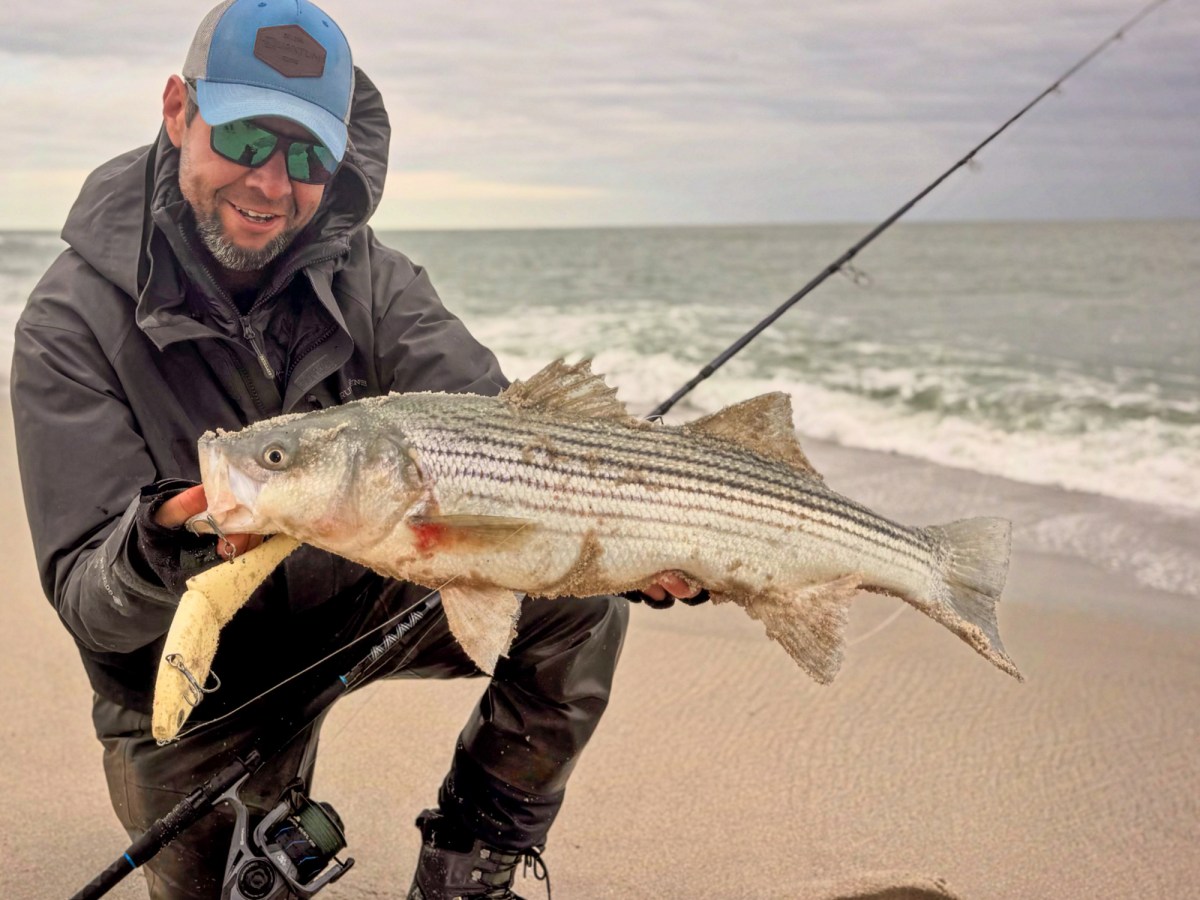
If you have just a little bit of fishing prowess, there’s a strong chance you can be dropped on any lake, river, stream, or pond and you’ll figure out where the fish are hanging out. There are, after all, so many visual cues like boulders that break the current, trees laying in the water, or visible holes and pockets. But unless you’ve already got a lot of experience fishing in the surf, even the best anglers can feel utterly lost standing on a beach trying to figure out where to cast. There’s no doubt, reading a beach can be complex and require time, but there are always jumping off points that can get you on track faster.
My friend Bill Wetzel is a veteran surf fishing guide based on Long Island in New York. He has decades of experience fishing jetties, inlets, and the open beach, and has taught countless new anglers how to be successful in these locations. Though getting truly dialed in can take time because all beaches fish slightly differently, his pointers for starting out will make it easier to score victories earlier whether you’re after stripers in the Northeast, bull reds in the Mid-Atlantic or Gulf, or snook down in Florida.
Listen to this episode of the QuickStrike podcast on Apple, Spotify, or wherever you get your podcasts.
Current Situation
According to Wetzel, what inexperienced surf anglers consider the least is current, and this makes a lot of sense. The ocean is so immense that it’s easy to forget that it’s also moving, especially right along the beach because of tidal influence. Geography, location, and a host of other factors will determine exactly how that current flows, but on any given beach or at any given inlet, there will be current moving up or down the beach. To find the fish, it’s critical to know exactly how that current is moving in your location.
“To be clear, the direction the tide is moving does not always determine which way the current is flowing along a beach,” says Wetzel. “As an example, if you’re fishing near an inlet, the current may still be pushing in even though the tide is going down because the bay on the other side of that inlet is still filling up and drawing in water.”
Figuring out which way the current is moving can help you determine which direction roving fish will travel along the beach. While there are plenty of apps for monitoring tide cycles, these will not tell you if the water will be moving left or right on the beach you’re fishing at any tidal stage. Wetzel says dialing this in requires you putting eyes on the location, then choosing exactly where you should fish based on that flow considering factors like which way the current will pull any forage.
Wind & Water
Success in the surf revolves around windows. It’s extremely rare for any piece of beach to produce action all day. More commonly, there is a bite window at some point during the tide. Perhaps it’s when it’s moving at exactly the right speed to make it difficult for a forage fish to swim but predators to easily catch them. It could be when the tide is exactly the right height for fish to enter a trough close to the beach. But the question Wetzel hears more than any other is, “when’s the best tide?” The answer is, there isn’t one.
“The best tide is going to be different in every spot you fish,” he says. “Low tide in one area might make it impossible for the fish to be there, but in another it will expose a piece of structure where the fish can set up. Then you also have to consider the wind.”
Wind direction on the beach can great affect—and predict—the action. As an example, on much of the East Coast, a west wind, even a hard one, will make the surf glass calm, which can attract forage fishing looking to get out of rougher water offshore right to the beach. Conversely, a hard east wind can push forage offshore away from the beach. Wetzel says when it comes to checking winds and tides, he leans solely on the National Oceanic and Atmospheric Administration’s data.
Hole in One
As with most types of fishing, you’re looking for an attractive anomaly in the surf that’s appealing to your target. In freshwater that could be a rock that’s bigger than the rest, or the shade of a lone tree overhanging the water. In the surf, you’re looking for a deeper bucket, trough, or sand bar, and if you know what to look for, the waves will point them out.
“You want to find cuts and troughs within the surf because they act like highways for fish and bait,” says Wetzel. “One way to figure out where they are is to watch for waves that flatten out before they reach the beach. If a wave suddenly tapers off, it’s usually because it just encountered deeper water. Or you’ll see the water ‘burp,’ as I like to say. A wave will wash through, and you’ll see the water behind it kind of lift or swell up.”
Read Next: The Best Lures and Live Baits for Striped Bass
Critical to understand is that big fish are often a short cast away. Many people assume you have to cast as far as possible all the time on the beach when in reality, predators like striped bass and redfish can be right at your feet. Whether you’re working lures or soaking bait, if there is a trough a quick flick away from where you’re standing, fish it.
Read the full article here