
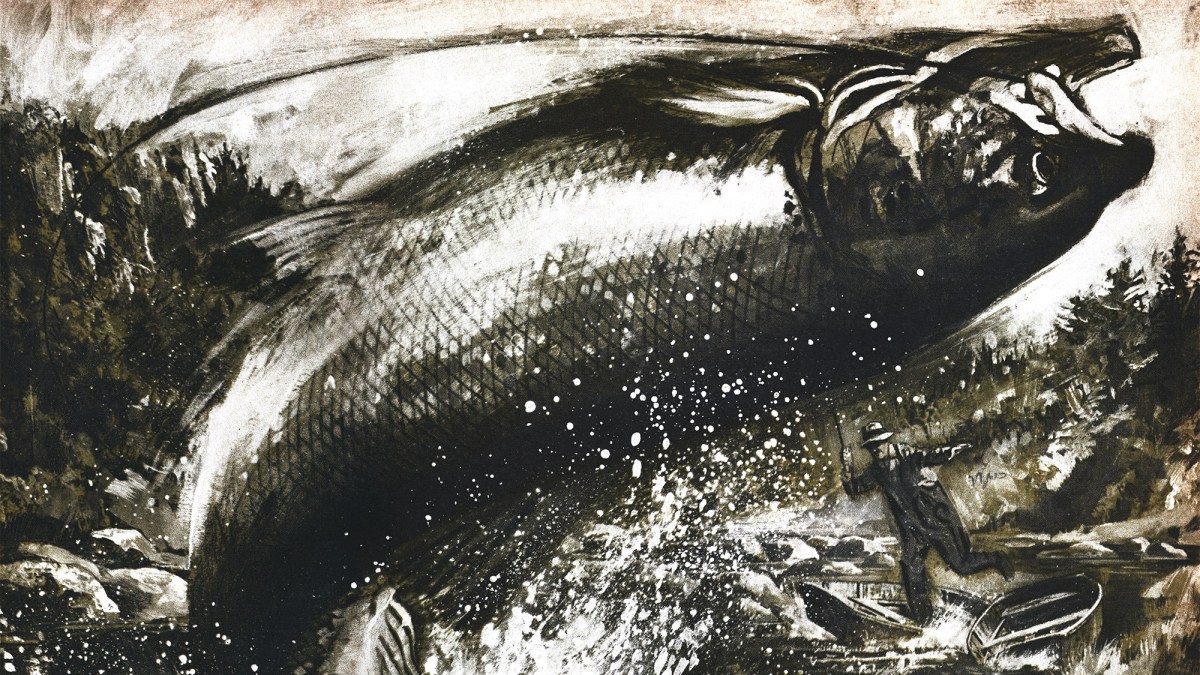
This story, “The Bulls of St. Mary’s,” appeared in the July 1965 issue of Outdoor Life.
Morning mist partly obscures the river as I wait for the legal opening hour of 6 a.m. before I start fishing. This is the St. Mary’s River in Guysborough County, Nova Scotia’s top Atlantic salmon river the past few years, and this is my first try of the 1964 season. I glance at my watch. 5:55 a.m. So far I am the only one at the Fjord Pool. The sun starts to break through the river fog, and I’m glad about this, because salmon rarely take when there is fog on the water.
Another fisherman comes down the bank. He asks if I’ve had any luck.
“Haven’t fished yet,” I say. “It lacks two minutes of opening time.”
This doesn’t bother him. He splashes right out in front of me and starts flailing the water. I move out of the way of his backcast and wait, watching the river for some sign of fish. The fisherman moves his splashing way down the pool. It has never ceased to amaze me how some people can make so much noise when they wade; great ripples move across the pool from his exertions.
I tie a No. 4 Cosseboom dry fly to the end of my six-pound-test tapered leader and give it a ducking in my bottle of paraffin wax and naphtha gas, the homemade dry-fly solution of salmon fishermen. The upper part of the pool has quieted from the angler’s antics, and I decide to start fishing. I wade out until water is about halfway up my armpit waders, and then I wait a minute before starting my dry fly floating down the pool. In that moment, a salmon does a porpoising roll in the placid pool about 30 feet below me and out about 60 feet from shore.
Read Next: How My Wife Outfished Me and Our Guide During the Glory Days of Northwest Salmon Fishing
I move downstream until I’m just above the spot, then shoot my G-A-F tapered line out toward it. My first cast is just short, and I let the Cosseboom dance its way below the spot. Then I apply back pressure to my nine-foot fiberglass rod and lift the fly off the water, bringing my wrist back with a hard snap, and then driving my arm ahead and letting go of several coils of extra line to gain distance. I cast a fly something like a baseball pitcher throws a ball, not always pretty but quite effective.
This time the fly lands just above the spot and floats its way down. No sign. I pick the fly off the water and try again. Ten casts right on his nose. Darn stubborn fish. Is he going to show or not? The suspense is getting me.
Then on the twelfth cast, up he comes, splashes water over the fly, half drowning it, but not taking it. A misrise. I let the fly continue its partly submerged float before lifting it off the water. If I strike and rip the fly off the water when he hasn’t taken it, he may get scared and not show again. I false cast for about half a minute to dry the fly off, then I set it down above him again.
His dorsal fin breaks the surface just after the fly goes past him. I lift it off the water, false cast half a dozen more times, then set it down again. He comes up in a slow roll, mouth open, and goes down — he and my pretty Cosseboom. I set the hook and feel solid resistance.
I put a good bend in my glass rod, check the drag setting on my reel, and wait. He shakes his head several times, accelerates up the pool, taking about 50 yards of line, and then comes out in a clean jump which sends showers of spray glistening in the early morning sun. He goes back to the head-shaking for a minute, then comes downstream fast. I crank madly and keep a steady strain on him. As he gets opposite me he bores deep, then comes out in another shower of spray. I guess him to be about 12 pounds. He makes a mad rush across the river and then heads down the run, by the ledge toward Castle Rock Pool.
My reel makes a high-pitched whirring sound as line streams off the drum. I release the tension drag a quarter of a turn, since the lower the line gets on the reel spool the more tension it takes to pull it off, and this could build up to a point where it would break my six-pound tippet. Without an adjustable drag, this often happens.
Related: 3 Simple Dry-Fly Tricks That Catch More Trout
About 100 yards of line has gone off my reel in this mad downstream rush, and I start following him, reeling in as I go. I always feel better when the last of my backing and the first few turns of fly line get back on the reel.
Now I get down opposite him again, and by keeping the pressure steady and turning the reel slowly I’m able to bring him in to about 30 feet from me. He’s starting to tire but is far from played out yet. Another short run and another jump.
At this point, my unknown and completely forgotten friend gets into action. He had been fishing just below me, and had turned around just in time to see my salmon break water.
“What was that?” he yells.
“A salmon,” I answer.
He starts toward me at a half run, casting as he comes. I prepare to duck, but his fly misses me and winds around my line about 20 feet from my rod tip.
“Hey, what do you think you’re doing?” I yell.
“Trying to catch that fish.”
“Well, you’re going to have some job, because I’ve got him on.”
With that, he gives his rod a yank. Somehow his fly unhitches from my line and sails into the arms of a waiting thornbush back on the riverbank. I breathe a sigh of relief and work my fish downstream into a little inlet, and there I slide the gaff through his gills and lift him up on the bank.
He’s a beautiful, fresh-run fish, just over 11 pounds on my scales. I tie a thong around his tail to carry him by, because a salmon’s gills usually tear out if you try to carry it that way. I head back upstream to the Fjord Pool and pass my friend still busily engaged in untangling his line from the thornbush. “It’s a nice day,” I say. There is no answer.
As I round the bend in sight of the Fjord Pool, I see three fishermen have arrived. They inquire about my salmon. What type of fly did he take? How many times did he jump? How long did I have him on? I try to answer truthfully.
The sun is now shining brightly and I decide to leave for greener pastures, or at least for a pool with fewer fishermen. The next pool upriver is the Lynds Pool, four miles above the Fjord Pool. As I drive along I think of a 20-pounder I caught there last year and of another fish that broke my leader by fouling it on the bottom.
OL Sticker Collection

See It
When I arrive at the Lynds Pool there is no one fishing; I have my pick of the best spots. This pool is composed of three runs with islands in between. Since the water is medium high, most of the salmon will be taking the middle run.
I wade across the top of the first run and start to fish. The water is quite swift here and is usually better wet-fly water than dry. I tie on a No. 2 Silver Wilkinson wet fly, cast down and across the run, and let the fly swim around in a half circle.
On the third cast, something hits the fly hard. I raise the rod tip and find I’m fast to a sea trout of about a pound. I slide him up on the sloping beach, thinking I will have him fried for lunch in about an hour’s time. Then I continue fishing a step and a cast, a step and a cast trying to cover all the water. I work down toward a submerged rock, and as the fly comes around behind it, the water boils and my rod tip snaps down sharply. No trout this time, by golly.
The thought hardly goes through my mind when my reel pipes a high crescendo. I lose about 75 yards of line and a salmon comes flashing out in a high jump.
“Go to it, you old silversides,” I yell.
He goes down to the bottom and sulks. I raise the rod, put a good tension on the line, and pound on the rod butt. This sends a shiver down the line, and he takes off again. I work him down to the end of the island, and after two more jumps he turns up on his side. I put a steady pressure on him and he swims his way right onto the sloping gravel bar. I like to beach a salmon this way, but conditions must be just right. This is a nice bright fish of about nine pounds.
The sun is very bright now, and it’s going to be one of those warm days we sometimes get late in June, and since I’m going to be here for a few days these fish will have to be put in cold storage at Sherbrooke.
I’m 40 years old and I work as a police sergeant in the town of Truro, about 200 miles from the St. Mary’s and not far from half a dozen other good salmon streams. I caught my first Atlantic salmon when I was 12, and ever since then I’ve been an ardent salmon fisherman. I try to maneuver my vacations and days off so I can get in a good deal of time fishing during the season. Last year I took 30 salmon, which represent enormous satisfaction.
Sometimes I take my wife and family along for a few days of camping and fishing, but since we have seven children, three girls and four boys, this is no small feat. It requires two tents and a station wagon to house us.
This time, however, I was on my annual trip during the third week in June, when the first big run of salmon comes through. I’d gone down for a week alone since none of my usual companions could get away. But I never feel lonely on the St. Mary’s, for the people one meets there are the salt of the earth and very hospitable.
After putting my fish in refrigeration at Anderson’s store at Sherbrooke, I return upstream to some picnic tables for lunch. The river is dropping so I tie some smaller dry flies for the next day’s fishing. One dry fly is to play a special role. It has a bright green body ribbed with oval, silver tinsel, a fox-squirrel wing, and a light-yellow hackle.
After spending the night in my station wagon, I go to the Fjord and Castle Rock pools. Other fishermen are there, but this usually isn’t a problem on the St. Mary’s. A rotation system is used by those accustomed to fishing there. One fellow starts at the top of a pool, and works down to the bottom, then another starts and does the same thing. This way everyone has an equal chance to fish the pools. If a stranger comes along and stands rooted to one spot, someone will gently instruct him as to the method used.
There are three fishermen ahead of me so I sit on the bank and wait my turn.
I enjoy watching other fellows fly casting. These men are all using wet flies, and I decide to try the previously mentioned dry fly. I dunk the fly in my gas-and-wax mixture, snap it out dry, and start drifting it down the Fjord Pool. No salmon move for either the wet flies of the others or for my dry, and we work downstream to the Castle Rock Pool.
A heavy current comes out from the ledge on the far side of the Castle Rock Pool and then broadens out about 30 feet below. The salmon usually lie at the tail end of this flow.
A hundred yards of line strips from my reel before I can turn him, and then he runs toward me so fast I can hardly keep a tight line.
I am working downstream a slow step at a time, my dry fly dancing down the flow, when suddenly a salmon comes charging into the air in a long jump. He hits the water about six feet from where he comes out, my rod tip snaps over sharply, and I’m fast to a fish in one of the most unusual dry-fly rises I’ve ever seen. Evidently he has taken the fly in his mouth while coming out of the water, and when he goes back the belly of the line dragging in the current sets the hook.
He runs up toward the ledge, then starts downstream. Out he comes in a high jump, makes a short run, then jumps again. Approximately 100 yards of line strips from my reel before I can turn him, and then he runs toward me so fast I can hardly keep a tight line on him.
I just start getting the end of my fly line through the tip guide when he’s off on another wild, plunging run. Fifteen minutes later I work him into shore and one of the other fishermen gaffs him deftly through the gills.
I sit on the shore and watch as these other fellows fish down the pool again, then I start working my dry fly down the flow below the ledge. Did I see a movement in the water below my fly? I cast again. The fly dances along for a few feet, then a salmon’s head comes out, he engulfs my fly, does a porpoising roll, and disappears. I set the hook, and upriver he goes in a skittering jump, then in and out twice more.
Read Next: The Best Trout Rods, Tested and Reviewed
He turns downstream, and I crank madly to keep a tight line. He races past me, the line cutting the water with a little swishing sound, and then comes out in a high leap and falls back on his side with a loud smack in a flurry of foam. The fellows below me reel in their lines and get out of the way. After a few more jumps and runs, he rolls up on his side, and I slowly work him into the mouth of a little brook where I pick him up by the tail and lift him ashore. Both this fish and my other one are in the 10-pound class, beautiful, full-bodied salmon.
So far I haven’t encountered any large salmon. The St. Mary’s is noted for its big fish, and many salmon between 20 and 30 pounds are taken each year. A lot of these larger salmon enter the river during May and the early part of June on high water, and run straight through to Melrose Lake, where they stay until the next rise in water. Then they head up the East River above the lake. It looks blank for big fish on this trip unless there’s a good rain to bring them out of the lake.
Again I take my fish to Anderson’s Store, and then I head upriver for the Mitchell Pool where I plan to spend the night. I fish Mitchell that evening, but see only one salmon. He makes a pass at my No. 4 Black Bomber wet fly, but misses it and I can’t find him again. As the shades of evening fall, I catch three sea trout on a fly I’ve tied with a body of radiant-red floss, a wing made from the tail hairs of a Canadian pine squirrel, and a brown hackle. Then I retire to my station wagon, boil a pot of tea, and climb into my sleeping bag to dream of enormous salmon ascending tumbling waters.
The squalling of a blue jay wakes me. It is 5:30, time to climb into my waders and go down to the river for a bucket of water. There’s nothing more invigorating than a wash in cold river water at 5:30 a.m. I start my camp stove and put on the teapot and pan. Bacon and trout for breakfast.
Shortly after 6 I start fishing. A beautiful morning, the sun hasn’t yet risen above the trees. The Mitchell is the most beautiful pool on the St. Mary’s and it is the least fished. The water has a nice flow for either wet or dry-fly fishing. I’m using a No. 6 Silver Gray Bomber since the water has dropped overnight. On my first trip down the pool I see the wake of a fish move after the fly, but he doesn’t show again though I cast over him two dozen times.
I move down to the bottom of the pool, above where a small brook comes in, and catch two sea trout about a pound apiece. I’m almost ready to move back up to the top of the pool when a salmon roars after the fly, hooks himself, takes off downriver in a long run, and then comes out in a high jump — a fish of five or six pounds. A salmon this size is fast and does a lot of jumping but hasn’t the stamina to last long. Five minutes later, I slide him onto the gravel bar at the mouth of the brook.
I notice several sea lice on his back beside the dorsal fin. Although the river is dropping, fresh fish are still coming through. Sea lice live only about 48 hours in fresh water.
I go back to the top of the pool and change to a dry fly, an orange Cosseboom on a No. 6 hook. I work down to where the salmon made a pass at the wet fly on the first trip and, suddenly, there he is. His back fin breaks the surface after the fly has floated past.
I wait a minute and cast again. He shows below the fly just as the current catches the line, causing the fly to drag, and he turns short of it. I wait another minute then cast again with more slack in the line for a longer float. He makes no mistake this time. Up he comes like a porpoise, engulfs the fly, and dives out of sight in the turbulent water. I raise the rod tip sharply and feel his weight against the line. He moves slowly up the pool shaking his head, then accelerates rapidly and jumps.
This is a nice fish, probably 15 pounds or more. He turns downstream and heads across the river. My fly line and two thirds of the backing disappear from the reel. He goes almost to the far shore and jumps. I lower the rod tip to give him some slack; back he comes and then heads downriver at a fast clip. My backing is almost gone, so I move downstream after him.
He’s really moving now. The double-click drag on my reel changes from a low growl to a high-pitched scream. I race down the shore trying to keep up, then cross the brook at a dead run in a shower of spray. He’d better stop soon because I’m getting winded. It’s 20 years since I played football (at Acadia University, Wolfville, Nova Scotia), and I was not conditioned for 100-yard dashes wearing chest-high waders.
However, this battle doesn’t last long. An ugly snag, looking like last year’s Christmas tree, has reared itself out of the water about midstream. He goes beyond this, my line catches on a branch, and the leader breaks with a loud crack. I reel in the slack line.
I barrel-knot a new piece of six-pound-test leader to replace my shattered tippet, then wearily retrace my steps to the top of the pool.
In the next two hours I catch a salmon of about eight pounds and a large grilse of about five pounds, both on an orange Cosseboom. This being my legal limit of three Atlantic salmon, I propose to tie some flies and then perhaps catch a few sea trout. Shortly after lunch, storm clouds blow in and by midafternoon it’s raining hard. If this rain keeps up long enough to raise the river, the chances of catching a big fish should be good. It’s still raining hard that night when I drop off to sleep.
Morning dawns gray and dismal, but the rain has almost ended. A look at the Mitchell pool convinces me that it’s useless to fish there, and I head upriver to the East branch above Melrose Lake. There should be some big fish that came through with the high water the first of the week. Now with the water rising, they should move up out of the lake and head for some of the pools on the river’s upper reaches.
The McKeen Brook Pool is one of the best high-water pools. Some other fellows have the same idea, but the pool is not overcrowded, and we rotate as we fish. I fish the McKeen Pool several times, then move down to the Bungalow Pool just below.
The clouds are breaking away, and the sun puts in its first appearance of the day. It’s 10 o’clock and no one has seen any fish. I decide to eat lunch early and then fish through the noon hour when the other fishermen are away.
On returning to the McKeen Pool after lunch, I find only one angler present. He works the pool down in front of me using a large wet fly. A good caster, he covers the water well.
The river is still rising but clear. I decide to rig up a heavier rod and use a reel holding more backing. Should a large fish be hooked in this water, a long line will be necessary. I choose a 10-foot, split-bamboo rod with extension grip, a four-inch reel containing 150 yards of 25-pound-test backing and 40 yards of G-2A-F fly line. Onto this I tie a new 12-foot tapered leader with a 10-pound tippet.
What fly to use is a problem. All the fishermen I’ve seen today have been using wet flies, and so have I. Perhaps a large dry fly will produce. I choose a fly tied the previous afternoon on a No. 1 Limerick hook. It has a black-wool body ribbed with oval, silver tinsel, a wing of gray squirrel hair, and a large cinnamon hackle. I tie this to the leader and dunk it in my dry-fly float.
Starting at the head of the pool just below the brook I work downstream. The fly floats like a cork. There is one spot at the lower end of this pool where big salmon sometimes lie. It’s a depression in the riverbed dug by sea lampreys on their spawning run, and it’s about 75 feet off my rod tip. I keep lengthening line as I approach this spot, and at last the fly floats over it.
So suddenly I’m not sure what happens, the surface of the pool erupts, my rod tip snaps down, and I feel the weight of a heavy fish. I lift the rod to give it a good, springy bend and wait for his first antics. He moves slowly up the pool, then circles toward me heading downstream. He comes out in a high jump, silver sides gleaming, then plunges in and out of the water three more times as he races downstream. My fly line has long since gone twanging through the guides, and my backing is getting uncomfortably short. I move downstream as far as possible to where a small inlet blocks my path.

I increase pressure trying to turn him. Finally, with the reel spool visible beneath the backing, I get him started upstream, pump and crank, pump and crank. At last my fly line comes in through the tip guide, but only for a minute before he’s off in another wild, plunging run. My line supply decreases with distressing rapidity. I’m going to have to go with him. There are two boats parked in the inlet, and by stepping from one to the other of these I’m able to gain the far side where I try to catch up with him.
About 50 yards below me a water fence is built out into the river to keep cattle from straying. My fish is well past this, but I’m going to have to hurdle it. Holding my rod high with one hand, I climb over, tearing the seat out of my waders on a sharp knot as I slide over the top. With about 500 feet of line out, my fish has obligingly decided to sulk.
I work down the shore cranking madly to get some footage back on the reel. When I get down opposite, I tighten up on the fish and bang on the rod butt several times. This starts him moving and he heads upstream and jumps, then turns downstream going fast, but this run is shorter.
We are now at the Bungalow Pool, and he seems content to battle it out here. He surges across to the far side of the pool, and at the end of this run rolls up on his side. He’s tiring fast, but my arm is starting to ache with the strain. I bring him in closer, he starts another short run, then rolls on his side again.
I move out into the stream until the water is just above my knees and transfer the rod to my left hand. I hold it well back, and with a steady strain I work him in until his tail is fanning just in front of my knees. I reach down carefully, grab him firmly by the tail, and walk ashore. He lies there quiet as a baby, a beautiful salmon that later tips the scales at 24 pounds.
I glance at my watch. This contest has taken just over 30 minutes. It’s time to go. This trip is nearing its end. But, even with the end so near, my thoughts turn ahead to preparations for another trip when the water recedes a bit.
Anyone wanting to fish for salmon on the St. Mary’s can do so with ease. Good hotel and motel accommodations are available at or near Sherbrooke, only a five or 10-minute drive from the best pools. Competent guides are available at a nominal fee, and the bite for a nonresident fishing license is only $5.
Read Next: No Other Fish Has Divided Anglers Quite Like Landlocked Salmon
This was the favorite salmon stream of the great Babe Ruth, and it produces a lot of salmon — over 1,000 in 1964.
Just one word about equipment. Any good fiberglass or bamboo rod in nine, 9½, or 10-foot length capable of handling G-B-F or G-A-F line is adequate. The reel should have a four-inch-diameter drum capable of holding at least 100 yards of 20-pound-test backing and 40 yards of fly line, and preferably have an adjustable drag. You’ll need tapered leaders in nine or 12-foot lengths with tippet test of 10, eight, or six pounds for varying water conditions. Flies can best be obtained from the various guides. Chest-high waders are adequate for most pools, though hiring a guide with a boat is an advantage on some, since he can put you in the best position to cast over a fish. He can also lend extra help when the fish is hooked.
Read the full article here