
- Hand Tools
- Animals
- Water Wheel
- Windmill
Which of these can be realistically adopted now on a small homestead?
Hand Tools
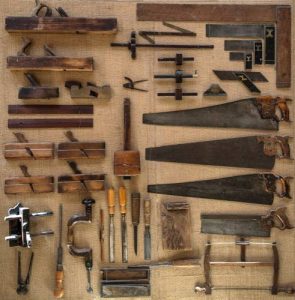
All historical cultures that I am aware of used hand tools and many of the tools that they used can be, and still are, used on homesteads today. Using tinkering and cultural memory, they discovered how to use planes, levers and other technology, in most cases without understanding the laws of physics that explained why they worked. They invented the sewing needle, sewing awls, spinning spindles, looms, knives, axes, adzes, scythes, spear throwers, bows and arrows, drills, abrasives, adhesives, waterproofing, fire starters, and many other tools.
Hand tools still see daily use in homes and homesteads the world over. Modern textile manufacturing and tractors may have changed which tools currently see the most on homesteads, but any of several threats could change that, thrusting the homestead back into the 1800’s once the available fuel runs out or breaks down.
Either way, our ancestors have used hand tools for six million years and counting and as long as humans walk the Earth, I imagine we will continue to use hand tools.
The Romans … and Others
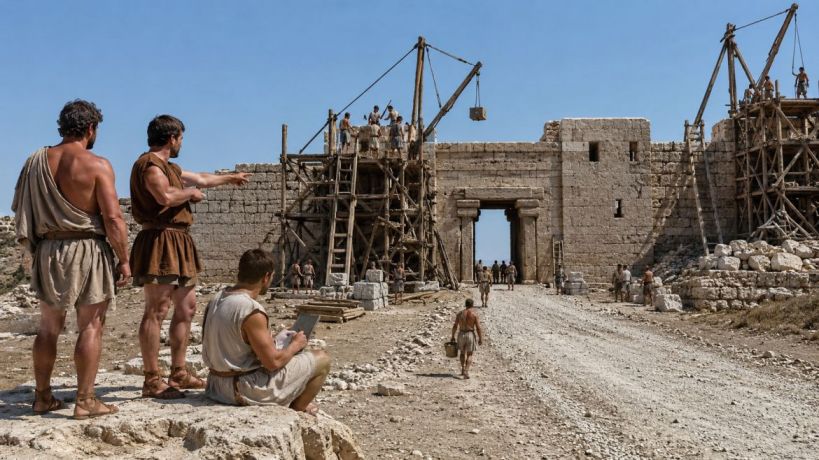
In addition to the hand tools listed above, the Romans also used workbenches, holdfasts, planes, saws, and other woodworking tools. (Schwarz, 2017) They also had advanced metalworking tools, surgical tools, masonry tools. They even invented advanced concrete that we have only recently been able to duplicate.
If you put a Roman woodworking toolkit or surgical kit next to a modern one, a professional would recognize many of the tools, although they would only know by the names of their modern reinventors.
The way Romans applied their passive solar building technology was arguably more advanced than the way we apply it today.
A prime example is how Roman law regulated the length of eaves on buildings, by latitude, to shade the walls in the summer and let the sun to shine on the walls to heat them in the winter. What determined the length of the eaves on your home? The answer for most people is that the mainly serve to keep rainwater off the walls and other than that, their length is arbitrary.
The Romans also passed legislation that prohibited builders from blocking a neighbor’s sunlight and thereby cooling his home in winter and preventing him from growing food. Many homes would benefit from passive solar building practices today, but we throw more central heating and cooling power at the problem instead.
It is impressive how much Roman architecture still exists 2,000 later. There probably won’t be any trace of the typical modern home in one thousand years, much less in two thousand years. Even our concrete structures won’t last like theirs did because we reinforce them with steel and iron, which rust and eventually end up destroying buildings instead of reinforcing them, but we don’t typically build things to last centuries or millennia. We simply don’t think in the same terms, timewise, as our nation is only a couple of hundred years old.
Interestingly, I saw a Roman archaeological site called Conímbriga, near Coimbra, Portugal which included Roman thermal baths and a “house of fountains” plumbed with ceramic pipe. When archaeologists hooked a pump up to the elaborate fountains, they were astonished to find that they still worked!
But it was not only the Romans who were so advanced. Many cultures have endured long enough to invent all the technology necessary to progress to Agricultural Revolution and then on to Industrial Revolution throughout history. This process took place in ancient Mesopotamian, Persian, Egyptian, Chinese, Greek, Roman, and Mayan cultures.
The necessary science has been discovered, lost and rediscovered many times. Who can say that it won’t be lost and rediscovered again? (Dartnell, 2014)
Animal Power
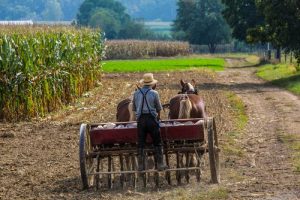 Most historical cultures also used domesticated and used at least some animals. Dogs, lamas, donkeys, mules, horses, oxen, camels and elephants have all been used by man. For thousands of years, man has used animals for their noses, prowess as hunters, superior situational awareness, carrying capacity, pulling power and their other talents.
Subsistence hunter/gatherers used dogs to hunt and some tribes that lacked large beasts of burden also used them as pack animals, sometimes pulling travois, or as sled dogs. Both human and animal power were used to lift water and to power early building cranes.
American pioneers who could afford them preferred oxen to pull their wagons on the journey west as they could pull more weight and were worth more at the end of the journey. The poor, including some of my own ancestors, pulled handcarts west across the plains.
We certainly use animals on homesteads today, but do we still need animal power?
Only in the last century or so did horses and other draft animals really begin to be replaced by the automobile. My grandparents started their lives riding horses, not driving cars. Without WWII, the process would have been greatly slowed. But as we learned in parts of the South pacific in WWII and parts of Afghanistan in the GWOT, even with trucks, and later helicopters, there are still remote places in the world where animal power trumps the combustion engine.
On homesteads today, animal power is mainly used by the Amish, for cattle ranching in remote areas, to maintain trials, to pull dog sleds in remote homesteads in or near the arctic, and simply to keep the old ways alive.
The Water Wheel
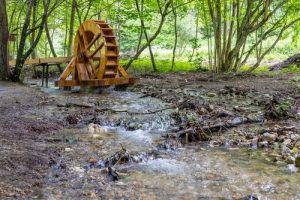 Water wheels have been in use since at least the 4th century BCE and small numbers are still in use today. (Wikipedia, Water wheel, 2026)
If you happen to live on a homestead with a river or stream suitable for driving a water wheel, it can be used to drive a grain mill, sawmill, trip hammer, lathe or even an entire wood shop or machine shop, provided you can find belt driven equipment or modify modern equipment to be driven by belts.
Determining which type of water wheel will best meet your needs requires analysis and water wheels require maintenance, but properly maintained, they can provide power or generate electricity 24 hours a day, something solar panels and wind turbines cannot do without storing electricity in a battery bank.
If your homestead is on a river suitable for a micro hydro installation, you have hit the alternative energy jackpot. Modern micro hydro generators are dependable, produce electricity day and night, and even installations often generate enough electricity to supply multiple homes with electricity.
Unfortunately, homesteads suitable for water wheels are rare in the western USA, and those suitable for micro hydro development are even harder to find, but if you own land on a suitable stream or river back east, either technology could save you from having to cut down trees that would shade a solar array, which could make a water wheel or micro hydro installation an appealing option.
The Windmill
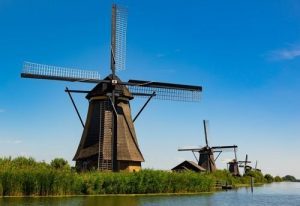 The first practical windmills came into use between the 6th and 9th centuries, but wind-powered machines have been around since much earlier, at least as far back as the 17th century BCE, making wind power another ancient technology that is still in use today. (Wikipedia, Windmill, 2026)
Windmills were used in northwestern Europe starting in the 12th century and eventually spread throughout Europe to areas where there was too little water flow to build mills powered by water wheels. Most windmills were eventually replaced by steam mills but a few still operate commercially today.
In the USA, the self-regulating windmill, a design in which the vanes would fold in high winds to prevent damage, was patented in 1854. (Pflug, 2026) Windmills soon dotted the landscape and could be heard creaking as they pumped well water into storage tanks. Pipes then delivered the water to farms, ranches, stock tanks and railroads. In the Western USA, many homesteads would not have been viable without them.
Windmills are still manufactured for pumping water and aerating ponds on homesteads today, but many homesteaders now rely primarily on solar for their off-grid water pumping needs.
Whether or not a windmill or wind turbine makes sense on a particular off-grid homestead depends on how much wind you get versus how much sunshine you get and weather you are have a suitable site for a micro hydro or water wheel installation, how much power you need, and the intended application.
Wind turbines generate electricity. On many homesteads, micro hydro and water wheels are not possible due to regulations or lack of suitability. Because wind turbines supply power outside of peak sun hours, at night, and on cloudy days when solar arrays deliver little or no power, homesteaders sometimes benefit from adding them to their alternative energy systems.
Summary
Hand tools, animal power, water wheels, and windmills have all been leveraged to get work done and, under the right circumstances, they all can be, and sometimes are, still used today!





References
Dartnell, L. (2014). The Knowledge: How to Rebuild Our World From Scratch. New York: The Penguin Press.
Pflug, G. (2026, May 19). Windmills. Retrieved from dumasmuseumandartcenter.org:
https://www.dumasmuseumandartcenter.org/windmills.html
Schwarz, C. (2017). Roman Workbenches. Port Mitchell, Kentucky, USA: Lost Art Press.
Wikipedia. (2026, April 14). Water wheel. Retrieved from wikipedia.org:
https://en.wikipedia.org/wiki/Water_wheel
Wikipedia. (2026, April 23). Windmill. Retrieved from wikipedia.org:
https://en.wikipedia.org/wiki/Windmill
Read the full article here