
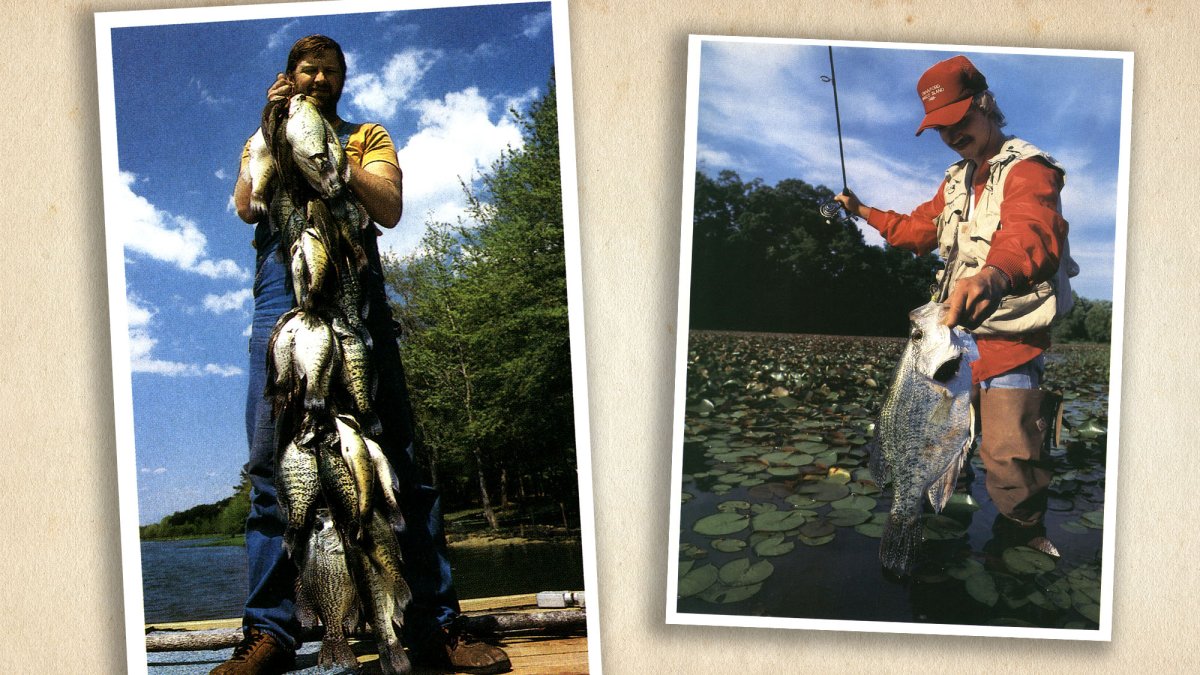
This story, “Tactics for Spring Spawners,” appeared in the May 1989 issue of Outdoor Life.
“You catching any crappies John?” yelled my fishing buddy, Robert Holland. We were fishing along a little stream that runs across a road just outside of Rome, Georgia.
“Not yet,” I yelled from my spot 50 yards upstream. Probably the worst thing that one fishing buddy can tell another is that he’s not catching fish when he is — and I had caught a lot of fish. I couldn’t wait to see Robert’s eyes pop out once he saw the size and number of fish I had taken from this small spot on the edge of the bank. Although the peninsula of land jutted out only three or four feet into the stream, the spike broke the current and created an eddy hole on the downstream side. By casting a small cork with a ½4-ounce jig upstream, I let my line wash around the peninsula and into the eddy. On every cast, a crappie in the one to two-pound range sunk the cork and zinged the line.
After I had about 30 crappies, I yelled upstream, “Hey Robert, why don’t you come on down here? I think the fish are about to start biting.”
When Holland arrived, I received the tongue lashing that I deserved. I was forgiven, though, when I let him move to the end of the peninsula where he could catch fish.
We must have caught 100 fat fish that afternoon, and I learned a very important tactic for catching spawning crappies. The first water to warm during the spring often be in small creeks and tributaries that feed major reservoirs. On their way to spawn, big crappies will follow the warm water up into the creeks, then search for eddy holes in which to rest before they continue their journey. If you can find an eddy hole in a small feeder stream where the water temperature is 1° to 4° warmer than the lake temperature, you can bank-fish and quickly limit out on crappies.
When he lifted the lid to his 48-quart cooler, I saw slab crappies stacked almost to the brim.
Anglers who want to get a head start on spring spawners are not limited to fishing from shore. Another lethal strategy on spawning crappies is one I learned from Red Cotton, a 75-year-old angler from West Point, Mississippi, who uses set-outs. Cotton’s set-outs work much like a duck hunter’s decoy spread. Cotton utilizes beaver sticks to lure and hold passing crappies until he can catch them.
“I put beaver sticks, which are four to six-foot-long poles that the beavers have stripped of bark, in the mud bottoms of shallow coves that have little or no cover,” explained Cotton. “Where crappies normally spawn, 1 set out the poles—usually about 15 yards away from the bank and 10 to 12 yards apart so that the tips of the sticks are visible above the water. Just before, during and after the spawn, I usually take one to two crappies around each beaver stick in a day of fishing.
“A crappie will associate with a beaver stick and protect that stick from other crappies. These fish are generally the biggest crappies in that area — maybe these fish chase the smaller crappies away from the sticks. The stick also provides an ambush point for the crappie, so when the crappie sees a small jig swimming by that stick, the fish will attack it.” Cotton uses a B & M Buck’s graphite pole with four feet of eight-pound-test line and a 1/32-ounce jig. Twitching the end of the pole, Cotton makes the jig hop as he swims the bait around and up and down the set-outs.
One advantage to fishing set-outs is that most other anglers don’t. Many sportsmen think that set-outs won’t hold crappies because the cover they provide appears to be so sparse. When I fished with Cotton, though, I found out that even though beaver sticks don’t hold the number of crappies that other spots may, the one or two crappies you do catch around each stick are almost always big. To catch more big crap-pies, an angler merely makes more set-outs.
Fishing eddy holes from the bank and using set-outs to decoy crappies are primarily light-line techniques, but big crappies also can be caught by using titan tactics in shallow water during the spring. Once while fishing an oxbow off a major river, I noticed an angler fishing from a boat in about two feet of water. The fisherman was using an 18-foot cane pole with about two feet of the tip broken off so that the pole was as stiff as a pool cue. When he pulled his bait out of the water, I noticed that his round red-and-white bobber was only two inches from the eye of the hook, which held a lively shiner. I motored over to see whether or not he was catching any crappies. When I asked if he was taking many crappies in such shallow water, he replied that he was catching “a few.” When he lifted the lid of his 48-quart cooler, I saw slab crappies stacked almost to the brim.
Related: The Best Crappie Lures for Catching Slabs from Spring to Fall
“When crappies are spawning in shallow water,” he explained, “they lie beside logs and stumps, looking for minnows swimming by just under the surface. Knowing this, I often will fish next to logs that are lying in shallow water. I catch the fish that other crappie fishermen either can’t reach because their boats are too big or won’t visit because they believe the water is too shallow to hold crappies.”
After seeing that ice chest full of crappies, I started shallowing up my cork. “If you’re going to fish this shallow water,” the angler added, “break off a foot or two of your cane pole. You need enough stiffness in the rod to jerk a crappie away from a log before it can get underneath it and break your line.
You also need to move the fish quickly because the faster you get it from the log, the less it will disturb the water and spook crappies that may be holding in the same area.”
During the spring, when crappies are going to the bank to spawn, most anglers catch papermouths in shallow water by using either jigs or minnows. According to biologists, however, not all crappies spawn at the same time, and each crappie doesn’t drop all her eggs the first time she moves to the bank. A female crappie will make several trips between shallow and deep water before she lays all her eggs. There are always some crappies, therefore, in deeper water during the spawn.
Ruby Hughley and Reba Yurgin are crappie fishing guides on Tennessee’s Kentucky Lake who have proven that bigger crappies often will be holding in deeper water just off the bank throughout much of the spawn.
“A few years ago, Ruby and I found a secondary creek channel that dropped from three to five feet about 120 feet from a spawning flat,” Yurgin told me. “Although this small channel was so insignificant that most other anglers wouldn’t fish it, there were some underwater stumps on the edge of the old creek bank that we spotted with our depth finder. We trolled along the little ditch with a number of poles rigged with three to four feet of line and ½4 or 32-ounce jigs, and we regularly caught more and larger crappies than the people who were fishing visible cover next to the bank-even during the spawn.”
Joe Wilson of Columbus, Mississippi, fishes for crappies in even deeper water during the spring because he believes crappies call deep water home. Sometimes they’ll move into shallow water — especially to spawn – but these movements are temporary.
To locate deep-water river and creek channels and the cover on them, Wilson uses a Humminbird LCR depth finder. He fishes with an eight-foot-long Buck’s Classic graphite crappie pole and minnows.
“I prefer using a shorter pole like the Buck’s Classic,” Wilson said, “because I can fish directly under the depth finder’s transducer, which is mounted to the foot of my trolling motor. When I use this technique, I can see the cover I’m fishing while I’m fishing it — even though the cover is submerged. I like the soft tip of this crappie pole because it bends and presents the minnow to crappies more effectively than an ultralight rod; yet I have power in the middle and butt of the pole to break the crappie away from cover and pull the fish in to the boat. By fishing the creek and river channels, I catch more and bigger crappies year-round.
Read Next: Flipjacking: We Uncover the Lost Art of Cane-Pole Fishing for Bass
“One of the problems associated with spring crappie fishing is finding the paper-mouths when a cold front hits,” he continued, “or when the water temperature rises and the spawn is over because these are the times when crappies leave the shallows. By fishing the river and creek channels, how-ever, I can catch all the crappies I want—no matter what the weather conditions.”
Sometimes anglers use new tactics to take fish because they believe that the old techniques no longer work or that they don’t work as well as the newer methods. When crappies are in shallow water either near or at the bank, though, two basic strategies have always provided fish and will continue to do so. They are drop-fishing down the bank and fishing the heart of thick cover.
Even a clean bank may have underwater rocks, roots, limbs, stumps and so on two to six feet from the shore. This cover can be so small, so close to bottom or in such shallow water that a depth finder won’t show it. Crappies find and then hold on these types of cover. Simply drop-fishing with minnows down the bank while using a sculling paddle or a trolling motor will enable you to fill your cooler with many crappies.
Read Next: Video: Never Fillet Bluegills Again, Use This Method Instead
Another strategy that works when the fish are at the bank is fishing the heart of the thickest visible cover you can find. One reason why some fishermen consistently catch more crappies than other anglers is that they know how to outfish the competition. Many fishermen won’t put their baits in spots where they’re afraid of getting snagged. These places, however, are where the larger crappies hold. You must be willing to break lines, straighten hooks and possibly break a pole to catch crappies. Fish the cover by dropping a minnow or a jig through its thickest part and thoroughly working the brush.
In most parts of the country, crappies are now spawning. By using these fishing strategies, you can also wrestle more slabs this spring.
Read the full article here