
On May 7, cancer succeeded in doing what Illinois mobsters, the People’s Army of Vietnam, the Viet Cong, and various Middle Eastern terrorists, failed to do, by ending the life of Philip Caputo. Phil, like Ernest Hemingway, was a major American writer who loved the outdoors, particularly hunting, and wrote about it. Field & Stream was lucky enough to have him grace its pages in many issues. One of his finest contributions, “The Old Man and the Mountains,” is below.
In his 84 years, Caputo wrote about everything. He began as a reporter for the Chicago Tribune in 1968 and won a Pulitzer Prize in 1972 for exposing political corruption. He continued for the Tribune as a foreign correspondent until 1975, covering most of the really unpleasant places in the world, and survived both a kidnapping by terrorists and a bullet in the ankle. He covered the fall of Saigon in 1975, and then retired from reporting to write full time. In the course of his career, he produced 19 books, both fiction and nonfiction, as well as magazine articles that are probably beyond count, and he was much in demand as a lecturer and commentator.
But what he will be remembered for is A Rumor of War, which was published in 1977, and is the account of his combat tour in Vietnam as a Marine Corps infantry officer. It’s been translated into 15 languages, has sold 2 million copies, and is the story of a journey from idealism to bitter disillusionment. Rumor, virtually since its publication, has been acknowledged as one of the two or three greatest books on Vietnam.
Phil was a man of extraordinary courage and limitless talent. May he rest in peace; God knows he’s earned it.
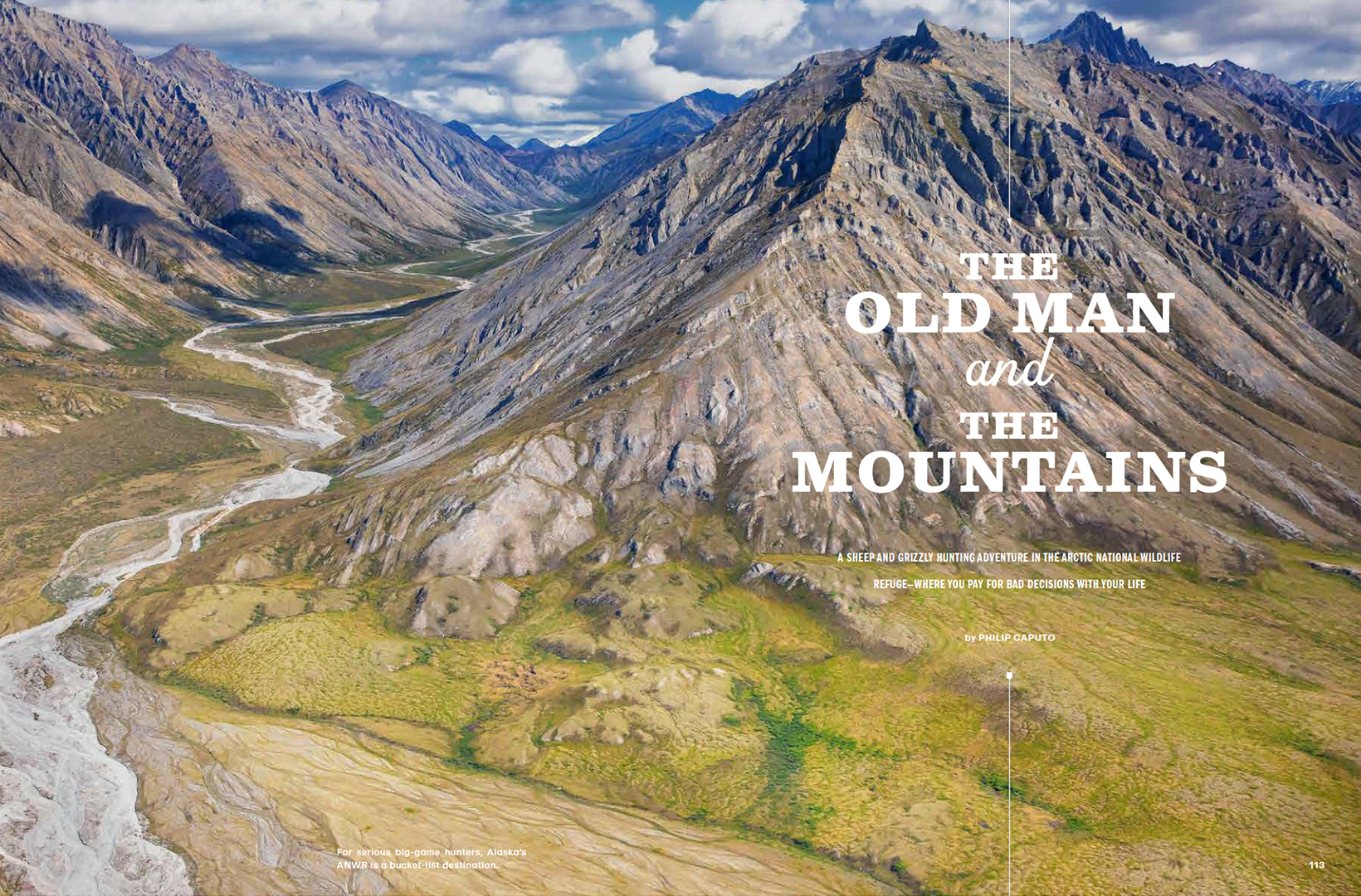
The Old Man and the Mountains
By Philip Caputo
(Photo/Rod Gardner via Adobe Stock)
To the unaided eye, it was a white boulder, poised on a knife-edged ridge a mile or more up the canyon, but Benson didn’t recall seeing it there when he’d scanned the ridge only moments ago.
“We have sheep, a ram,” he said, adjusting his binoculars. I raised mine and saw the animal, legs tucked under his body, his head with its whorled horns held utterly still. He seemed to be studying us as intently as we were him. Certainly, he was capable of seeing every twitch we made—the Dall sheep of Alaska has eyesight almost as keen as the 8X lenses we were looking through.
Moving with exquisite care, Dave Marsh crept to his spotting scope. It revealed that the ram’s horns were only three-quarter curls, meaning we could not shoot it. Only rams with full curls are legal game. The news was not entirely a letdown. There was no way we could have approached the wary animal without alerting him. Besides, it was only the first day of a 12-day hunt, and the first day of any hunt is like the first day of a honeymoon—disappointment seems impossible.
“He could have others with him, higher up or on the back side of the ridge,” said Marsh, who was guiding Benson and me. “No point in spooking him. If he gets spooked, they’ll all be gone. We’ll head up that way tomorrow and see.” We were in the Arctic National Wildlife Refuge, in the easternmost Brooks Range, America’s ultimate mountains—ultimate in the sense that it is the last mountain range in the country. Like a bent rib, it runs at a right angle to the spine of the continent, curving east to west for 600 miles across far northern Alaska.
The Brooks are the wildest mountains you will find anywhere. Through their canyons and high passes, the last great caribou herds on Earth make annual pilgrimages to the coastal plain, gathering in such numbers that the tundra itself seems to be in motion. Moose browse among sparse willows fringing nameless creeks; the barren-ground grizzly lumbers across alpine meadows with an imperious tread; the gray wolf howls beneath the boreal fires of the northern lights; and Dall sheep graze on pastures that look almost vertical.
I had tramped and rafted through the mountains for three weeks in 1995, exploring and fishing for salmon, and had returned the next year to hunt with three Alaskan friends. I shot a bull caribou, and two of my companions bagged grizzlies, but sheep eluded us. On our second-to-last day, we saw a sight that would live with us always: snow geese marshaling for their migration to wintering grounds in California and New Mexico. In wedges so thick as to resemble low-flying clouds, they soared over us for hours, their calls as much a melody of wilderness as the wolf wails we’d heard earlier in the trip. I had been looking forward to a bath and shave after two weeks without either, but the Brooks Range had cast its spell. I promised myself that I would return the next year.
Everything from work to family obligations to money (or lack of it) kept me away. Finally, as the century turned, I called Marsh, asking to book a Dall sheep hunt for the following season, when I would turn 60. It was going to be a landmark birthday present to myself. Sorry, Marsh replied, he was booked up till 2003. I hesitated. By that time, I would be 63, an official, card-carrying Geezer. I had learned something about hunting mountain sheep in Alaska: It is a younger man’s game. I gave Marsh my answer: Yes.
On a mid-August morning, I met up in Fairbanks with Trey Benson, a trim, athletic 43-year-old from Dallas. He and Marsh had been high school classmates in Kentucky, had lost touch with each other for many years, and then were reunited at a gun and trade show, where Marsh had set up a booth advertising his outfitting company. He had no trouble talking his old friend into booking a trip. Benson earns his living as a salesman for an employment screening firm, but hunting is his avocation.
I was a little nervous about spending nearly two weeks in the bush with a stranger, and I’m sure my partner was too. We were pleased to discover that we hit it off right away. Benson was my kind of hunter—he loved wild country and had a naturalist’s curiosity about it.
We flew from Fairbanks to the Gwich’in Indian settlement of Fort Yukon, where we were picked up by Kirk Sweetsir, a voluble bush pilot with a master’s degree from Cambridge University. An hour and a half later, having passed over 200 miles without seeing a town, road, or fence, the Cessna touched down at Marsh’s base camp—a cook tent and three one-man mountain tents pitched on a tundra fell above a river I’ll call Kate Creek.
There, we took care of preliminaries. Marsh set up a target to make sure our rifles were properly sighted in to hit 3 inches high at 100 yards, which puts them dead-on at 300, roughly the average range at which sheep are shot. That done, we were issued our hunting tags—sheep for me, sheep and bear for Benson. A lecture on how to use the satellite phone and radio—in case Marsh met with a mishap—was followed by a dinner of pork chops and rice. Next morning, we set off toward our first spike camp, a 4-mile trek to a willow bar.
The Mythic Kingdom
Four miles in Alaska is worth 10 anywhere else. With some 48 pounds on my back, I felt every yard and staggered in 15 minutes behind my companions. At Marsh’s urging, I had conditioned myself for several months prior to leaving: sit-ups, push-ups, and long hikes three times a week carrying a 40-pound pack and an 8-pound length of pipe to simulate a rifle. It should have been enough, but there comes a point in life when you’re not as old as you feel but as old as you are. Therefore, I had to ask myself, Why are you doing this?
The answer lay in an observation once made by John Voelker, alias Robert Traver, author of Anatomy of a Murder and Trout Madness. Asked why he fished for trout, Voelker replied that he liked to be where trout were. So I was hunting sheep because I wanted to be where sheep were.
The second morning brought a dense fog, and because you can’t shoot what you can’t see, we hung around camp until it burned off. Over an austere breakfast— coffee and a cup of oatmeal with raisins— Marsh entertained us with tales of his adventures. I should point out that he guides in Alaska about three months of the year—one month in the Brooks Range for sheep, caribou, and grizzly; the other two in the southern part of the state for brown bear and moose. He spends the rest of the year managing a family farm in Kentucky. A wiry man in his early 40s with curly brown hair and glasses that make him look more like a high school teacher than a grizzled sourdough, Marsh is a colorful= storyteller, spicing his narratives with sound effects. His terrifying tales of going in after brown bears wounded by clients were punctuated by imitation snarls, roars, and gunshots.
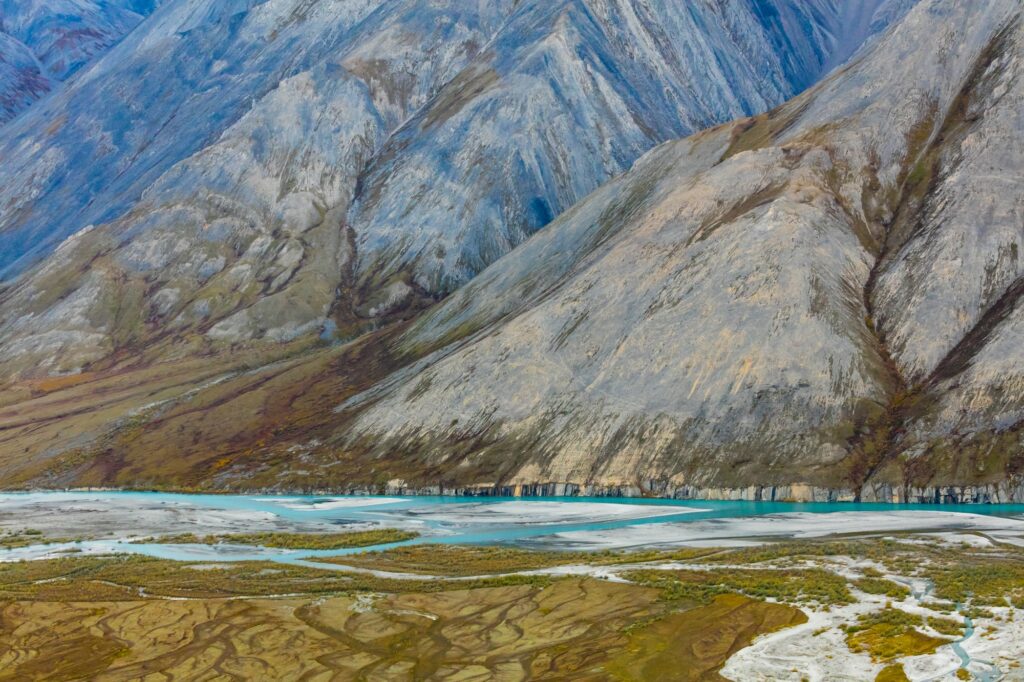
The fog lifted around 10. Shouldering rifles and packs, we tramped some 2 miles up a drainage paved with more rocks than there are stars in the heavens: big rocks, small rocks, smooth rocks, sharp rocks, round, square, and triangular rocks, rocks upon rocks, an ankle-bending ordeal. The braids of a nameless creek twined through the geologic rubble, disappearing underground for a spell, reappearing farther on, the canyon narrowing as it climbed between scree- swept slopes, the slopes rising toward crags and spires that, partly veiled in mist, looked like fortress walls guarding some mythic kingdom. Finally, we reached the base of the ridge where we had seen the ram with the three-quarter curls.
A short but steep climb brought us to a low rock face, the scaling of which provided some mild adrenal stimulation. We then crossed a moss-covered meadow striated by caribou trails. It ascended gradually toward the rim, with fields of shale sliding away on both sides and gorges plummeting below those. The consequences of a misstep being obvious, I took care about how and where I placed my feet. Some three hours after leaving camp, we came to the spot that had been occupied by the young ram. We saw his tracks and droppings, but not him.
Having consumed roughly 200 calories for breakfast and burned 10 times that much apiece, we pounced on a lunch of brick cheese, candy bars, and pemmican. The bones of a moose that we’d come upon in the drainage below were the topic of discussion. What had a moose been doing in that canyon, where there was nothing for it to eat? “Probably trying to get out of a winter gale,” Marsh speculated. “He figured he’d get out when the weather broke. Maybe it didn’t break, and he starved to death, or wolves got him. This country doesn’t forgive bad decisions.”
I didn’t consider his and Benson’s next decision, to climb to the rim for a look-see, a bad one for them, but it would have been a bad one for me. I was whipped and, figuring I ought to save myself for the next two days, elected to wait. The east wind had a bite to it. I took shelter behind a granite slab and glassed the surrounding hillsides, and basked in the silence and solitude, the forbidding beauty of unclimbed peaks stabbing broken clouds.
In time, I began to hallucinate sheep. An estimated 30,000 Dall inhabit the Brooks Range, and one-third live within the Arctic National Wildlife Refuge. You would think I would see at least one ram.
Hard Times
Sheepless still, we struck out for a new spike camp to the south. Bears appeared in the distance—a sow and two large cubs, ambling across a tundra fell. The sight of grizzlies always brings a certain tingling to the scalp and spine, and given the female grizzly’s reputation for defending her young with awesome ferocity, it was just as well that those three were well over a mile away. The sow was a beauty, with honey-blond fur that glistened in the sunlight, but she wasn’t fair game.
Over the next three days, we felt as if we were filming an episode for Survivor. A chill rain blown by a hard wind turned to sleet, the sleet to snow. Six inches fell one night, the sky cleared in the morning, then another storm rolled in. We crouched around willow-stick fires that gave off only a little more heat than a cigarette lighter. We slept shoulder to shoulder, three men in a tent built for two. We stalked up river basins that seemed to invite us into the mountains, while the mountains themselves seemed to warn us to keep out.
We returned to base camp to find the cook tent and our mountain tents collapsed under the weight of ice and snow. After setting things to rights, Marsh told me that my bottle of Scotch had been knocked off the table and smashed on a rock. Then, as I looked like a man informed that his dog had died, he produced a metal shot glass brimming with whiskey and had a har-har at my expense.
Death Valley
The sun came out, the sun vanished, and freezing rain lashed across the Kate Creek valley. In such weather, the Brooks Range becomes a formidable place. Soaring abruptly from the river basins, peaks as gaunt and sharp as flint arrowheads frowned through the enshrouding mists and talked to me: You, little man, travel here on my terms, not yours, and I can kill you any time I choose.
As we trudged up a slope to glass for game, Marsh observed that I was struggling and offered some advice. “You’re fighting this country,” he said. “You’ve got to roll with it because you’ll never win. Best you can do is break even.” I wanted to tell him that it wasn’t the country I was fighting—it was my years, another battle I couldn’t win.
We saw ewes and lambs grazing on a mountainside across the valley, but no rams. Our one reward in the game department was a lone musk ox bull, a fairly rare sight. Exchanging our rifles for cameras, we stalked down to the creek and managed to creep within 40 or 50 yards before he knew we were there. I don’t think he’d ever seen a human being, for he simply stopped to gaze at us with a kind of curiosity in his dark eyes.
With his hide a deep brown, his mane a pale brown, his shining horns curving down the sides of his head like a pointed helmet, he looked prehistoric out there among the low willows in the long Arctic twilight. I imagined the first Ice Age immigrants to America gazing at such a beast and felt privileged to have gotten so close.
The weather decided we’d had enough of the soft life and changed the sleet to snow once again. Hypothermia is the killer that stalks the Alaskan bush, and Marsh cautioned us to keep ourselves and our gear dry. “You do not want to get behind the eight ball out here,” he added for emphasis. “That’s how you lose instead of break even.” Then he regaled us with uplifting stories about hunters whom blizzards had buried alive in their tents.
Death March
Trey Benson spent a restless night, waking every hour on the hour to knock the slush and snow off his tent. I slept well for whatever reason, dreaming of game. I dreamed about bears, but no sheep appeared to my sleeping mind. In the morning, I spoke of my visions and told Benson, who had a grizzly tag, that I believed he would get his bear, and I was right.
At noon, a bright sun broke through, warming bodies, lifting spirits, and we packed up to head for our third spike camp—a 13-mile trek up Kate Creek, then 2 more up a side drainage. Marsh yarned about the sheep that previous clients had bagged in this area, and frankly I was getting irritated. Next thing, I thought, he’ll be telling us we should have been here last week. I wasn’t desperate yet, but with the hunt past the halfway point, I was getting there. Three moving white specks on a far slope to the north brought on a revival of hope. The spotting scope gave us another boost: They were rams, but so far away and so high up it was difficult even for Marsh to judge the curvature of their horns.
“One of them might make it,” he said cautiously, and then planned the stalk. A ridge topped by crenellated rocks rose between us and the rams. We would use it to mask our approach, then climb it and let it be our shooting platform. We dropped our gear beside a narrow stream and began.
This stalk nearly proved to be a death march for me. First, we had to cross half a mile of tussock tundra. To do that, you must hop from one unstable tussock to the other, frequently slipping into the muddy crevasses that separate them. Higher up, the soil grew firmer, but then the ridge loomed at a pitch resembling the roof of a Swiss chalet and to a height that brought two dread words to mind: cardiac arrest.
Marsh went up as if, in years of hunting sheep, he’d absorbed some of their DNA. Benson was just at his rear, but I fell way behind. My companions reached the top when I was only two-thirds of the way there. My heart rate was well into triple digits. Gasping for air, my legs quivering. I sat down as a precaution against ending up in the obituaries. The view was stunning: Kate Creek far below, running on amid its gray gravel and green willow bars, snow-crowned mountains to the south, as nameless as when they were sculpted by the hand of God.
I stood and had climbed another 50 yards when Marsh came hopping back down, waving his arms to tell me to stay put. No good, he said. The rams had moved out of range in the hour it had taken us to make the stalk, and the best one wasn’t quite legal anyway—a seven- eighths curl. I was actually relieved.
“Dave,” I gasped.
“Yeah?”
“I’m beginning to think I’ve bitten off more than I can chew.”
He slapped me on the back, whether to agree with me or to encourage me I didn’t know. Nor did I ask.
The Bear
In deference to my fatigue, Marsh decided not to press on to our original destination, but to pitch camp where we’d left our packs. While we set about our domestic chores, we spied the three rams, plodding single file up a gray mountain, up and up until they vanished into the clouds, the incarnation of all that is unattainable and all the more desirable for it.
The decision to stay put proved lucky for Benson. In the early evening, displaying an energy I found astonishing, he slogged to a knoll about half a mile away to glass for bear. Marsh had told him to signal if he spotted one. He’d been gone less than an hour when we saw a bright orange panel appear on the hillside. Marsh went off to join him, while I stayed behind and had a ringside seat for the unfolding drama.
The bear came shambling across the tundra beneath the knoll, its light fur shining so that it looked as if it were illuminated from within. Marsh and Benson were crouched low as they moved behind the willows picketing a creek bed. With the wind in their favor, they made a textbookperfect stalk before they got into position, 60 to 70 yards from their quarry. The bear wasn’t aware of their presence. Benson rested his 300 Weatherby Magnum on his pack, laid atop the creek bank.
The grizzly ambled along, pausing to scrape the tundra for roots. Willow bushes between it and the two men were blocking a clear shot. It was some 400 yards from me, and I could see its face clearly through my binoculars, its striking blond fur mixed with an array of darker browns. It was a beautiful animal.
Twenty minutes passed. The bear turned broadside to Benson. Now, shoot now, I thought, and wondered why he didn’t. As I found out later, Marsh had told him to wait until he, Marsh, made some judgments about its size, the shade of its hide, and other factors that affected its qualities as a trophy. Also, he’d observed it was a sow, and he needed to estimate her age, to make sure she wasn’t in her prime breeding years.
Twice during this wait, the bear faced the concealed hunters and half rose to her hind legs, as if she sensed danger but wasn’t sure. At last, she turned broadside, and I saw her fall hard onto her belly a fraction of a second before I heard the shot—a flat, echoing crack. The sow whirled around, lunging with her forelegs toward the thing that had struck her from out of nowhere. Even through binoculars, I could sense her rage and shock. Benson fired a finishing shot. The bear went down again, thrashed for a second or two, and then lay still.
Despair Comes Calling
Dall ram country is hard, remote, and almost inaccessible, because only in such terrain does the ram feel safe from wolves and bears, who aren’t willing to climb treacherous slopes for a meal. Only armed Homo sapiens are dumb enough to endure what it takes to kill a ram. With only two days left, the winds of despair were beginning to erode the soil of my optimism.
We hunted hard, covering some 10 miles up and down three canyons that spread out from the main drainage like the claws of a chicken’s foot. Marsh had never been in those parts, so we were likely the first human beings to set foot in them.
The region was as desolate as it was remote—granite mountains almost entirely bare of life, hardly a patch of moss or lichen. The bones of fossilized fish were painted like rock art on the boulders of the riverbeds. Streams of black shale poured down the sides of ridges that crested out in sheer, broken cliffs resembling the skylines of ruined pueblos.
“How would you describe this?” Benson asked me.
The adjectives that came to mind were: Barren. Lifeless. Bleak. Austere. Disheartening. Harsh. Stark. I answered, “All it needs to be another planet is an unbreathable atmosphere.”
The final day brought a sky innocent of clouds and a warm sun. Our socks and boots had gotten semidry beside last night’s fire. Marsh spied a pair of rams high up on a mountainside, under a pinnacle that looked a little like the Statue of Liberty. One wasn’t legal size, but he wasn’t sure about the other because its head was hidden in the pinnacle’s shadow. For an hour, hugging the canyon side to stay out of sight, we moved closer, pausing to glass the rams, waiting for the second to show himself. I felt a stab of irrational hope. After a long stalk and a long wait, Marsh got a good look at the second ram—a three-quarters curl. I gazed at the bad news through the spotting scope. The rams did make a splendid sight, aloof and aristocratic, surveying their domain, but how I wished they were a year or two older.
“I knew it would be fairy-tale stuff to score on the last day,” I said.
The long march back to base camp, conducted the following day, left me feeling like a washout from Navy SEALs BUDS camp. Disappointment warred with relief that it was over. In my memory flashed images of the two rams resting 1,000 feet above us; of the three filing into the clouds. Next year, one or more might be legal, but would I be capable of hunting them? I was aware of a fragility that hadn’t been in me on my last journey through the Brooks Range, seven years ago—a sense that my body was offering diminishing returns.
A grand bull moose showed up at twilight. Marsh estimated his rack at 5 feet, and he stood 7 feet at the shoulder. Moose aren’t legal game in those mountains, so we made a stalk just to get a closer look at him. Perhaps mistaking us for a wolf pack, he changed direction, passing within yards of camp, then splashed into the willows bordering Kate Creek and continued his solitary pilgrimage to God knows where.
An hour later, the northern lights came out over the mountains to the south—trembling curtains of pale green. I watched them and thought about the moose and the musk ox and the bear that had stood before me and the rams in their high dominions and figured all that would have to do. And it did just fine.
Note: This classic feature originally ran as a two-parter in the February and March 2004 issues of Field & Steam. This version, edited for length, ran in the Fall 2024 Wilderness Issue.
content_big-game-hunting,content_hunting,content_stories

THE 1871 CLUB

Recommended Products
Read the full article here