
This story, “The Ghost of Shelby Forest,” appeared in the May 1971 issue of Outdoor Life.
I had been sitting in my tree stand 15 feet above the ground for nearly two hours, but it seemed like two weeks. The early-morning cold was beginning to creep inside my hunting clothes, and the numbness of my feet warned me that I could not stay in the stand much longer without impairing circulation.
The light was improving a little now. The fog had lifted to the highest branches of the trees, and the eerie sound of a barge whistle came wailing in from the Mississippi River some two miles to the west. The squirrels that were sharing their beech tree with me were having an early breakfast, and it was hard to tell whose teeth were chattering louder, theirs or mine. The sweet spicy aroma of the freshly cut beechnuts smelled very pleasant as the thin flakes of shells filtered down through the sparse leaves like fine brown snowflakes.
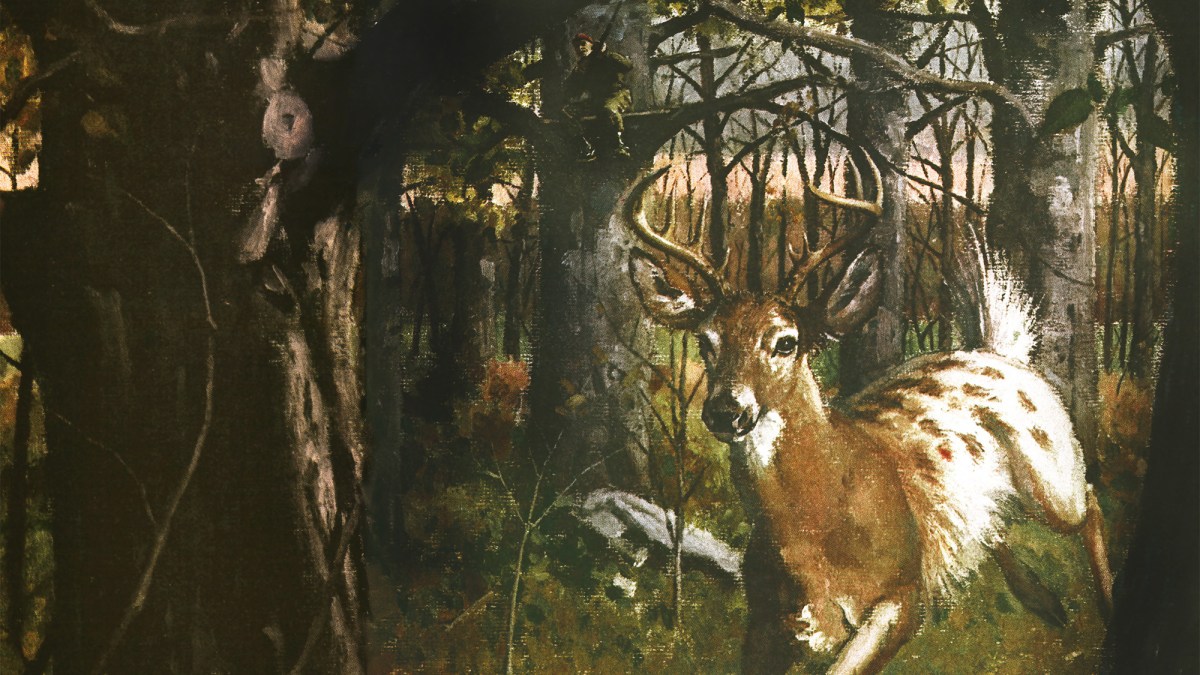
My legs were dead stumps. I knew I couldn’t bear this position any longer. I had to move a little and work my arms and legs to get my blood moving again. But before I did, I wanted to be absolutely sure that no deer were in the area. Very slowly I scanned the woods again — the persimmon trees to my left, the soybean field directly ahead, the cottonwood grove on the right. Suddenly a glimmer of light caught my eye. Then I saw a slight movement through the trees. I brought the 3 to 9X variable scope slowly up to my eye, and there he was, the most beautiful animal I had ever seen! It was Old Whitey, the legendary ghost of Shelby Forest. I was hunting north of Meeman Shelby Forest in western Tennessee. It was November 19, the second day of the state’s firearms deer season. A sudden cold snap had sent the temperature to near freezing, and the deer were moving.
The afternoon before, I had shinnied up this big beech tree and built a makeshift stand by placing a 2 x 8 board across two large limbs and fastening it in place with some baling wire. Later in the evening, as I sat in my snug little nest overlooking a much-used deer trail, two full-grown does had come down the trail and passed close to my stand, pausing a moment to sniff the air and to listen for any sounds of intruders in their domain. Seeing the does in the area made me hopeful that a buck might be close by and that he would use this same trail in the morning.
So here I was, sitting in the stand once again, with Old Whitey sighted clear in my scope. I could make out the white patches on his rump, and they brought back memories of all the stories I had heard about an appaloosa-marked buck that ranged the 12,500 acres from Meeman Shelby Forest to private property surrounding the hunting preserve.
When hunting alone, my decisions and my wits are all I have to worry about. If I goof, I have no one to blame but myself.
Though several hunters had reported seeing this deer and even shooting at him during managed hunts in the forest area, no one had yet been able to bring him down. Most of the sightings had taken place in and around the north end of the management area.
I’d got my first glimpse of Old Whitey three years before, during a squirrel hunt early in the fall. I had spotted the white deer for a fleeting instant as he crossed a road dividing the managed area and the private property. Until that time, I had taken all the tales I’d heard about him with a grain of salt.
I’m 36 years old, and my father and I have an electrical-contracting business in Millington, Tennessee, a small town near Shelby Forest. The business me many opportunities to talk with landowners. Like the day I made a service call at a farmhouse on River Bluff Road.
The job was to replace a burned-out element in a hot-water tank. While waiting for the tank to drain, I struck up a conversation with the farmer. He was an old-timer, and he was complaining about how hard it is nowadays to make a living off the land.
“If it ain’t the bugs eatin’ up your crops,” he said, “it’s them durn deer trampin’ ’em to pieces.”
He went on to tell me about how he’d planted pumpkins in his cornfield in hopes of making some “cash money” around Halloween time.
“But I’ll swear to you, son,” he said, if a durn deer ghost didn’t come through there and stomp nearly all of them punkins to death.”
I sympathized with him and asked him how he knew the deer was a ghost.
“Cause I seen him, that’s why,” he answered. “And I shot him, that’s why. He stood right there a-facing me as close as that barn over there, and I put a twelve gauge slug into his chest, and he nary blinked an eye. He just stands there looking white and wispy like cotton. Then he snorts and tears out through my punkins hell-bent to squash all of ’em. Yep, he’s a ghost all right, and a big mean one at that.”
So on and on the stories went — some of them ghostly, some of them more down-to-earth. But the descriptions of the ghost were nearly always the same — a large white buck with a huge rack. He was smart and elusive and had never been knocked down by a hunter’s bullet.
One Saturday afternoon I stopped by Thweatt’s Country Store on Rankin-Branch Road. Deer season would open in about a week, so the tale-swapping was going hot and heavy. Stories about Old Whitey were way out ahead. But if I’d been handing out a prize for the best, it would have gone to the owner of the beagle hound that used to run deer as if they were rabbits:
“He’d run ’em in a big circle … might take him all day and half of Sunday, but he’d bring ’em back so close to you, you could spit in their eye. If I still had that dog I’d get that white buck, even if he is a ghost.”
I was brought into the conversation and asked why I didn’t head a party of my hunting friends and set out to get Old Whitey. I made excuses. Not that I don’t like the guys; it’s just that I have always hunted alone. I love the feeling of being in the woods by myself. It relaxes me after I’ve crawled around in hot attics and damp basements all day.
OL Arrowhead Buck Sticker
Browse the Collection
When hunting alone, my decisions and my wits are all I have to worry about. If I goof, I have no one to blame but myself. If I sit in a stand for three days in miserable weather, dying for a smoke, freezing my tail off, and not seeing anything on four legs but an old scrawny bluetick hound, then I tell myself off: “Dale, you nincompoop! You really know how to pick a spot.” I don’t have to listen to someone else say it. I talk to myself, to the trees, to the varmints, and to my gun. They don’t give me back any sass.
A few autumns ago I decided to combine my squirrel hunting with trying to locate Old Whitey’s range. I knew that he had been sighted only in the north area of the forest, so I concentrated on the private property bordering that area. Most of the landowners gave me permission to hunt. And I don’t blame the ones who refused me. Each of them had suffered a bad experience, such as brush fires or loss of livestock, because of thoughtless hunters.
I know that deer can’t read, but I came to the conclusion that when the hunters moved into Shelby Forest, Old Whitey moved out and ate persimmons and tender winter wheat under and around the Posted and No Hunting signs. So with a mental map of where I could hunt and where I couldn’t, I searched for trails leading from the forest. I concentrated on the land between the forest and the posted properties.
Before the season opened I was dead sure I had found Old Whitey’s high-way. It cut across a heavily wooded pie-shaped acreage about 600 yards wide, from a grassy field at the forest’s boundary to a fenced-in soybean field bordered with scrub timber. The trail was well-used, but the tracks were old. I guessed that the deer came this way only a couple of times a year. When the controlled hunt started in Shelby Forest, they moved out. Then when the statewide hunt opened, they went back into the shelter of the forest.
When the season opened in November, I was in my stand 10 feet up in a big willow oak. I sat in that stand for 15 days of the season. The weather was miserable — freezing rain and sleet that western Tennessee is notorious for. I watched at least 14 deer walk that trail, and I burned out three pairs of electric socks. I saw little deer and big deer, young ones and old ones, girl deer and boy deer, brown deer and not-quite-so-brown deer. Only once did I see a patch of white hide. When I first spotted it my heart jumped and I nearly fell out of the tree trying to get the animal in my scope. But what I thought was Old Whitey was just an old billy goat browsing his way home.
I know that deer can’t read, but I came to the conclusion that when the hunters moved into Shelby Forest, Old Whitey moved out and ate persimmons and tender winter wheat under and around the Posted and No Hunting signs.
On the last day of the season a nice four-point 150-pound buck came down the trail and I brought him down. I figured that if I waited until the last minute for Old Whitey to come along, my freezer would be empty for the first time in 10 years.
A few months later I discovered one reason that the wise white deer had become a legend.
I had been turkey hurting and was taking a shortcut out of the bottom-land. As I walked across a shallow creek that ran less than 100 yards south of and parallel to the trail where I’d had my deer stand, I spotted a well-used buck rub. Right out in the middle of that creek the smart old buck had rubbed his antlers on a small willow tree and then prissy-footed on his way along the creek, protected by the high, densely covered banks on both sides.
I stood there red-faced, in water up to my ankles, and gave Old Whitey all the credit. I was no match for this buck. I would try to outguess him no longer. But just in case he should make a mistake, I decided to do all my deer hunting in the north-road area only.
And now here he was, about 130 yards off, coming down a cottonwood grove that was too thick to shoot through, even though I was using a 180-grain slug. An indescribable feeling of excitement came over m.e, as I guess it comes over every hunter at least once in his life when all the stalking and planning is over and his quarry is in his sights. My mouth was dry, my heart pounded loud in my ears, and I felt that if I took a breath it would be heard all the way to Nashville.
Looking out in front of the buck, I spotted a small clearing that he would pass through if he didn’t change directions. I sighted the scope on the clearing and waited for him to step into the field of view.
“Come on, boy, move. Just a little farther … “
I threw the safety off and took up slack on the trigger of my .308 Winchester Model 100. The crosshairs of the scope met the buck’s shoulders. I squeezed the trigger.
The recoil bucked my shoulder as I looked to see the results of my shot. To my dismay, the buck lifted his flag and bounded off through the cottonwoods. Because of the thick trees and the impossible task of trying to find the running deer in my scope, I couldn’t get a second shot. I hung my head and tried to recall the last few seconds and what I had done wrong.
After sitting in the stand and mumbling to myself for about 30 minutes, I decided that I could not have completely missed the deer and that I had waited long enough. I figured that if he hadn’t seen or smelled me he may not have traveled far. I unwound my chilled, cramped legs, climbed down from the stand, and walked over to the clearing where the buck had been when I shot.
At first I couldn’t find any signs of a hit, but after some careful examination of the area I discovered a bit of blood.
“Hey, Gun, what you think about that? A ghost that bleeds.”
A little farther down the trail I found a somewhat larger drop of blood.
“Dale, old boy, it’s a good thing you’ve got your walking shoes on. It might be a long day.”
Knowing now that I had hit the animal, I was determined to find him, or at least to convince myself from the sign that he was only scratched, not seriously wounded. I took a compass reading in case the day turned out cloudy. Then I started quietly along the trail.
About 25 or 30 yards down the trail, the blood spots became thicker and easier to follow. The buck apparently was hit hard. I followed the red trail for about another 30 yards and then — nothing.
“Where’d he go, Gun? Where’s our ghost?”
I moved ahead, searching carefully, and then backtracked. Not a sign. Somewhere along the line he had changed course. I hung my hunting cap on a bush to mark the spot and moved into the heavy brier thickets to the left, searching and crisscrossing over an area of about 10 square yards. It was clear that the buck hadn’t come through there.
I moved back to the trail and went into the woods to my right. Suddenly there was a fast, thrashing movement. I brought my rifle to my shoulder, ready for a shot. A fat raccoon scampered out of sight into the heavy brush. The morning sun was breaking through the high fog, and the woods became alive with sounds. The squirrels had finished their breakfast and were busy at work filling the pantry for winter. Some crows were loudly telling one another off.
I was disheartened that I hadn’t dropped the buck. My experience told me that the odds of finding him now were very poor.
It was a large, beautifully camouflaged world that Old Whitey lived in — nearly 13,000 acres consisting of huge hickories and oaks, thick stands of pines, grassy clearings, and impenetrable walls of briers and honeysuckle vines. This was his home, not mine. He knew every deep ravine, every spring and creek. He might even return to the spot where he was born. His mama had known where it was safe to have her fawns and to nurse them, where they’d be well hidden.
I had to find that buck or I’d worry for the rest of my life that he had lain somewhere for days without food or water before he died.
I followed the rusty strands for several feet and was just about ready to give up when I spotted what I was hoping to find.
I crossed through another brier patch and came to an old barbed-wire fence. The lower wire was loose and partly unstrung at some of the posts. If the buck had come this way he could have cleared the fence easily if he weren’t hurt too bad. But I figured he was in no condition to jump. He would have had to go under the wire.
I followed the rusty strands for several feet and was just about ready to give up when I spotted what I was hoping to find. A patch of hair flecked with blood hung from one of the lower barbs. There was also clear sign that the buck had lost his footing for a second as he went under the fence. The dirt and leaves were dug up considerably, and a large amount of blood was present.
With my rifle on ready, I moved cautiously and followed the sign to a dirt road that wound through the woods and around the edge of a slough. After crossing the road and looking down the side of the ditch, I saw Old Whitey lying about three feet from the edge of the road. I approached carefully and moved my gun barrel close to his eyes. He showed no flicker of life.
He was a beauty. I put my gun on safety and sat down on a log to admire him. I lit up the first cigarette I’d had in over four hours and felt the mixed emotions of elation and sadness that always overcome me after a kill.
I finished my smoke and then looked my prize over carefully. He would go 175, maybe 185 pounds. His rack was a near-perfect 10-pointer, and his flanks and rear legs were snow white. There were no signs of old bullet scars. My bullet had entered the left side, evidently hitting a rib and blowing up, with part of the slug coming out through the other side. I had missed his shoulder by nearly a foot, but my 180-grain Remington had done its work. The deer had traveled no more than 200 yards from the spot where it was shot.
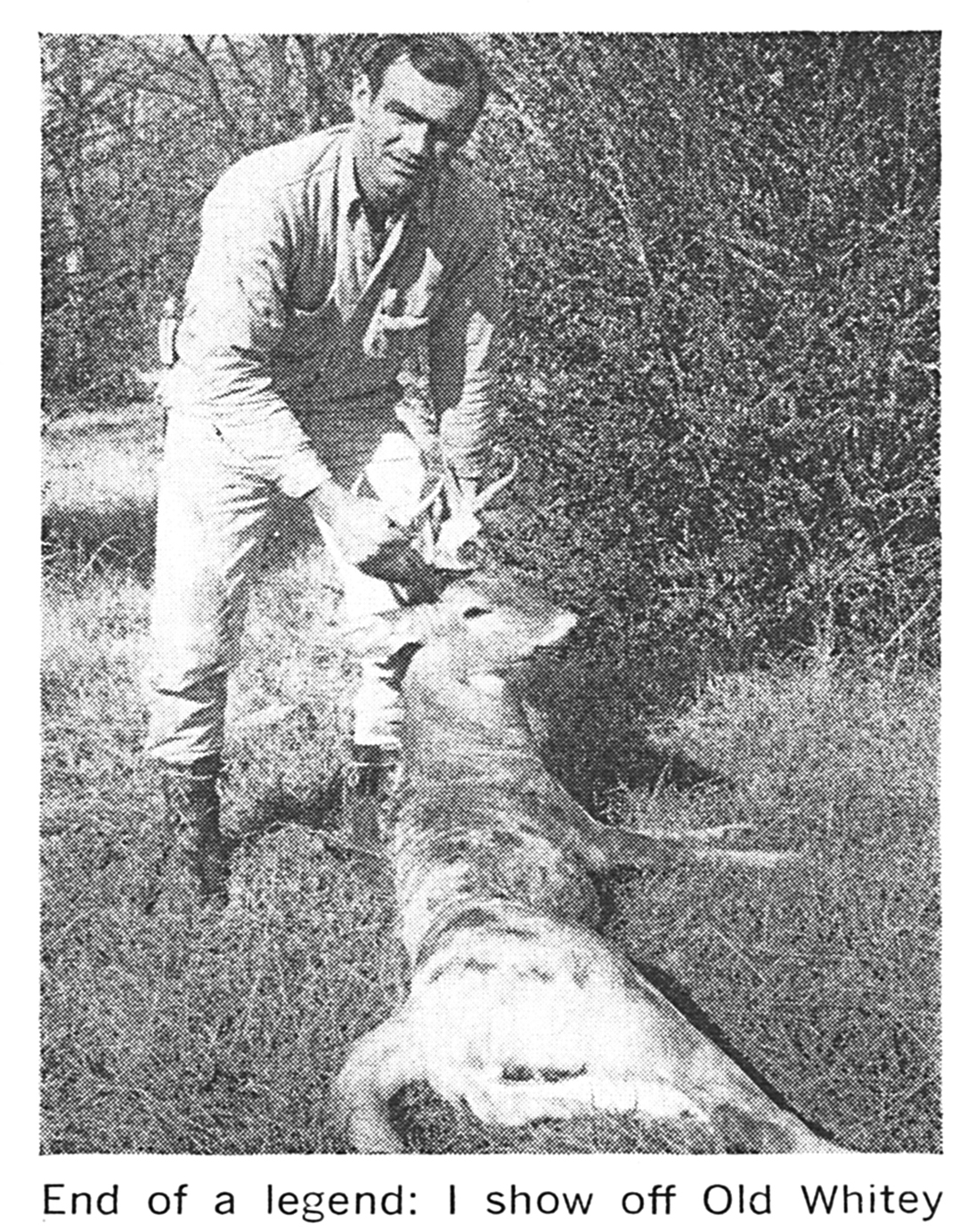
After tagging and cleaning the buck out, I walked the two miles back to the main road for my truck. I was thankful he had dropped close to a secondary road. I couldn’t see myself dragging him very far. As it turned out, I was able to load him into my truck in less than 10 minutes.
A short time later at the Shelby Forest checking stand Willis Wheeler, the area manager, weighed the buck in at 180 pounds. That’s big for these parts, where the average buck weighs around 150 pounds.
It seems that this would end the story of Old Whitey. Now the majestic head is mounted and the beautiful appaloosa-marked hide is tanned. But late one fall afternoon as I was sitting in Thweatt’s Country Store, drinking my Coke and listening to the tales, a farmer brought a load of cotton in to the gin located in back of the store. He told us a young spike had just run across the road not 20 feet in front of his tractor down close to John O’Dell’s place on Cuba-Millington Road. And he said the deer had a white rump!
Read Next: The Mystery of the Ahrens Buck, a World-Record Whitetail That Vanished
So here we go again. We’ve got another phantom buck in Meeman Shelby Forest. He has been sighted a number of times and shot at and missed more than once. But I’m taking all these stories with a grain of salt. I got my ghost. I’ll leave this one to you.
Read the full article here