
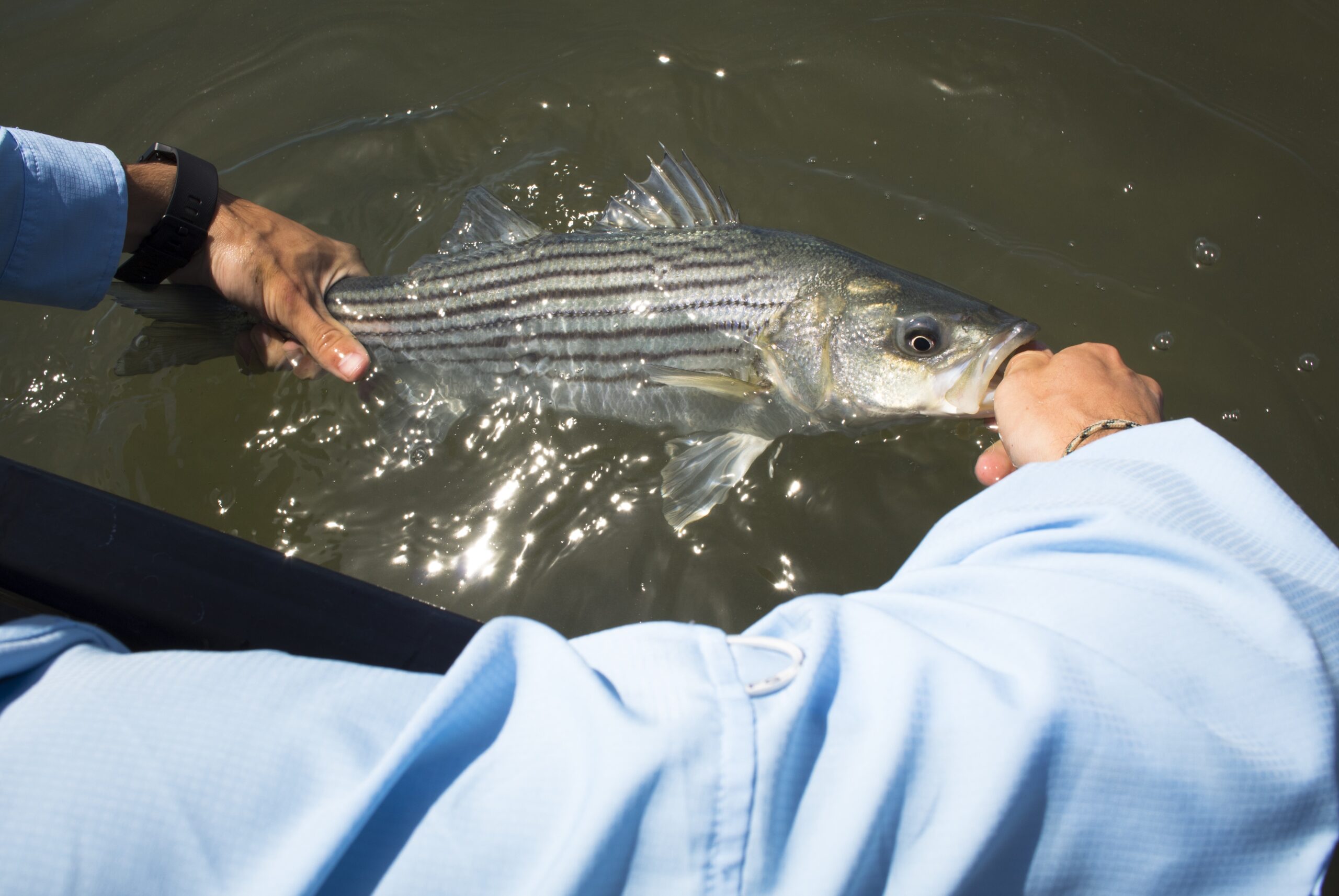
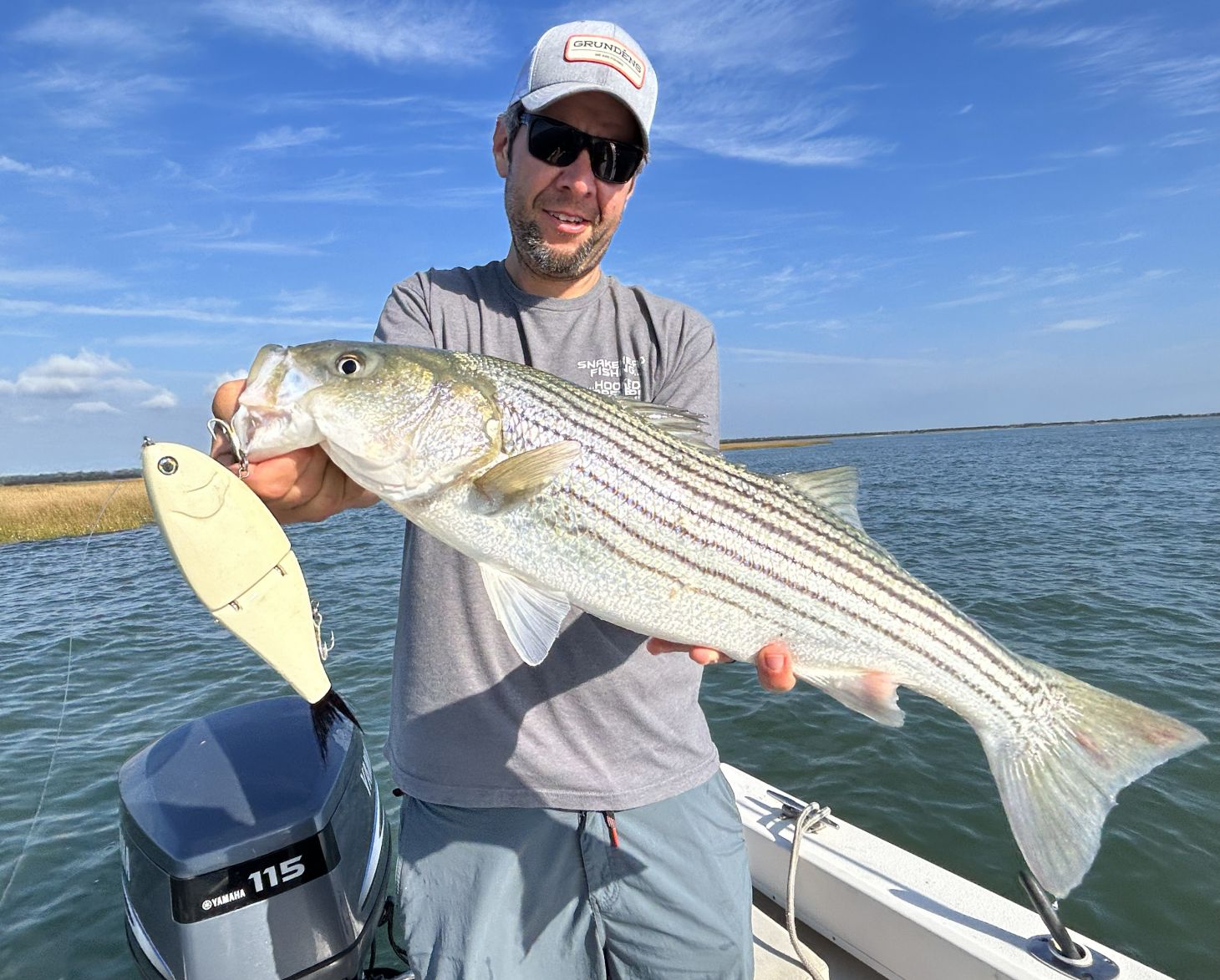
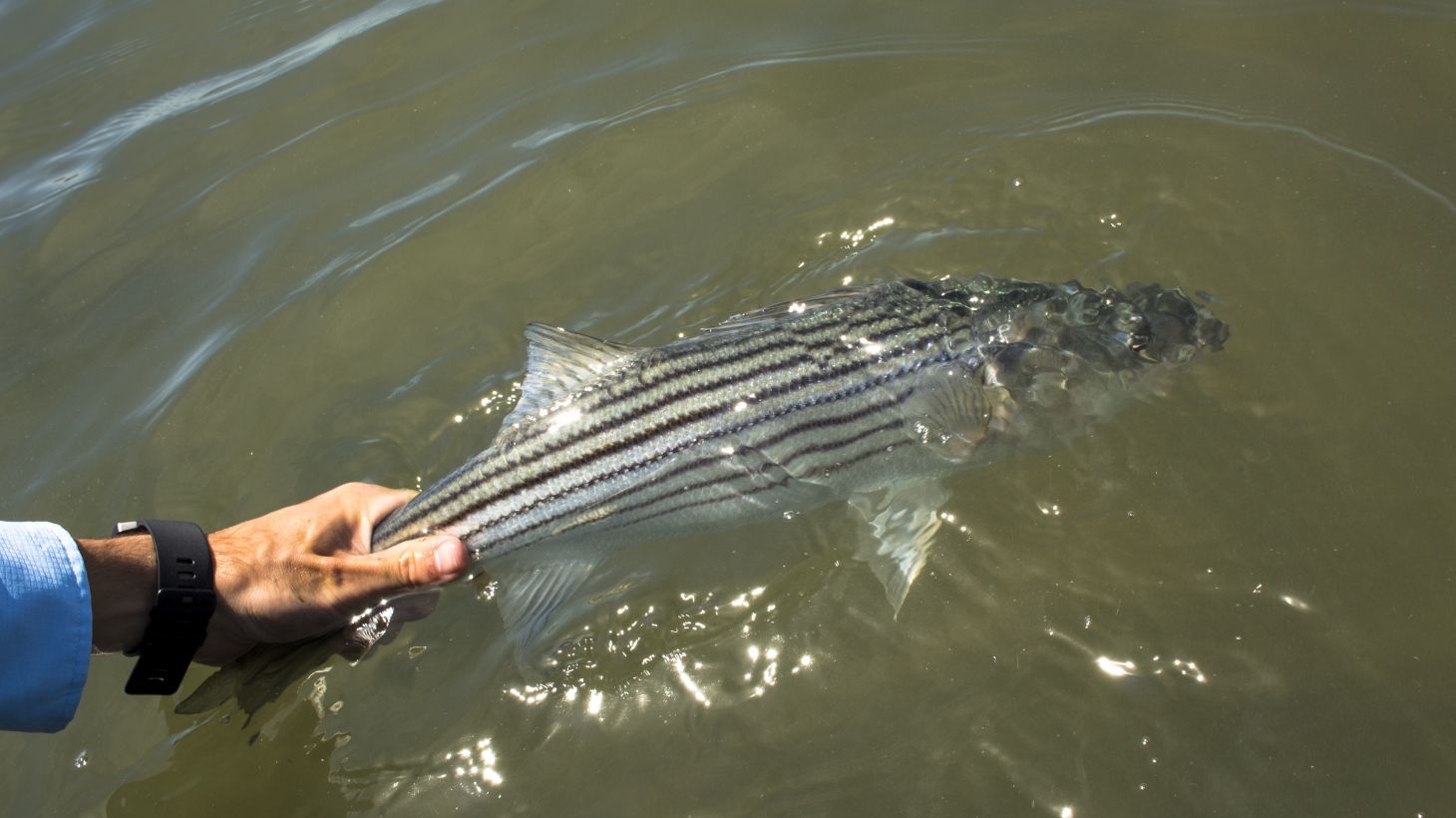
I’m going to let you in on a secret: schoolie striped bass aren’t difficult to catch. If they’re in feeding mode, they’ll take a whack at just about anything that mimics a small baitfish as long as it swims seductively. From bucktail jigs to metal spoons, diving plugs to soft-plastic swimbaits, “matching the schoolie hatch” is pretty easy. Finding them, though? Well, that’s the real challenge.
Schoolie stripers might be the kindergarten class compared to their big, varsity cousins roaming the ocean, but their size doesn’t make them any less prone to requiring certain conditions to get on the feed. Once you understand how these back-bay fish use the tide, how they hunt, and why they gravitate to certain locations, you’re in for season after season of light-tackle fun. Here are a few critical pointers for getting on the fish, as well as a few ideas of what to throw at them on the off chance they’re not blasting your favorite popper or paddle-tail shad.
Find the Mud
Since I was a teenager, catching my first schoolie striper of the season was a big deal. In those days, long before the explosion of social media, you monitored tackle shop web pages starting March 1—the annual back bay opening day—for reports of the first keeper fish to hit the scales. Here, and throughout the entire eastern range of the striped bass, there are known early-season sweet spots. And they all have one thing in common—mud.
Although school-sized stripers will migrate, most of those found in back bays and tidal rivers are residents. They spend the cold season in wintering holes, but as the water temperature begins to tick up in spring, these fish gravitate to mud flats for two key reasons. First, dark mud holds the sun’s heat, so the water on these flats can be a degree or two warmer than the rest of the bay. Second, marine worms live in this dark mud, and early in the year, when food sources are scarce, sand- and bloodworms are some of the stripers’ best protein options.
Though live marine worms can be pricey at the tackle shop—and using them feels more like catfishing than active striper fishing—these nasty wrigglers are often the key when the water is approximately 45 degrees or less.
Keep It Moving
Striped bass are built for current. They know how to use it to their advantage to hunt, which explains why they thrive in coastal rivers and even inland freshwater rivers where they’ve been introduced. But just because a bay system might look more like a lake to the naked eye, make no mistake, striper success is based on current here, too.
In this case, I’m talking about the tidal current that pushes in and sucks out via the closest inlet to the ocean twice a day. Moving water carries food. It creates ambush points behind jutting pieces of land, bridge pilings, docks, and submerged structure that deflect the current depending on the direction it’s moving. Tidal current, of course, is ever-changing. Its speed will ebb and flow during different tidal stages, and at some point, a bite window will open. It may be (and often is) fleeting, but the bottom line is schoolie stripers feed based on water movement.
This means monitoring the tides in the area you’re fishing is critical. There could be 20 fish behind a single bridge piling, but show up at the wrong point in the tide, and they won’t eat. Bite windows can open at any time or tide based on the specific setup of a given spot, but as a rule, start fishing at the top of the high tide and expect the fish to kick on within the first 3 to 4 hours of the falling tide, as this is when depth and flow speed often align to get the fish chewing.
Oceans Away
The cooler the bay, the happier the stripers. They are most active in water from approximately 55 to 70 degrees, though they will feed in water that’s warmer and colder. This means during the earlier part of the spring, entire bay systems are fair game because the water temperature everywhere is to the stripers’ liking. But as spring turns to summer, they can be harder to find in inland rivers, creeks, and channels, as the further an area is from an inlet to the ocean, the hotter it will get.
As early as May, it’s smart to plot a schoolie attack closer to an inlet, as twice a day the tide will push cooler water into the bay. This doesn’t mean you need to be fishing within sight of an inlet, but use Google Maps to gauge whether a location is close enough to be affected by inbound ocean water during the push of one incoming tide. Bury yourself too far in the back during the warmer months, and the influence of cooler ocean water may never reach your location.
Strike Early & Late
Every fisherman knows that getting on the water at first light or staying through sundown can produce magical results, hence the “magic hours.” However, when it comes to schoolie bass, these times become even more critical, especially during the summer months.
For starters, striped bass are light-sensitive fish. Sure, they’ll feed at high noon on a bluebird day if there’s a pile of baitfish around that they’re beating to a pulp, but it’s more common to see that behavior in the ocean where the fish can quickly dive to darker depths. In the bay, the water tends to be shallower, which is why gray, snotty days are often the most productive.
Likewise, there are a lot fewer jet skis and cigarette boats running around on drab days. Stripers don’t like heavy water traffic either, so fish that stack up in bay channels that see heavy use will move the farthest and feed the hardest early and late when the light is low and the water is quietest. This is also when they’re most inclined to strike topwater lures, as they can hear them better and track them from greater distances.
Hunt the Shadows
Speaking of a striper’s love of low light and minimal water traffic, one of the best times to get after them is at night. Striped bass are adept nocturnal hunters, and during some points of the summer, will hardly move or feed at all while the sun is out. Flip the light switch, though, and it’s game on, especially where you find some glow.
Any dock, bridge, bulkhead, or pier featuring a light that illuminates the water night after night is a prime spot for schoolie bass, especially if the location coincides with strong tidal flow. Stripers use shadow lines like hard structure, concealing themselves in the darkness as they wait for tidal current to move baitfish from the lit area into their waiting maws. Whenever possible, cast parallel to the shadow line and slightly up current into the light source so your jig, plug, popper, or fly has more time to work along the dark edge as it sweeps.
Don’t Sleep on the Crabs
As I mentioned, any lure or fly that mimics a small baitfish will appeal to schoolie stripers, but even long after their early-season feast of marine worms, there’s a lot more on their summer and fall menu. And crabs are arguably one of the most overlooked prey items.
It really doesn’t matter if they’re juvenile blue crabs, sand—a.k.a. mole—crabs, green crabs, or calicos. Stripers slurp these crustaceans like candy and they’re abundant practically all season. More importantly, even if the fish aren’t actively hunting crabs, they’ll rarely pass one up if the little pincher gets caught in the tidal current and whisked past a striper’s nose. Whether harvested or purchased, a crab pinned on a light jighead can be deadly when drifted past dock pilings, around sod bank points, or across bridge shadow lines.
Not into live bait? A weighted crab fly such as the classic Merkin or a pre-weighted soft-plastic imitator like the Savage Gear Duratech Crab will do the trick, especially in scenario where the current is moving fast enough that the fish don’t have a lot of time to think before striking.
Cast Small Doses
When schoolie bass are keyed in on forage like peanut bunker or mullet, lure choices are practically limitless. Ranging in size from approximately 3 to 5 inches, these baitfish are easily imitated by a plethora of plugs, jigs, and soft-plastics, but what happens when the bass are dining on micro baits? Species like glass minnows and anchovies are common in bay systems up and down the East Coast. In scenarios where these are the preferred meal, if you opt for a larger, more castable lure, it will get ignored because the fish are so cued into the little stuff. But there is a solution.
Fly anglers have the upper hand in these situations because a fly rod and line are designed to cast very light, small flies far and bring them to life effectively. Conventional anglers, however, can steal a page from their book with some clever rigging.
Grab any small popper lure you have lying around (even if it’s made for freshwater) and remove all the hooks and split rings. Next, tie a 2-foot leader to the rear eye of the popper and finish with a small baitfish fly such as a Deceiver, Surf Candy, or Clouser Minnow. The popper supplies the weight you need for casting, and as you work it across the surface, the trailing fly will dance, twitch, and get noticed by those morsel-drunk stripers.
content_striped-bass-fishing,content_saltwater-fishing,content_fishing,content_stories

THE 1871 CLUB

Recommended Products
Read the full article here