

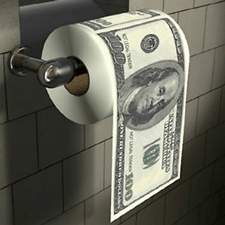
This article was originally published by George Ford Smith at The Mises Institute.
As a “stealth tax,” inflation requires no legislation to impose, no agency to collect, and diverts responsibility for damages onto politicians’ favorite whipping boys. It gives the government the ability to buy almost anything for nothing, while creating endless problems that serve as a pretext for intervention. Inflation is the foundation of arrogant government and a prescription for our own demise.
The government inflates through its central bank, the Federal Reserve System. The Fed does many other things, but its foremost responsibility is to support favored market actors through a convoluted process of monetary inflation.
Inflation, economist Judy Shelton explains, chisels away at the foundation of free markets and the laws of supply and demand. It distorts price signals, making retailers look like profiteers and deceiving workers into thinking their wages have gone up. It pushes families into higher income tax brackets without increasing their real consumption opportunities.
Inflation is alluded to in the Fed’s charter, which calls on it “to furnish an elastic currency.” Former Fed Chair Ben Bernanke once boasted about it: “The U.S. government has a technology, called a printing press (or, today, its electronic equivalent), that allows it to produce as many U.S. dollars as it wishes at essentially no cost.”
If this sounds like the Fed is a giant counterfeiter, be advised that almost no one sees it that way, especially government and Fed officials.
The Fed’s inflation is often part of a process called monetizing the federal debt, a stultifying expression describing the hocus pocus used to cover the government’s deficits. In simple language, the government puts ink on pieces of paper and calls them “securities,” in response to which the central bank puts ink on pieces of paper, calls it money, and “buys” the securities (though indirectly). Like magic, the federal government has new money to spend—thanks to the tooth fairy known as the Fed.
When the government imposed its central bank on us in 1913, pulling money from a hat was more of a challenge than it is now. Since inflation is the increase in the money supply, gold imposed a limit on the amount of government debt the Fed could buy, which in turn put restrictions on government spending, a severe impediment when it decides to go to war. Restrictions on government spending put restrictions on government expansion. If gold could be eliminated, those restrictions would go away.
Eight years after the Fed’s inception, the country slid into a depression (1921) that’s mostly unknown because the government didn’t “fix it,” and after another eight years, the stock market crashed. By the time a new administration took power in 1933, the economy was on its knees.
Assured the free market had failed them, a bewildered and out-of-work public turned to government for deliverance. On April 5, 1933, President Roosevelt issued Executive Order 6102, in which he ordered all persons to turn in their gold or face severe penalties. For this and countless other interventions, most historians rank Roosevelt as a great US president.
After the gold heist, dollars were no longer redeemable domestically. Foreigners were allowed (though not encouraged) to swap their dollars for gold until August 15, 1971, when President Nixon repudiated the government’s redemption obligations. With gold completely severed from the dollar, our monetary system lost its best defense against political caprice.
Not surprisingly, inflation rose to double digits by 1973. As Mises tells us, the gold standard makes the supply of money depend on the profitability of mining gold. The pure fiat dollar faces no obstacles to its production, other than the integrity of government and Fed officials.
Nevertheless, spokespeople for the government’s monetary monopoly assure us that the proliferation of fiat dollars helps the economy. As such, the Fed doesn’t inflate; it accommodates. Inflation is a dirty word for its “accommodative monetary policies.”
Fed Accommodation
What happens when the Fed “accommodates” us by increasing the stock of money?
First, it reduces the value of the dollar. More dollars mean each one buys less, putting upward pressure on prices. Technology and improvements in production tend to push prices downward, but because of inflation, fewer people can afford admission to the market’s bounty.
As a rough idea of how far the dollar has plummeted, $5,000 in 1913 had greater buying power than $164,040 in 2025, an increase of 3,180 percent.
Second, a depreciating dollar discourages savings. Why put money away if it’s going to lose value? Instead, millions of investment neophytes put their funds in the stock market in an attempt to protect themselves against the Fed printing press.
Third, new injections of money spur a tinsel prosperity, and the Fed keeps injecting new money to feed the boom. As the public broods over higher prices, a semantic shift takes place. Inflation comes to mean not an increase in the money supply, but the rise in prices itself. Thus, businesses that charge higher prices become the villains, while government officials who threaten price controls are the avenging angels. Most people have no idea what the Fed does, so the government can scapegoat business and appear to be defenders of the public weal. Nor do most people understand that price ceilings create shortages by encouraging consumption and retarding production. Shortages, in turn, bring on government-imposed quotas, which foster corruption, black markets, and violent crime.
Fourth, as the influx of dollars drives prices higher, some industries find themselves at a disadvantage with foreign competitors, tempting them to lobby Washington for protection from imports. Protective tariffs and quotas, of course, push prices up further, while sometimes sparking trade wars as other countries retaliate against American exports. And trade wars can lead to shooting wars.
In June 1930, with the economy fighting the recession brought on by Fed monetary policies, President Hoover signed the Smoot-Hawley Tariff Act, raising tariff levels to the highest in US history. Other countries immediately retaliated, markets shut down, and economic conditions worsened worldwide.
Fifth, inflation raises nominal incomes, pushing people into higher tax brackets, which increases government tax revenue. As people’s wealth goes out the window in depreciating dollars, taxes consume more of what remains.
Sixth, inflation shifts wealth from people who can’t or don’t know how to defend themselves from monetary destruction to those who can. As a simple example, a person living on a fixed income may find his buying power so depleted he sells a family heirloom to pay for an unanticipated expense. Or worse, a bank that was part of the lending spree that helped drive prices skyward may foreclose on the homes of some of its borrowers, whose incomes were ravaged by monetary debauchery.
Seventh, the Fed’s “accommodative” measures keep people working much later in their careers because they cannot afford to live off their deteriorating pensions.
Eighth, because the government often gets the new money first, it can fund controversial measures such as war and bailouts without drawing taxpayer ire. The government simply puts the funding on its charge card, prompting the alchemy of Fed debt monetization. We get the bill, of course, but this way it’s spread over everything else we buy, so we never see it itemized.
Ninth, because inflation has an uneven effect on prices, raising some faster than others, people have a hard time distinguishing illusion from reality. As cheap credit abounds, business people, investors, and cube-dwellers hear the siren call of can’t-miss profit opportunities.
Tenth, the government may pose as the savior of a group of voters they’ve impoverished, such as the elderly, by subsidizing their medical expenses. New entitlements create the need for more revenue, which fuels more inflation, pushing the dollar closer to a complete collapse.
Eleventh, as Mises observed, “[U]nder inflationary conditions, people acquire the habit of looking upon the government as an institution with limitless means at its disposal: the state, the government, can do anything.” Through deficit spending, the state will devour limited resources trying to maintain this illusion.
If gold is the barbarous relic its many detractors claim it is, we might expect the Fed’s fiat currency to be a better deal. But even former Fed Chairman Greenspan admits that it isn’t, telling a New York audience in 2002 that prices soared in the decades following the gold heist of 1933.
Keynes, the 20th century’s guru of deficit spending, never spelled out how deficits should be financed, admitting only that increased taxation was not the answer. Perhaps he had pangs of conscience about calling for inflation outright, since he knew it would destroy society in a manner that not one man in a million could diagnose.
Political issues dominate the news, but how little we hear about the policies nurturing those issues, one of which is the government’s power to confiscate wealth with the Fed’s invisible hand.
Read the full article here