
This article was originally published by Clifford F. Thies at The Mises Institute.
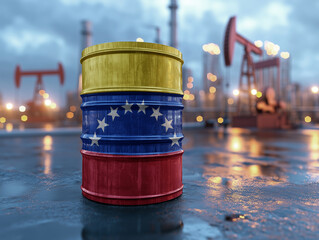
In his press conference on January 3 concerning the arrest of Venezuelan “narco-dictator” Nicolas Maduro, President Donald Trump talked about US oil companies restoring the former productivity of Venezuela’s oil industry and using that money for 1) compensation for the nationalization of the industry a couple of decades ago; and 2) (somehow) benefiting the people of Venezuela.
First, regarding the fall in the productivity of Venezuela’s oil industry, production fell from a peak of 3 million barrels a day twenty years ago to less than half a million barrels a day recently.
This fall in oil production reflects the long-term effects of the nationalization of the industry. When he nationalized the industry, Hugo Chavez looked at Venezuela’s oil industry as a source of funds to provide relatively generous welfare benefits to the urban poor of the country, assuring that he would win re-election.
As a consequence of these welfare benefits, millions of Venezuelans stopped working, and many made their way from the rural areas of the country to Caracas and other urban centers. In addition, many non-oil businesses were also nationalized, and price controls were imposed on many products. The economy became quite dysfunctional with shortages, rampant inflation, and a black market in Venezuelan currency. For example, Venezuela was no longer able to feed itself. Not a problem, thought the government. Use the proceeds of the nationalized oil industry to import food.
The impact of the collapse of the economy can be seen in the following chart. GDP per capita—once among the highest in Latin America—fell to below $2,000 in 2020, one of the lowest in Latin America, and arguably relegated the country to low-income status that year. The figure has recovered a bit recently.
A periodic social survey conducted by the Andrés Bello Catholic University of Venezuela gives us a sense of the extent of poverty in the country. In the survey, “poverty” and “extreme poverty” are defined in terms of diet, housing, and other living conditions. At its worst, 90 percent of the population was living in poverty, and 70 percent in extreme poverty. Even though there has been some recent improvement in these numbers, the extent of poverty in Venezuela remains scary.
The combination of the massive increase in non-working urban poor needing welfare and the erosion of productivity of the oil industry meant that the government had to seek alternate sources of revenue. To some extent, sex tourism was an alternate source of revenue. Perverts made their way to the country and used their euros and US dollars to buy Venezuelan currency in the black market to buy girls and boys for pathetically low amounts of money.
The biggest alternative source of revenue was narcotics trafficking. Most drugs exported from the region originate in Colombia. But, since 2010, Venezuela has become involved with the international drug trade.
The government of Venezuela has also overseen this drug activity via Maduro himself, his family, and other associates. The evidence of Maduro’s involvement in drug-trafficking is such that the US government claims to be confident of convicting Maduro in a US court of law.
Returning to Venezuela’s oil industry, the country has the world’s largest untapped oil reserves—if one believes the government’s statistics. To be sure, these reserves are quite high in sulfur content and require extensive refining. However, the country is unable to produce much oil because of corruption and the neglect of capital that happened after nationalization. In recent years, the Chinese have increased production there, but it remains at a low level.
President Trump, on the other hand, thinks US oil companies could restore the former high level of production of Venezuela’s oil industry. Assuming away the problem of occupying Venezuela, US oil companies, as he sees it, would have the incentive and the ability to turn around this part of the Venezuelan economy. Perhaps the entire economy could enjoy something like the West German economic miracle that followed World War II. Sure! Why not!
Of course, occupying Venezuela would be a big problem. As impressive as the military and police action that resulted in Maduro’s arrest might have been, a successful invasion and occupation of the country would be a much greater challenge. Trump was first elected president largely due to the cost and duration of US occupations of Iraq and Afghanistan. In those places, the US military achieved similar spectacular successes only to subsequently get stuck in two quagmires.
After something like twenty years of our attempting to “win the hearts and minds” of the Iraqis and the Afghanis, all we wound up with was trillions of dollars spent and tens of thousands of killed and terribly wounded soldiers. The idea that we could transform these places into democracies capable of defending themselves was revealed to be completely unrealistic.
In 2015, Trump rode down the golden escalator at his fabulous Trump Tower in New York City and vanquished Jeb Bush—the heir apparent of the neo-cons—in the Republican primaries. For his own sake, as well as the sake of the country, President Trump should be wary of repeating the mistakes of Iraq and Afghanistan.
Read the full article here