

This article was originally published by Wanjiru Njoya at The Mises Institute.
The idea of constitutionalism is that of limited government under the rule of law. The whole point of agreeing on the basic rules by which the country is to be governed is to constrain the tendency of bureaucrats, and all those vested with executive power, to become despots and turn on their own citizens. In theory, the Constitution should safeguard individual liberty by giving citizens a bulwark against state tyranny.
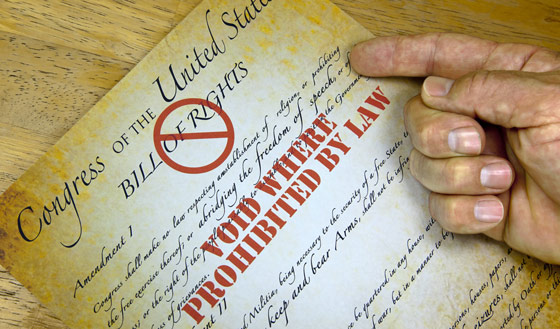
As stated in the words of the theoretically mighty First Amendment, the Constitution of the United States declares that, “Congress shall make no law…abridging the freedom of speech, or of the press; or the right of the people peaceably to assemble.”
Yet, constitutionalism is a double-edged sword, as the constitution can also function as a means of legitimizing government power, enabling despots to justify arbitrary power as being authorized by the constitution based on their own self-serving interpretation. This is why Lew Rockwell described the Constitution as a weak reed that often fails in its essential purpose of safeguarding citizens from state tyranny.
But ultimately, the Constitution is a weak reed. As Rothbard also noted in the posthumously published Volume 5 of Conceived in Liberty, the Constitution was a triumph for those who wanted a large central government. It was a blow to those who believed in states’ rights and civil liberties.
Rothbard describes how Hamilton rejected decentralization of power as making the Union too weak, arguing that “we must establish a general and national government, completely sovereign, and annihilate the state distinctions and state operations.” A good example of how the Constitution may be used to further centralize power in the federal government is the interpretation of the Fourteenth Amendment, which courts use to find a way around the clear words of the First Amendment by interpreting the Civil Rights Acts in exactly the manner prohibited—so as to abridge the freedom of speech. In his book Government by Judiciary, Raoul Berger shows how the Fourteenth Amendment has been used in precisely this way—to legitimize almost unlimited state intervention under the “equal protection” clause.
The equal protection clause was intended to give the federal government constitutional power to protect black people from being discriminated against by their states in the South, by means of the Civil Rights Act 1866. As William Dunning explains, the Radical Republicans were apprehensive that the South would not accept the outcome of the war and would instead attempt to restore slavery in all but name if the federal government did not intervene to prevent them from doing so. Or so they claimed. To that end, the Fourteenth Amendment gave constitutional power to the federal government to override state legislatures to protect civil rights, a power it has put to enthusiastic use since then. Berger explains,
…the objectives of the [Civil Rights Act 1866] were quite limited. The framers intended to confer on the freedmen the auxiliary rights that would protect their “life, liberty, and property”—no more. For the framers those words did not have the sprawling connotations later given them by the Court but, instead, restricted aims that were expressed in the Act.
Some might see “sprawling connotations” as a potentially good thing—shouldn’t the federal government have sprawling power to intervene in cases of civil rights violations? After all, if the federal government ever misuses its power, the Supreme Court would strike down its actions, right? Lew Rockwell shows why that reasoning is misguided:
But doesn’t the Supreme Court act as a check on the federal government, by sometimes ruling that Congress or the President has violated the Constitution? The problem with this is one that John C. Calhoun long ago pointed out: the Court can legitimize the federal government by affirming that what it has done is constitutional. What else would you expect—it is a branch of the federal government.
Far from constraining federal power, the Supreme Court uses the Fourteenth Amendment to expand federal power, amending the Constitution by interpretative stealth if necessary to legitimize this. Berger observes that, “The Fourteenth Amendment is the case study par excellence of what Justice Harlan described as the Supreme Court’s ‘exercise of amending power,’ its continuing revision of the Constitution under the guise of interpretation.” Berger suggests—a point which many would regard as self-evident—that “the Supreme Court is not empowered to rewrite the Constitution,” arguing that,
…in its transformation of the Fourteenth Amendment it has demonstrably done so. Thereby the Justices, who are virtually unaccountable, irremovable, and irreversible, have taken over from the people control of their own destiny, an awesome exercise of power.
Berger uses the word “awesome” in its original sense, to mean inspiring fear and awe, arguing that this awesome power was far from the intention of the framers of the Constitution, who were well aware of the temptation of those in power to break out of their constraints through “judicial construction” of new powers. As Berger points out, the weight of opinion among modern intellectuals is that the more power vested in the federal government, the better. They believe, as Berger puts it, that “constitutional limitations must yield to beneficial results, a result-oriented jurisprudence that is a euphemism for the notion that the end justifies the means.” He gives the example of the constitutional lawyer Bruce Ackerman, who argued that a progressive Supreme Court—exemplified by its sprawling decision in Brown v. Board of Education—would serve the purpose of “confronting modern Americans with a moral and political agenda that calls upon them to heed the voice of their better selves.” Social engineering through race-craft may be Ackerman’s opinion of what would reflect the “better selves” of modern Americans, but the Constitution is not meant to be a charter for some citizens to turn their moral opinions into law. The Southern writer Zora Neale Hurston did not regard Brown v. Board of Education as a reflection of anyone’s better self; on the contrary, she regarded it as such an insult that she wrote to the Orlando Sentinel to express her opinion:
The whole matter revolves around the self-respect of my people. How much satisfaction can I get from a court order for somebody to associate with me who does not wish me near them? … For this reason, I regard the ruling of the U.S. Supreme Court as insulting rather than honoring my race.
The point Berger makes is that the Constitution should uphold the rule of law, not rule by moral opinion or executive decree. The issue is not which opinion one would agree with, but that individual liberty denotes the freedom of conscience and belief, freedom to hold whatever opinions one may deem right. This was the original idea behind protecting the freedom of expression under the First Amendment, a freedom which is now being subverted under the guise of constitutional interpretation.
Read the full article here